Posted on 19 Comments

How artists (and bloggers) can survive the “google apocalypse”

Google Logo

The Rise of AI

We all want to be seen. I want people to see my work. I also want people to see the process behind that work (have you listened to my recent radio interview yet?) I also want to maybe inspire and/or encourage people to undertake their own creative journey. There are bumps in the road, however. Making a living in the creative industries is difficult and uncertain at the best of times.

I recently wrote about how Generative AI was scraping/stealing artists’ copyrighted without permission or recompense. Its not clear how the rise of AI will change things. It has already been disruptive for many of those in the media industry. The protective tools such as “Glaze” are only short-term fixes, if you can get them to work. But that disruption may also create opportunities for some – its hard to tell.

Many people aren’t very interested in AI but wonder why they can’t get speak to a human in customer services but only an online bot.

Walled Gardens

A Walled Garden – 2013 SOLD

As an artist who sells much of their work directly, I am reliant on the internet to get my work “out there” to as many people as possible. For many years I have used social media sites like Instagram, Facebook, Twitter/X, Pinterest in addition to my own website (with blog) as well as a mailing list. I have posted my work on a handful of online Galleries, Artfinder,in particular. To be honest, I don’t know what works.

I used to assume that everything did a bit of something. Lately its become apparent that some are doing very little indeed. A couple of years ago my instagram posts used to regularly get over a thousand likes, these days I am lucky to get over two hundred. I have pretty much given up on Twitter/X now from lack of engagement. I am wondering whether Facebook is worth the effort too. Since the arrival of TikTok in 2026, the short form video has been given priority by “the algoritim”. Not great news for camera-shy artists, like me.

What is apparent, is that social media sites are like walled gardens, where leaving is discouraged. Posts with external links are downgraded by the site and search algorithims. Facebook and Instagram are both owned by Meta. These walled gardens can and do change their rules for who get seen and who doesn’t.

A rather dated illustration of “Walled gardens”

“Enshitification” (Or – Its all going to Hell in a hardcart)

This is something that what Cory Doctorow calls the “Enshitification” of the internet. He points out that “Once upon a time, Facebook and Twitter showed you stuff from your friends and followers; now you get a torrent of things that the platform’s algorithms think might increase your “engagement”. Doctorow says “First,” he writes, “they are good to their users; then they abuse their users to make things better for their business customers; finally, they abuse those business customers to claw back all the value for themselves.” You do this by offering “free” services (Google, Facebook, Twitter, YouTube, Instagram), or loss-making reduced prices (Amazon). Then once you’ve got them locked in, you turn them into a captive market for your real customers – advertisers and vendors. And once you’ve got them locked in then you’re in a seller’s market – and have a licence to print money.

Twitter/X and Facebook have made it harder and hard to post and see external links to websites and publications. Many users have left the site. Opinions and comments used to be reinforced by reptutable publications. Partly as a result of this policy many online publications that people used to link to in their twitter posts have seen a big drop in traffic.

The Death of Google

The rise of AI is another threat to the stablility of online ecosystem. The death of Google has been predicted for many years now (at least since 2018). Google dominates internet search results so much that for many people it is the internet. These days, however, your Google search is likely to be swamped in link-farms, clickbait, long-form articles with thousands of words that ultimately say nothing, those weird ads about cars/fridges/hots tubs being “practically given away”. In fact, tons and tons of ads.

AI Overviews

In order to try and weed out some of the spammy stuff, Google recently introduced something called AI Overviews. maybe you have noticed it. Maybe not. The tech company unleashed a makeover of its search engine in mid-May that frequently provides AI-generated summaries on top of search results – it used to use Wikipedia for its summary with a list of links below. That was uncontroversial.

Google’s new AI Overviews saves you the effort of clicking on links by using generative AI to provide summaries of the search results. So if you want to know how to make cheese stick on your pizza – it will save you the bother of clicking on a receipe site. Google want to be the search and answer engine. However, when someone asked Google to suggest what to do if cheese is not sticking to pizza, it claimed that its AI suggested adding non-toxic glue to it! This was based on an 11-year-old comment from a forum site called Reddit that has recently done a deal to allow AI to train on content.

AI can’t tell fact from fiction, or from jokes or sarcasm. This is causing big problems for AI – a response to a advise on depression included “Jump of the Golden Gate Bridge”!

AI’s Advice on identifying edible wild mushooms was worryingly vague, emphasising looking for those with solid white flesh — which many potentially deadly puffball mimics also have. It has been said that “pharmaceutical companies aren’t allowed to release drugs that are harmful. Nor are car companies. But so far, tech companies have largely been allowed to do what they like Google is now making “more than a dozen technical improvements” to its artificial intelligence systems!  It is important that Google maintains user trust. Other browsers are available. I have started to use one called Brave, there is also DuckDuckGo, Firefox and Microsoft Edge.

Google Zero – what does it mean for the artist blogger?

Google’s summaries are designed to get people authoritative answers to the information they’re looking for as quickly as possible without having to click through a ranked list of website links. This desire for Google to become a search and answer engine is called “Google Zero” by Nilay Patel, editor-in-chief of the Verge Magazine.; when Google Search simply stops sending traffic outside of its search engine to third-party websites. That possibly means my website, or your blog. Independent review sites have been feeling the effects of the changes.

There’s a review website called House Fresh, who review air purifiers that they have personally tested (instead of recycling PR puff from the manufacturers). Since 2023, they have seen their reviews ripped off by bigger websites and web traffic to their own site decimated. The teething problems of Google Overview may see it being ditched by Google. They have a track record of ditching apps that were’t immediately successful – you can read a long list of them here. Remember Google Street View? Gone. Google Hangout? Not Really. Google My Business? Yes. That’s gone too.

What to do?

So whilst Google Overview maybe gone very soon, AI wont be going anywhere soon. Too much money has been spent on it. The big tech companies are desperate to keep ahead in the innovation race. They are also desperate for web-domination, regardless of the collateral damage. Yes, that maybe your amazing following on Youtube, Facebook, TikTok that gradually loses traction.

Artists may follow the latest advice to make reels, or stories (how many daft videos on Instagram reels have I seen of an artist turning around to “reveal” their latest work) and it may work for a while. All these innovations are designed to please the “algorithim”. Not the audience. Certainly not the artist. The goal posts keep moving. Once it was stories we had to make, then reels. What next? It’s exhausting. It’s a bottomless pit that sucks in a lot of your creative energy. I am an artist and I want to paint. Not perform.

The moral of the story is don’t build your house on someone else’s land. I have known this for sometime. Several years ago, Facebook unexpectedly deleted my Emma Cownie Artist page without warning. I set up a new one (two actually, one also to link to my Instagram account) but the follower numbers have never come close to the numbers or engagement of the original page. The waters closed in pretty easily.

I redoubled my efforts with my own website (with this blog) and a mailing list and my website numbers and views have steadily grown. You have to build an audience.

I looked at a blog I wrote in 2019 when I first started my mailing list and most of the suggestions I included (but not necessarily followed) still look good to me. There is a lot of cross over with my blog on this website but its not identical.

I write high-quality, carefully researched content. I write about my new work, sales and the inspiration behind my paintings i.e. the local history of the the places I paint and the process of painting – including technical stuff to do with colour, composition.

I write about the process of creativity.

I also write about the inspiration provided by other artists. I know its a cliche but I am on a “journey” but I am keen to explain what is informing that journey. Why I paint in a certain way and not another? It’s vital to keep supporters/fans engaged to maintain their relationship with you and your business. It’s all about adding value to their lives.

Apocalypse Now?

Not necessarily. So it seems that the best advice is don’t panic. Keep on keeping on and build those ladders over the walls in the walled gardens into your own garden!

Join my Mailing List Here

Find Out More about Issues discussed in this blog

https://emmafcownie.com/2024/04/07/ai-and-artwhat-you-need-to-know/

https://www.theguardian.com/commentisfree/2023/mar/11/users-advertisers-we-are-all-trapped-in-the-enshittification-of-the-internet

https://www.cjr.org/the_media_today/google_ai_summaries_publishers_fears.php?ref=biztoc.com

https://www.pbs.org/newshour/politics/google-makes-fixes-to-ai-generated-search-summaries-after-outlandish-answers-went-viral

https://theconversation.com/eat-a-rock-a-day-put-glue-on-your-pizza-how-googles-ai-is-losing-touch-with-reality-230953

https://www.theverge.com/2024/5/31/24168605/google-search-api-leak-openai-media-vergecast

https://www.theverge.com/2024/5/30/24168344/google-defends-ai-overviews-search-results

How Google is killing independent sites like ours – https://housefresh.com/david-vs-digital-goliaths/
Posted on 14 Comments

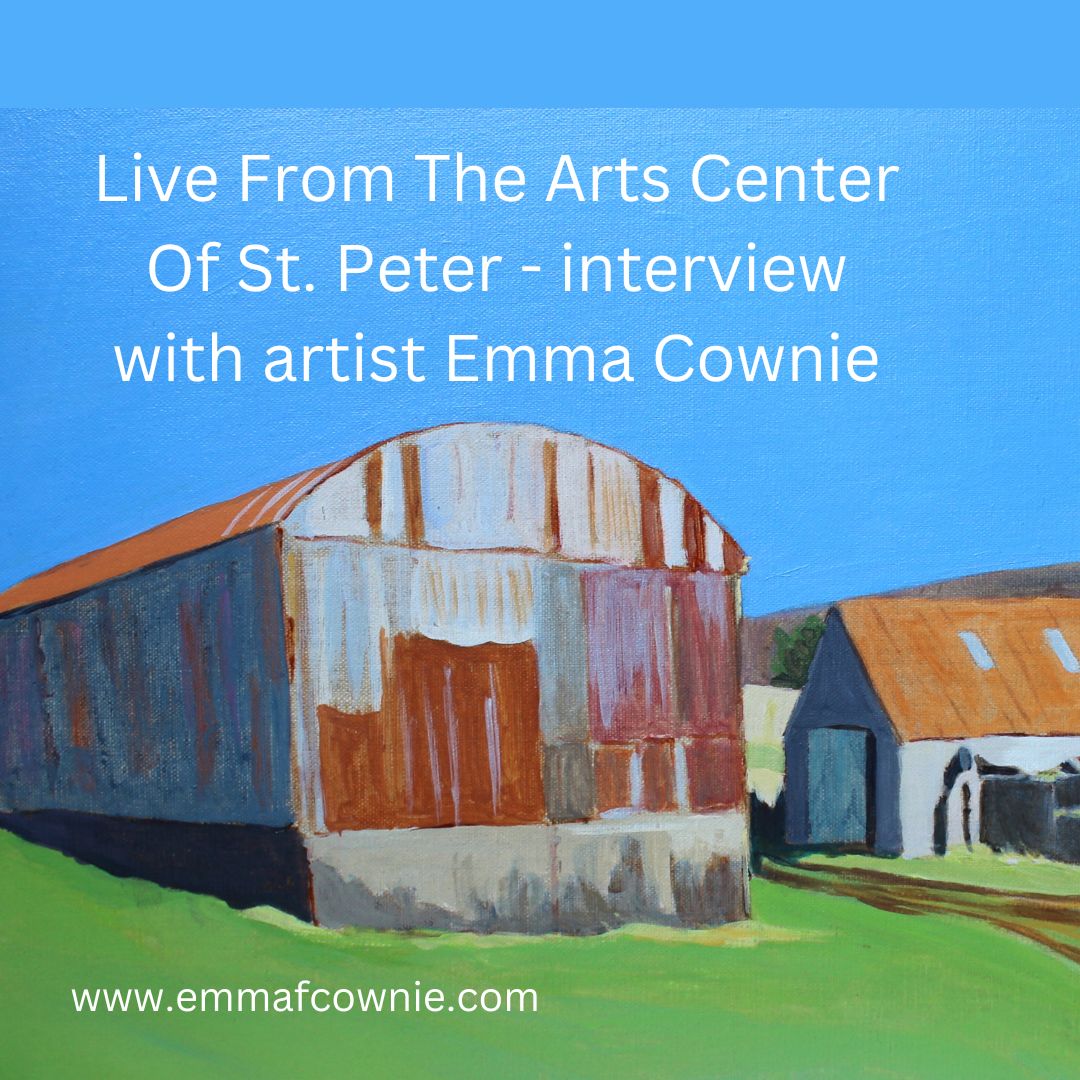
Live From The Arts Center Of St. Peter – interview with artist Emma Cownie

I did this interview back in March this year with artist and magician Michael Callahan and co-host Ann Rosenquist Fee, executive director of the Arts Center, St Pauls, Minnestota, USA. In it I talk about how I came to be an artist, my process, my love of colour and paint brushes!

SEE DONEGAL PAINTINGS                                             BUY DONEGAL PRINTS 

Posted on 6 Comments

Above Mussenden Temple

Above Mussenden

There is a unique architectural gem, perched upon the high cliffs above the shores of the north Derry coastline. It is an elegant Roman-style round temple; a beautiful rotunda. It is a wonderful surprise. There is none other in Ireland. It looks out across Lough Foyle to Donegal to the north and on a clear day the Scottish Isles can be seen to the north-east. This remarkable building is Mussenden Temple.

Mussenden Temple from Downhill Strand

It was built by the eccentic and extravagant Earl Bishop of Derry, Frederick Hervey (b.1730-1806). The 18th century is full of mischievious and surprising characters and he’s one of the best. Frederick Hervey was in turns controversial, revolutionary and yet both shocking and popular in his own life time. He came from an aristocratic English family, the 3rd son of an earl with big estates in Suffolk. Having two elder brothers he probably never expected to inherit from his father. He first tried law and then became a vicar hoping for a career in the church. His family connections helped a lot. He became chaplain to the king, George III in 1763, who later called him ‘that wicked prelate’ .

When his eldest brother George became Lord Lieutenant of Ireland in 1766, he managed to wangle the post of Bishop of Cloyne for Frederick and then, shortly afterwards, in 1768, Bishop of Derry, one of the wealthiest Irish sees.

Frederick threw himself into being Bishop of Derry, reportedly visiting every parish in the diocese and embarking on a number of notable building projects in the city of Londonderry including building St Columbs Cathedral’s first spire (it had to be replaced later as it was too heavy) many fine building and the first (wooden) bridge over the River Foyle, earning himself the nickname ‘the Edifying Bishop’.

In 1779 his brother George died and Frederick became the 4th Earl of Bristol, inheriting an income of £20,000 a year. He now even more money. He spent a fortune on building and collecting art.

He was widely travelled and had a fine appreciation of art, especially Greek and Italian. He spent 18 years of his life in Italy and spoke Italian fluently. Frederick was also well-read and he was an expert in flora and fauna and publicised The Giant’s Causeway. The Earl Bishop did extensive research into the origins of the Causeway and promoted his findings to the scientific community and wider world.

He also visited Staffa Island on the Western Isles of Scotland to confirm the links with similar columnar formations. In 1782, he was made a Fellow of the Royal Society for his efforts.

The Earl Bishop was a colourful character and was clearly someone people loved to gossip about. There are many examples of his eccentricity. It is said that he made his clergy run a leapfrog race on Downhill beach to see who would win the best area!

He had an eye for the ladies and was reputed to have had several affairs. Among his mistresses was society beauty Madam Ritz, as well as possibly Emma Hamilton who was also the mistress of Admiral Lord Nelson.

Bramante’s Tempietto, Rome 1502

It was on his tour of Europe that he fell in love with Bramante’s Temple in Rome. He reportedly tried to buy it and have it moved back to Britain but the Pope would not let him. So the Frederick Hervey built his own. Several of them. He built Ballyscullion, near Bellaghy, Co Derry, in 1787 to his own extravagant designs. The façade was inspired by St Peter’s in Rome, and measured 350ft across, with a central rotunda flanked by curved wings and a large pavilion at each end. It sadly, no longer exists.

Ballyscullion House

He also started Ickworth House, in Suffolf in 1795 which was completed by his successors.

Ickworth House, Suffolk, England

His first rotunda, however, was Musseden Temple, built in 1873. It was built as a library on the cliff edge of his estate at Dunbo, County Londonderry, Northern Ireland.  Dunbo derives from the Irish Dún Bó, meaning ‘fort of the cows’. Dunbo was renamed Downhill Demense and an incredible 300,000 trees were planted on the estate; although there is little sign of them today.

A huge castle was built with the assistance of number of architects (Frederick kept firing them) including Michael Shanahan of Cork and Placido Columbani of Milan, who was supervising plumbing and the installation of water closets, a swanky innovation for the time. So we are not entirely sure who designed the rotunda/temple on the cliffs.

Mrs Daniel Mussenden (born Fridiswide Bruce, d.1785)
Unknow French artist c.1780

The temple was dedicated to his lovely young cousin Frideswide Mussenden (neé Bruce) who had recently married the rich banker, Daniel Mussenden, had given birth to a child. The temple was meant to a be delightful retreat for her to escape to and look out at the wonderful view or read some of the many books there. A fire was kept lit at all time to save the books (and her) from the damp Irish weather. Sadly, Frederick’s terrible reputation with women meant that their “friendship” was gossiped about, in the press. The fragile Frideswide was horrified to be written about in the Freeman’sJournal, even if she wasn’t mentioned by name, and it may well have supposedly sent her into a physical decline, dying at the age of tender age of just 22 in 1785.

There is a minature of her in the National Gallery of Ireland painted when she was 17 in 1780, presumably when she had just married Daniel. She has a very sweet and tender face; you can easily imagine her upset at the nasty rumours.

So the library on the cliffs is a poignant place. Built for a young woman who perhaps only used it for a short time before she died. It was always close to the cliff edge, reported 30 foot away when it was built. I think that is an exaggeration, as maps from the early 19th century do not show that much land between the temple and the cliff edge. The cliff has eroded and about 20 years ago the National Trust did extensive work to stablise the cliff and underpin the temple.

OSNI 1831 Downhill
OSNI 1831 Downhill

I am very bad at remembering to take work in progress photos of my work. I often get too caught up in painting the piece. I am also usually very anxious about a painting until I have practically finished it!

This is a painting done with acrylic paints. I work with thin layers of paint, building up the colours and adjusting them, lighter or darker with each new layer. Often I like the painting best when its about a third done – I am confident I know where I am going with it and it still has “potential”.

Work in progress - Mussenden Temple

Here there are still some “problems” to solve, the shadow on the temple needs to be darkened.

Work in Progress 2 - Mussenden Temple
Work in Progress 2 – Mussenden Temple
Above Mussenden Temple_ Painting by Emma Cownie

Frederick Hervey was a fascinating man, who had a long and varied life and I could write a lot more about him.  He was minor celebrity in his day, he travelled widely on the Continent, where he kept company and correspondence with leading philosophers, princes, politicians, scientists, artists, architects and writers—including Voltaire, Goethe, Benjamin Franklin, John Strange, Jeremy Bentham, James Boswell and the Pope. He has been described as “a bad father, and worse husband, a determined deist, [who was] very blasphemous in his conversation”.

Yet he was a generous man who treated the people of Derry well, whether Catholic, Protestant or Non-Conformist (a type of Protestant that was discriminated against by the state at the time). He argued all his life for religious tolerance.


_Earl-Bishop_with_His_Granddaughter_in_Gardens_of_Villa_Borghese_Hugh_Douglas_Hamilton_Circa_1790_National_Gallery_Ireland.
Earl-Bishop with His Granddaughter in Gardens of Villa Borghese c1790 National_Gallery_Ireland.

He believed the answer to the Irish question or the Irish problem of a disaffected Catholic majority is, was not meanness but generosity. Just as God wins our prayers of thanksgiving by His extravagant generosity, so England could learn how to win over Irish Catholics by giving them more, not less. He bankrolled the first Catholic chapel in Derry—Long Tower Church—and personally chose the magnificent Italian marble that adorns the altar.

He undertook public works to relieve poverty, and was a generous patron to the Catholic population of Derry.  

He died in Italy in 1803, trying to recover his art collection that had been conviscated by Napoleon Bonaparte. Hundreds of artists attended his funeral in Rome and he was buried at his ancestral home, Ickworth in Suffolk, where there is an obelisk paid for by public subscription by the Catholics, Presbyterians and Protestants of Derry.

obelisk-memorial-blue-sky-ickworth-suffolk-495470
obelisk memorial, Ickworth House

Find out More  

https://www.nationaltrust.org.uk/visit/northern-ireland/mussenden-temple-and-downhill-demesne

It’s Downhill All the Way

The ‘oral-bishop’: the epicurean theology of Bishop Frederick Hervey, 1730–1803

https://www.earlbishopstrail.com/
https://vipauk.org/enter/muse/ni/i30.html

Click to access EARL-BISHOP-BOOKLET-WR.pdf

Edifying and Eccentric – The Earl Bishop

Posted on 3 Comments

Spring Newsletter

Spring Newsletter 2024

Read about my other appearances in the media here 

New Work Spring 2024
See Derry City Paintings Here
New Work 2024

The Causeway Coast and Antrim


A selection of some of my paintings of the area. Please check my website to see my full collection of work

Antrim and Causeway Coast

A Recent Commission

Mumbles View _ Emma Cownie
"Mumbles View" 120cm x40 cm

Paintings of West Donegal, Fanad and Gower, Wales 

Paintings of West Donegal, Fanad and Gower, Wales

Wishing Everyone a Happy and Relaxing Easter/Spring Break! 

Posted on 8 Comments

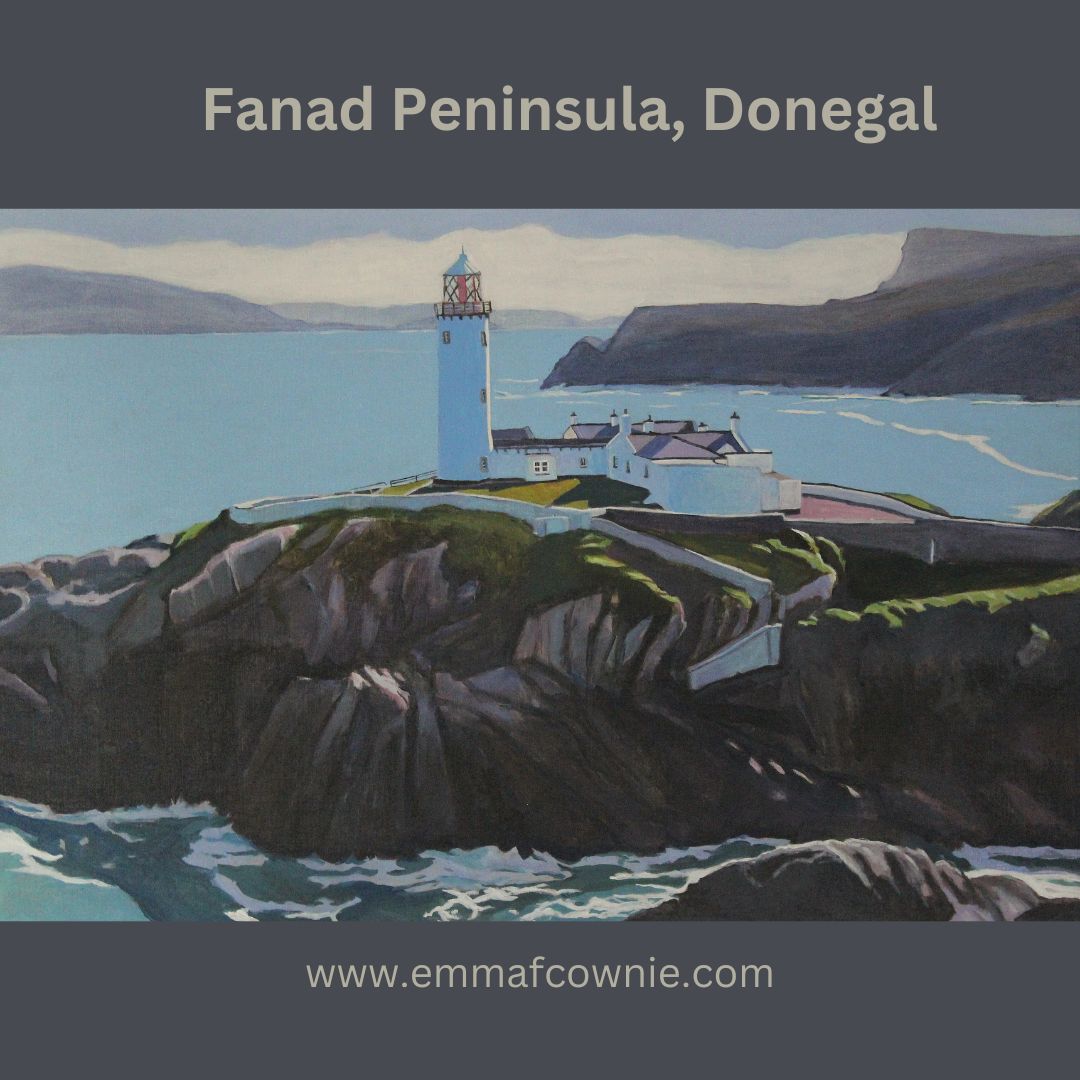
Fanad Peninsula, Donegal

Painting of Fanad Lighthouse by Emma Cownie

Fanad is a finger of land that lies between Lough Swilly and Mulroy Bay on the north coast of County Donegal, Ireland. It is not that easy to get to and the the survival of the Irish language is testiment that relative isolation.

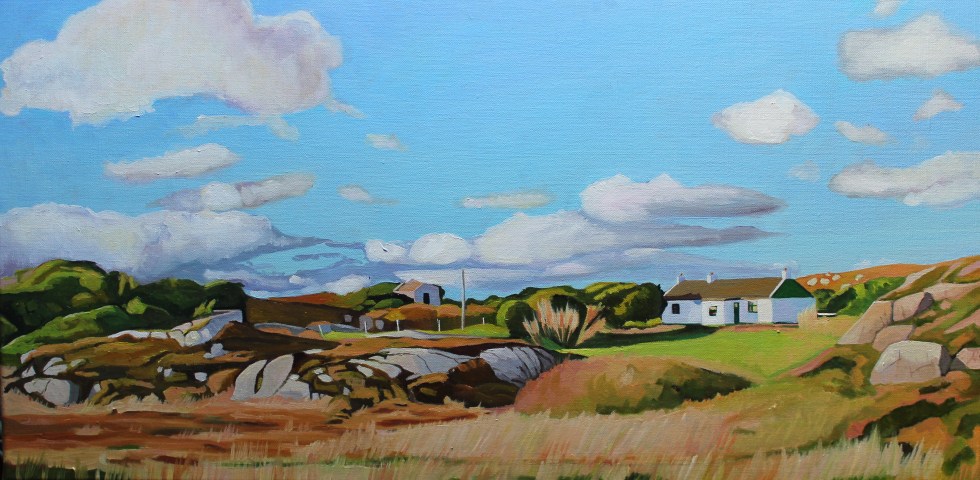
Painting of Lambing season at Fanad Head (Donegal)
Lambing season at Fanad Head (Donegal) SOLD

Fanad Lighhouse (Donegal). Is one of the 12 Great lighthouses of Ireland. It was built in 1886 at Fanad Head (although the station was originally established in 1817). The lighthouse, or more acrrately, the harbour light, marks the entrance into Lough Swilly which forms a natural harbour.

Fanad Lighthouse (Donegal)
Fanad Lighthouse (Donegal) SOLD

I have painted this isolated structure several times before. I have always enjoyed painting the northernly light on Fanad. I have only have painted it in acrylics. That’s not a delibertae choice, more one of circumstance because at times I have had limited space, and I dont want to use oil paints with kittens close at hand.

Over to Fanad Lighhouse (Donegal) _Emma Cownie
Over to Fanad Lighthouse (Donegal) _Emma Cownie SOLD

I think acrylics suit the airiness of the subject matter. After a couple of years working out how to use them, I have settled on a technique of light layers of paint that allow the underlying colour to show through. This can give a transulent quality to the colour. This is in contrast to the relatively flat areas of colous I use for the larger areas of colour such as sky or the sea.

Read more about my use of acrylics here

a painting of Fanad Head and lighthouse
Fanad SOLD

My latest painting was an experiment in composition. We used an image from a drone shot done by my artist husband, Seamas (James Henry Johnson).

In this piece, I wanted to create a sense of space from the mountains of the Inishowen Peninsula in the distance. The distant mountains were layered with bluish white until I got the right impression of distance.

I often find myself looking at the tiny Fanad lighthouse far off in the distance when I am at Lisfannon on the Inishowen Penisula.  There is a sign comemorating a famous Atlantic storm that happened in 1748. this storm threatened to sink The Greyhound, the ship of one John Newton, a slave trader. John was so frightened that he called out to God for mercy. This moment marked a profound spiritual conversion, and many years later he wrote the words for the hymn “Amazing Grace” one of my favourite hymns, and to also campaign for the abolition of slavery.

There is some confusion how many storms there were . One website claims the terrible tempset happened far away out in the Atlantic because it took John Newton another four weeks after his conversion to sail into Lough Swilly and arrive at Derry/Londonderry. The Amazing Grace.ie site however, makes it clear a second storm happened in Lough swilly itself as it quotes John’s journal ” We saw the island of Tory and the next day anchored in Lough Swilly  in Ireland.  This was the 8th day of April, just four weeks after the damage we sustained from the sea.  When we came into this port, our very last victuals was boiling in the pot; and before we had been there two hours, the wind began to blow with great violence.  If we had continued at sea that night in our shattered condition, we must have gone to the bottom.  About this time I began to know that there is a God that hears and answers prayer.” It’s got to be said, that John Newton really took his time putting his evangelical beliefs into action because he went back to being a slave trader for another five years before he eventually retired and became a minister in 1757!

The heaving sea at the foot of the massive lighthouse rock intrigued me. The Atlantic Ocean has such a bulk and stregth, even on a relatively fine day, I am not surprised that John Newton was terrified by its strength far away from the Donegal coast. I wondered about the long and difficult process of building this structure all those years ago in a remote location. Yet, this lighthouse has stood the test of time and proudly marks the entrance to Lough Swilly and can be seen from inland and further along the coast.

Painting of Fanad Lighthouse, donegal by Emma Cownie
The Heaving Sea at the foot of Fanad Lighthouse, Donegal by Emma Cownie

Fand Lighthouse by James Henry Johnston (c) 2024

Turquoise Sea At Fanad Lighthouse

Find out more

Fanad

https://www.ireland.com/en-gb/destinations/regions/fanad-head/

John Newton

http://www.amazinggrace.ie/newton-in-ireland.html

Posted on Leave a comment

My Autumn Newsletter

Painting of ferry at Magheraroarty Pier

Autumn 2023 Page 1

Paintings of Donegal by Emma Cownie

Paintings of Donegal by Emma Cownie

Paintings of Donegal by Emma Cownie

Paintings of Donegal by Emma Cownie

Paintings of Donegal by Emma Cownie

Paintings of Donegal by Emma Cownie

Paintings of Donegal by Emma Cownie
Finally…

Paintings of Donegal by Emma Cownie

Find out more on my website 

Cruit Island in the Autumn light

Posted on 20 Comments

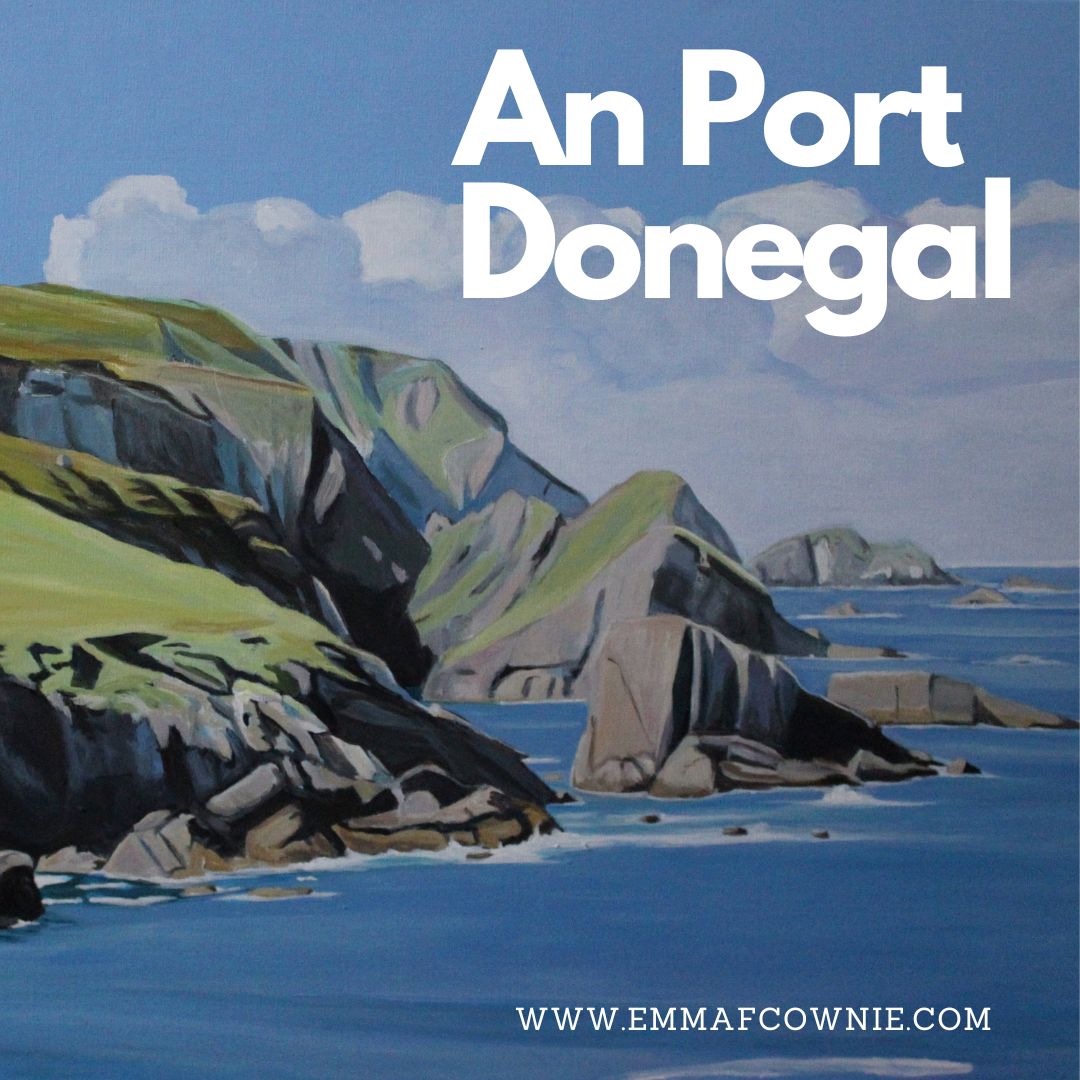
An Port (Donegal)

Painting of An Port, Donegal

An Port has loomed large in my imagination for a long time. It’s very remote and quite difficult to get to. To reach it, you have to drive down a very, very long single track road (it’s about three miles but it feels longer) on the way to Glencolmcille. There are plenty of sheep and only a few people.

The Road to Port
The Road to Port

At An Port there is a small quay and a tiny deserted fishing village which looks out over a small bay, surrounded by cliffs and truly massive slabs of rocks and sea stacks. Its one of those landscapes that you imagine can be found all along the west coast of Ireland but is actually unique. When I visited Texas in the late 1990s I thought it would all look like Monument Valley, thanks to those John Ford films. I was surpised to find it was pretty flat.

An Port, Donegal - pphoto creditEmma Cownie
An Port, Donegal – photo credit Emma Cownie
An Port: Photo credit Emma Cownie

The village was still inhabited in the 1920s. The hillside is littered with the remains of the stone houses

Remains of houses at An Port: Photo credit Emma Cownie

There is one inhabited house, now an AirBnB property. You can see it on the hill behind me in the photo my husband took of me (below). This was Annie McGinley’s family home.

Me at An Port
Me at An Port

I first heard about Port in 2018 from a TV programme about the famous American landscape artist Rockwell Kent and his stay in Donegal the 1920s. Rockwell Kent is probably best known today for his illustrations for Moby Dick.

Moby Dick Illustrated by Rockwell Kent

Unfortunately Kevin Magee’s film (in Irish with subtitles)    “Ar Lorg Annie” or “Searching for Annie” is no longer available but you can see a short clip on Youtube here. A friend of Kent’s,  Rex Stout, had funded his trip to Ireland. He paid him $300 a month on the condition that he had the choice of two painting when he got back. This is one of them in California,  “Prince Charles’ Cove”.

https://donegalnews.com/2018/04/58113/

Rockwell Kent and his second wife Frances Lee Higgins (they were on honeymoon) spent several months in the near by valley of Glenlough on a farm belonging to farmer Dan Ward. Kent stored many of his paintings back at Port, in the home of Annie McGinley, who modeled for him. Her she is.

"Annie McGinley" now rests in a private collection in New York
The original “Annie McGinley” now rests in a private collection in New York,

Rockwell Kent returned to Donegal, 32 years later. He had wanted to buy Dan Ward’s farm but it had already sold to another farmer. Instead he sought out ‘this singularly lovely teenage girl with whom I had danced many a jig’ and found her in nearby Crobane, married, midddle-aged and ‘broad-beamed’. She had had 14 children, 12 had lived.

Annie McGinley 1958
Annie McGinley and Rockwell Kent in 1958

Rockwell went to find Annie’s long abandoned cottage in An Port where in 1926 he had dried his Donegal paintings. It turned out to be the only structure still standing, barely supporting the weight of an overgrown thatched roof, a year or two from dereliction. ‘This house, we thought, we ought to buy and fix and have as a place to come every year …’ but he didn’t.

Painting of fishing boat at Port Donegal
Fishing Boat at Port Donegal-Emma Cownie

If you look on the left hand side of my painting “An Port” (below), you will see tiny fence posts along top of the cliff. They help give a sense of scale of the huge cliffs and rocks. I can’t remember who first described this landscape it as the “land of giants”but it truly apt.

painting of An Port, Donegal
An Port, Donegal_Emma Cownie

It is hard to do justice to this incredible landscape but I think that Rockwell Kent’s paintings do. He really capures the majesty and warm colours of Donegal. He also excels at Donegal skies and light. I am really in awe of him.

 https://www.wikiart.org/en/rockwell-kent/sturrall-donegal-ireland-1927

Rockwell Kent – “Sturral”  https://www.wikiart.org/en/rockwell-kent/sturrall-donegal-ireland-1927
 

I wish I could see the original paintings but this is very unlikely. It seems that none of Rockwell Kent’s large paintings stayed in Ireland. Most of them are either in the USA or in Russia. But that’s another story.

Read about my visit to Glenlough here

SEE DONEGAL PAINTINGS                                             BUY DONEGAL PRINTS 


I have added a few links about the artist Rockwell Kent below.

Rockwell Kent and Donegal

http://in8motivation.com/tag/rockwell-kent/

https://www.gleanncholmcille.ie/rockwell_kent.htm 

https://www.bbc.com/news/uk-northern-ireland-44534911

Click to access The-Missing-Irish-Kent-paintings.pdf

Irish paintings of American artist Rockwell Kent in new documentary Ar Lorg Annie on TG4

The Girl in the Blue Dress

https://www.sullivangoss.com/artists/rockwell-kent-1882-1971 Includes a chronology of his life (but doesn’t mention his Irish trip)

Christy Gillespie The Road to Glenlough  – A massive book on the History of Glenough Valley

Stay there/near by 

https://www.bizireland.com/port-donegal-cottage-087-253-3166

There is the amazing Cropod too which got rave reviews in the Irish TImes more than once  – https://www.irishtimes.com/life-style/travel/2022/09/01/cabin-fever-12-get-away-from-it-all-cabins-to-retreat-to-this-autumn/

How to Get there

http://www.welovedonegal.com/port-ghost-village.html

Climb the stacks (if you are brave enough – not me!)

https://uniqueascent.ie/  There are some excellent guides to the seastacks of Donegal on this site.

Posted on 13 Comments

Summer Newsletter

Emma Cownie Newsletter Summer 2022

While many of you are baking in England and dealing with a hosepipe ban, in Donegal it’s cloudy with occasional showers. I thought I would share you my recent newletter. They have ended up being quarterly. It depends of how much news I have and how busy I have been. I always make it strong on the visuals and light on the words! I also make the typeface large for reading on smart phones!

Emma Cownie Newsletter Summer 2022

Emma Cownie Newsletter Summer 2022


Emma Cownie Newsletter Summer 2022


Emma Cownie Newsletter Summer 2022


Read More

More about greyscaling 

Buy Paintings 

Visit our viewing gallery

Commission a landscape painting 

Posted on 18 Comments

The Burtonport Old Railway Walk, Ireland

Paintings of Ireland

Autumn brings incredible colours to the west coast of Ireland. As the grass and bracken die off, they turn a fantastic shade of orange and pink. The pink granite rocks that litter the landscape accentuate the warm colours. They have provided me with much inspiration for my landscape paintings of Donegal, Ireland.

Painting of Donegal Ireland
Autumn in the Rosses, Ireland

This series of paintings has been inspired by the Old Railway Walk which starts near Burtonport, near Dungloe in Donegal. There are no railways in Donegal anymore. There used to be. The line to Burtonport was built in 1903 as a joint venture by the British government and the Londonderry & Loch Swilly Railway Company to attempt to alleviate poverty in north West Donegal.

Steam train at Burtonport, Donegal
Steam trains at Burtonport, Donegal

The trains used to carry fish from the port at Burtonport in Donegal to Derry, in the neighboring county. It also carried many seasonal workers to and from Derry and Scotland.  After 1922 the line crossed from one country into another; from the Irish Free State into Northern Ireland.

Donegal Railways in 1906
Railways in 1906: Credit: Donegal Daily.com
Gweedore train station (Mount Errigal in the distance)

In the 1940s, however, the Irish government decided to close down the railways in Donegal. I have never really found a clear explanation for why this happened but I am going to assume that the cost of running the line was an important factor. There were also concerns about the safety of the line.

Owencarrow Viaduct, Donegal

In January 1925 disaster had occurred on the at the Owencarrow Viaduct when winds of up to 120mph blew carriages of the train off the viaduct causing it to partially collapse. Four poor souls lost their lives.

Owencarrow Viaduct
Owencarrow Viaduct

After the Second World War, the Irish government presumably decided it would cost too much to continue the maintenance of the line and it was closed in 1947. The Burtonport-Gweedore section closed in 1940. There is a great graphic on the Donegal Daily here illustrating the shrinkage and disappearance of the railways. Donegal became a very remote part of Ireland, with no railways and no (still) motorways. Communication with the area improved in 1986, however, when Donegal airport started operations.

Painting of the Rosses, Ireland
The Railway Walk, Ireland

It seems that for half a century nothing much happened on the old railway line. In 2009, however, there was a heavy snowfall, and some of the old railway line was cleared to access water mains that needed repairing. The remaining section was later cleared and gradually developed as a walkway with the support of the local community. A massive effort has gone into creating this beautiful and peaceful walk.

The Burtonport Old Railway Walk

Here are some of my paintings inspired by my husband Seamas’s photographs of the railway walk.

Painting of Donegal landscape, Ireland
Roshin Acres, Ireland
Ireland landscape painting
Long and Winding Road, Ireland

There are many features of the old railway remaining which you can view along the way such as stations, gatehouses, accommodation crossings, lots of pillars, cuttings, embankments, a bridge and rusty gates. There are also lots of shelters for walkers to hide from passing showers to use.

Photo credit: James (Seamas) Henry Johnston

Youtube video- Siúlóid an tSean Bhóthar Iarainn—The Old Railway Walk by Ralph Schulz.

Find out more about the Railway Walk by clicking on the links below:-

http://www.therosses.ie/walking.html

https://www.ireland.com/en-gb/what-is-available/walking-and-hiking/walks/destinations/republic-of-ireland/donegal/burtonport/all/1-94786/

http://www.walkingdonegal.net/article/walking-the-line/

http://magherycoastaladventures.ie/sli_na_rossan.html 

Getting here: From Letterkenny and Dungloe – SITI Rural Transport – Tel 0749741644. From Dublin – Bus Eireann@ www .buseireann .ie From Scotland & Northern lreland – Doherty Travel (00353) 749521867

https://www.donegalairport.ie/  There are twice-daily flights from Dublin and Glasgow to Donegal airport via Aer Lingus and Logan AirDonegal Airport : 00353(0) 74 95 48284.


.

Posted on 20 Comments

Over to Owey Island

Blog about Owey Island Donegal, Ireland

I love painting the coast, particularly if it’s rocky. Owey Island, lies just a short distance off Cruit Island near Kincasslagh in west County Donegal. Strictly speaking there have been no permanent residents since the 1970s. [Photos from http://www.welovedonegal.com/islands-owey.html]

There is no electricity or mains water, yet plenty of people visit and many visit during the summer months. If you want to visit, there is a ferry service run by Dan the Ferryman.

View of Ireland From Owey Island: Ian Miller
View of Ireland From Owey Island (Ian Miller)

The name Owey, in Irish Gaelic “uaigh”, means cave. The island is a cavers, kayakers and rock climbers’ paradise.

The island is encircled by massive rock stacks and it also has an underground lake. As I am cave-phobic this video is the closest I will ever get to it!

I am fascinated by rock stacks and Donegal has plenty of them. I like to think of how these massive structures have gradually been eroded by wind and waves over thousands of years, forming first sea arches and then stacks.

I also love the colour of the rocks and the wild Atlantic Ocean. The ocean is incredible shades of blues, greens and mauves, mixed in with browns and frothing surf. Although I feel I am getting better at representing the layers of Donegal sky and clouds, but capturing the movement of the seas is still frustrating me.

Painting of Owey Island, West Donegal, Ireland.
Over to Owey Island (SOLD) 


If you to find out more about Owey Island see Ian Miller’s Unique Ascent’s website for detailed descriptions and incredible videos.

Just thought I’d add a post script about the “Holy Jaysus Wall”. I think if you look at photo of it you will understand the name. It makes me feel ill just looking at it!

Holy Jesus Wall, Owey Island
Holy Jesus Wall

Irish climber and alpinist John McCune, climbed it in 2014.

Here’s a fascinating film clip from the 1970s about Owey Island’s postman, Neil McGonagle, who used to visit the dwindling population on Owey Island by small boat four times a week to maintain the island’s contact with the outside world.

https://www.rte.ie/archives/2018/0205/938419-owey-island-postman/


Painting of donegal, Ireland
Owey Island (SOLD)