Just a footnote to my last post really about painting scenes at markets.
What Now? SOLD
One of the small dogs spotted at Stroud a fortnight (2 weeks) ago. This tiny girl was waiting for her people to stop talking so she could carry on leading the way forward.
Apologies for the short post but I am having trouble typing for any length of time due to pain in my hands. A vigorous Yoga session a couple of months ago either sprained my wrists or set off something like arthritis, I am not sure. Anyway, I have had some sort of intermittent pain in my hands (the right one especially) for weeks now, but it’s particularly bad when I type or text!
I have been ill this week so this is a short post.
In last week’s post, Seamas, my husband and I were standing on rocks looking out towards Gola island in Donegal. This week we are looking back inland to Dunmore Strand, and beyond to Mount Errigal.
Dunmore Strand (with Mount Errigal in the distance)
As soon as I saw this scene I knew I wanted to paint it. I loved the dark shadow under the protruding lip of the undulating dunes. It gave the impression that the grasses were merely a thick blanket laid across the top of the sand.
Scattered along the beach and in the water, were granite rocks. These were so large that they were more like massive boulders. They were a beautiful pinkish colour close up. The sand was also very slightly pinkish but closer to the shoreline it was almost white. Lines of seaweed marked the rising and falling tide.
The tiny white houses gave a sense of sense scale of the dunes. They reminded me a little of boats on the surface of a heaving sea; humans eeking out an existence on the edge of nature. The ocean itself was calm and benign. It was as clear as glass at the shoreline and further out was a beautiful turquoise. It is not always this smooth creature, in autumn, I have seen it roaring and thrashing the shoreline like a wild beast.
Mount Errigal dominates this part of West Donegal, known as Gweedore. The mountain looks close but it’s an optical illusion, it’s actually about 10 miles away to the east. The top of Mount Errigal was swathed in clouds. The mountain always seems to have clouds around its shoulders, or totally smothering it. I had to wait for about 3/4 of an hour for the mists to part for a clear view of the peak. The clouds near to me were dirtier rain-filled clouds that were building and threatening to release their burden on the land somewhere nearby.
Another wonderful thing about this beautiful beach is that on this chilly April afternoon is that there was not another soul there. The only people we saw were the postman in his van on the way down the long lane to the beach.
My next post will peer “through a glass darkly” at Seamas’s Donegal family history (it is very dark in places) and the History of Gweedore along with the controversial issue of modernizing landlords.
I warn you now that this is a blog post about paint; about one shade of blue in particular. It might even involve watching paint dry. Which, unless you are an artist, probably isn’t very exciting.
Paints represent a sort of non-verbal language for me. I actually find it hard to put into words how I feel about paints. I have a “feeling” in my stomach and I want to wave my hands about a bit to express those feelings, but it all seems very inadequate. I don’t know if other artists are like this. I see colours in life and think of the paints I might use to represent them on the canvas. There is a particular warm shade of brown that I am yet to satisfactorily find in a paint. For a long time, I struggled with particular shades of green, until I found that mixing turquoise produced the right level “zing” in my summer greens. In Donegal the greens need yellow ochre to make them ring true.
The Madonna’s ultramarine cloak
I am particularly obsessive about a particular colour that until yesterday, I was even sure how it was pronounced. This is phthalo blue. I doubt you have ever heard of it. It’s not like Ultramarine blue, made from lapis lazuli stone, which was was famously so expensive it was solely reserved for painting the Virgin Mary’s cloak.
Now, I am absolutely no good at saying words I haven’t heard someone else say out loud. That “ph” at the beginning really confused me and I used to call it “p-th-al-ff-oo” blue, deliberately tripping over the syllables because I’d never heard it said out loud. Until yesterday, when I realised I could look it up! So it did.
What! It’s pronounced “thalo”!! Why don’t they just call it Thalo Blue? I noticed in the comments below the video that someone else said ” I say it as pfthpfthpfthpfthpfthpfthpfthalo blue”. I don’t recommend, however, that you listen to the Russian pronunciation of “пхтхало блю” on google translate because it’s sort of like my original managling of the word!
Phthalo blue pigments
You are probably thinking, who cares? Well, I care because I am passionate about Phthalo blue. No, that’s not true I am obsessive about it. It is very useful colour in my messy box of paints. I particularly like the version made by French paint manufacturers Lefranc & Bourgeois.
I love you!
It’s not cheap but it a very useful colour. Its very strong. It’s very dark and I love it for creating really dark blues, blues that mixed with Van Dyke Browns and make wonderful dark clouds. I don’t like to use black for dark shades as it has a tendency to “kill” a colour. I have found that its essential for both the massive white Cumulonimbus clouds and the really filthy rain clouds of Donegal. It’s actually a synthetic pigment from the group of phthalocyanine dyes. When it’s mixed with Titanium white it makes a delightful light blue that’s also very useful for skies.
Swirling Clouds Round ErrigalPhthalo Blue with titanium white
Oil paints are in essence pigments carried in oil (once upon a time vegetable oil was used) usually linseed today. The pigments were originally derived from mineral salts, a few from organic materials such as roots. Many of the historical pigments were dangerous, such as the wonderful greens called Paris Green (copper acetoarsenite) and Orpiment (arsenic sulfide), which were highly toxic. Happily, these pigments are no longer used. Later, man-made or synthetic, pigments increased the range of colors available, phthalo or phthalocyanine blue is one of these modern colours.
Chemists first developed this blue pigment in the late 1920s and it was sold under the trade name “Monastral“ in 1935. This list of alternative names is bewildering. Here are some of them; monastral blue, phthalo blue, helio blue, thalo blue, Winsor blue, phthalocyanine blue, C.I. Pigment Blue 15:2, Copper phthalocyanine blue, Copper tetrabenzoporphyrazine, Cu-Phthaloblue, PB-15, PB-36, C.I. 74160. I want to add to this long list of names Hoggar blue. Surprisingly, this colour is also used in Lidl’s Dentalux Total Care Plus toothpaste!
Now, I am sometimes faced with the situation that I have used up all the paint in a tube (and I really do get all the paint out of the tubes) but I can’t read the name or number of the paint to reorder the right one. I might be able to work out the manufacturer but its name or number. Here’s an example of what I mean.
What’s your name?
Still a bit of paint in here!
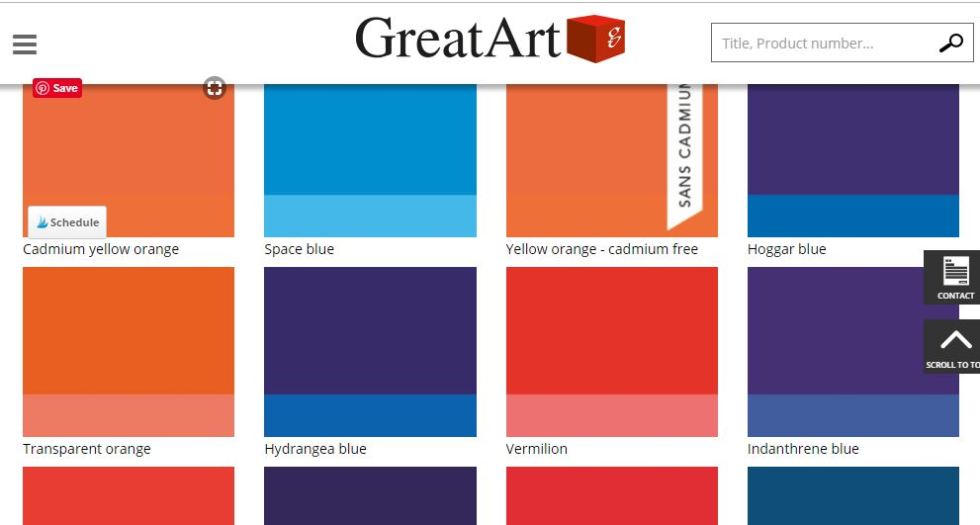
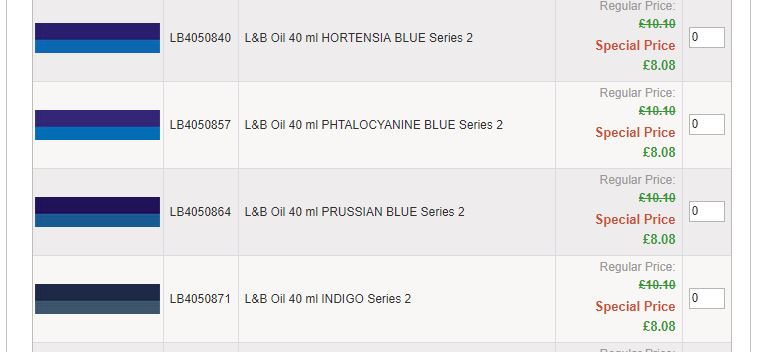
Lefranc & Bourgeois are the oldest artists’ quality colourmen in France. They share the same parent company as Winsor & Newton. This is why, it difficult to get their paints in the UK most stockists carry Winsor & Newton paints instead. A while back they decided to have a rebrand and they changed their labels and the names on the labels. This caused me great confusion because neither of the two suppliers where I usually ordered this great colour listed “phthalo blue” anymore. I’ll show what I mean. Here’s the Lefranc & Bourgeois page from the Great Art website.
So I ordered a Phthalo blue made by another paint maker, Lucas 1862. It was OK but not half as good as the L&B version. It didn’t feel the same, and it didn’t mix with other colours in quite the way I wanted.
Left L&B and Right Lucas 1862
Looking back now, I can see that Hoggar Blue and Phtalocyanine Blue are actually the same colour, phthalo blue. The colour I thought they had stopped making. This meant I spent weeks eeking the last drop of paint out of the what I thought was my last tube, thinking that this colour was no longer to be had in the UK. Then I realised that I had another tube in a drawer so I got it out and studied the label carefully.
All those different names
I realised that the names for this paint in other languages used Hoggar a lot (the Hoggar mountains are in Algiers, once a French colony); Blu Hoggar /Azul Hoggair /Hoggarblau so I went back and looked at the Great Art online catalogue and worked out that my phthalo blue was actually now listed as Hoggar Blue. So I ordered this Hoggar Blue and it was the same colour as Phthalo Blue. I was so happy! It meant that a part of my vocabulary was restored to me and I wasn’t going to run out of words!
So, you can see that I wasn’t exaggerating when I said I was obsessive about colour. Who else but an artist has a celebration over a particular shade of blue? The moral of the story is that all paint is not created equal and it’s always worth being obsessive about colour.
Brooding Clouds Over Errigal
Oh yes, if you want to watch the video about paint drying, be my guest. I have watched and actually found it interesting (OK I actually skipped the drying bit to see the different colours)!
As a Christmas present, I promised I would paint my sister’s cocker spaniel, Dolly. I have a few photos of her but I thought my sister might prefer a painting based on an image she’d chosen.
My sister, however, gets distracted by all sorts of stuff, like the builders arriving to take down her lean-to shed and then having to deal with the junk that has accumulated in the said shed. In her defense, she’s inherited the contents. None of it is hers. There’s a fair bit of it.
Contents of my sister’s ex-shed
Anyway, I am waiting for her to send me her chosen image.
“Dolly won’t sit still when I try and take a photo!”, my sister complains.
So I may be waiting a while!
So in the meantime, I have been practicing painting other people’s hounds. I like to do quick tonal acrylic sketches as a break from oil painting. It challenges to think about tonal value rather than colour. Sometimes, it get it right, sometimes I don’t.
Cocker Spaniel
Goldie
Gilda
I also did a sketch of Dolly from a photo my mother had sent me. It may be the one my sister ends up getting!
Life as an artist is a very insecure one, you never know where your next sale is going to come from. You can plan and prepare for exhibitions and work on your social media, but it’s impossible to know how many people will see and respond to them.
That’s why it’s really important to take stock, and celebrate the success you have achieved and thank all the supporters and collectors who have helped you over the year; whether it’s a positive comment on a blog post, a “like” on facebook or an instagram post, the sale of a mounted print, a greeting card, a commission or the sale of a painting. They all help keep me going! You may not believe it, but artists have fragile egos (this one has, anyway) and they need encouragement, especially if they venture off into new directions, as I so often do.
Here’s a review of some of my sales of paintings and mounted prints from the first part of 2018. Many were sold via the online gallery Artfinderbut increasing I have sold direct via my own website. Each painting is a unique work. I don’t paint generic people or landscapes. They are all real people and locations. In April’s collection you can see many of the Gower painting I did as part of the Gower Coastal Path Project. Bloggers’ comments and encouragement really helped me complete that project. Thank you, all.
January Sales 2018February Sales 2018
March Sales 2018
April Sales 2018
My next post will complete the review. Thank you to the brilliant people who have supported me and bought my work this year, I couldn’t do it without you!
Hedgehogs and bears have the right idea about winter.
Is this the best way to spend winter?
They hibernate and miss the dark winter months. I am finding this winter quite a struggle. In the last fortnight most days have been characterised by gloomy skies and poor light quality. In previous years I have struggled to get much painting done. I have spent hours tapping away on the computer looking up at the black sky outside my window, waiting for the sun to rise so I can start painting, and then often abandoning work at 2pm when the light goes. The best light to paint by is undoubtedly daylight, and my attic studio is blessed with a lovely northern light, but I needed to extend my painting time, to keep working.
A couple of years ago I invested in a “Professional” artists’ light. It was pretty pricey at £60 ($75US) but I hoped it would be worth it. I think it helped me paint on for about half an hour after the light had faded but not much more.
Daylight Professional Artists Lamp (old version)
So I decided to add to it with a photographer’s’ daylight lamp. These have screw fittings so I had to buy a converter so that it would fit the clip fitting that I also bought. The whole set up did not cost much more than £12 ($15) so just on price it was likely to beat the expensive artist’s light. The bulb arrived, but when I opened it up I was so surprised it’s strange appearance (it was easily twice the size of the regular light bulb) that I laughed so hard that I dropped it, and it and smashed! Drat (not my actual words). I then had to order another one and wait all over again for a new one to be delivered.
Don’t Laugh! Photography Daylight White E27 Lighting Lamp Bulbs
It was worth waiting for. It was pretty good. It was cheap too. So I got a second one to place either side of me. This enabled me to paint on for an hour and half after the light had gone. This year, I have gone for a “full-Hollywood-lighting” with three of these beauties blazing away. The artist’s light has been relegated to acting as handy arm to clip the photographers’ lights to! I don’t even bother to switch it on, anymore, unless it’s really dark.
The two photographers lights clipped on the bendy arm of the artist’s lamp.
Now I think I can paint any time of the day or night (almost). It’s best for augmenting natural light and extending painting times. In yesterday’s gloom I was still struggling to see pale yellows and light greens. I am very tempted to see what a fourth one will do for me.
Interestingly, despite all this artificial light I find I still need my SAD lamp to keep me relatively cheerful and regulate my sleep patterns. I have found that if I don’t get a good shot of SAD light around 7pm I awake at 4am bright-eyed and decidedly grumpy. That extra burst of light helps tell my brain that I should not wake up until 6.30, at least. That’s the best I can do most days. I long to sleep in til 9am but for some reason I just can’t.
What do other artists do to keep working in the winter months? Or you sensibly, wrap up warm and go to sleep for four months like hedgehogs and bears?
That looks so cosy!
Here’s another artist’s solution to the dark days of winter.
We didn’t get an “Indian Summer” in September, which when we usually get one in Wales. What we have had, instead, is a series of sunny days in late October/early November. The sparkling autumn light is stunning. From a painter’s point of view is more interesting than summer light. So last week I drove down to Three Cliffs Bay to enjoy the light. I was surprised by the dark blue of the calm sea. It was quite a different colour from the summer sea.
Three Cliffs Autumn Light
I was hoping that there would be plenty of orange bracken and there was. Not on the slope of the the Three Cliffs, as they are covered in grass, but on the slopes of Cefn Bryn, in distance.
Painting of Pobbles Bay, Three cliffs, Gower
These colours sum up the Welsh landscape for me. In fact, I think I like the Welsh landscape in autumn/winter best. The red and the green of the bracken and the grass also put me in mind of the red and the green of the Welsh flag.
Welsh Flag (an interpretation)Light on Great Tor (Gower)
I find it ironic that there’s less light around but its better quality, from an artists’ point of view. I still have not adjusted to the clocks going back last month, and I am still waking at 5 -5.30am! It does not seem to matter what time I go to bed, I awake in the dark feeling ready to rise. So I get up and here I am tapping away at my computer in the dark waiting for the sun to rise. Soon I will have to get my SAD lamp out to stop the slow slide in winter gloom. Before, you ask, yes, SAD lamps work for me.
Does anyone else suffer from this problem? Does anyone have any tips for sleeping in later?
Update: I sat with my SAD lamp on for 20 minutes around 7 pm last night and it seemed to help me go back to sleep when I awoke at 4.30 am, and I didn’t get that “wake up” surge of hormones til 6.30. A definite improvement.
The people of Britain love their dogs. It is no secret that I love animals. I come from a family of animal lovers. My younger brother has three cockerpoo type dogs, my sister has a Cocker Spaniel called Dolly one and myself and my husband have two gorgeous mutts.
Animals can do no wrong in my family. I suspect that my mother would prefer to see photos of friends’ dogs rather than photos of their grandchildren!
So its no surprise that I often choose dogs (and their owners) as subjects for my art. I also love painting dogs as commission portraits.
I am not always terribly good at making eye contact with people when I am talking with them but when I am out walking, I will often catch the eye of a dog and a glance will pass between us. Perhaps, I am imagining this.
Dogs are cool. They live in the moment and know how to fully enjoy themselves. They love being out and about and enjoy seeing that. There is no joy like the joy of dog running free in the park or in the woods.
I like to try and see the world from their point of view. This usually means a low view point. Little Jack Russells are a favourite of mine. They have a big personality.
I particularly like to capture the body language between the dogs and and their humans. I am intrigued by the bond that links them. Even if they are just a dog and a human, they are a pack. The human is not always, “top dog”!
The Rosses (in Gaelic, Na Rosa) is a region in the west of County Donegal, Ireland. The name comes from “Ros”, the Irish word for headland. It is a curiously rocky place. Not rocky, in the sense that national parks in the American west, like Utah and Arizona, are made of 100% rock, but rather the bedrock is covered with a thin layer of earth, with slabs of rocks and boulders poking through. It’s a barren but beautiful landscape, studded with a myriad of lakes and inlets of the sea.
Aerial View of the Rosses, from the aeroplane (with Mount Errigal in the background).
It may feel like the edge of the known world but this area has been inhabited “since time immemorial” according to Wikipedia. Coastal places like the Rosses, in Donegal, looked out onto a massive highway – the sea. Missionary Celtic saints were busy in this area in the 6th century AD. These saints relished a challenge and liked to travelled up and down the Celtic waterways to spread Christianity to nearby Scotland. In the 1990s it was fashionable to argue that these Irish monks had in fact, “saved civilisation” by copying the books being destroyed elsewhere by Germanic invaders, eventually bringing them back to the places from which the books had come. Part of this movement included women like St. Crona or St. Crone (Cróine) , a female religious of royal blood. She found a monastery in Termon near Dungloe. She was a cousin of the the better known St. Columba (St. Columcille in Irish) one of the Twelve Apostles of Ireland, who founded the monastic settlement at Iona.
Much later (about a thousand years or so) in the 16th century, a number of ships from the Spanish Armada sank off or landed off its coast. Some 24 to 26 Spanish Armada ships are believed to have foundered off the Irish coast in 1588 while returning from a failed invasion of England by King Philip II. This is not just local myth as the wrecks of two Spanish ships were discovered by archaeologists in shallow water near Burtonport, Donegal, in 2008/9.
What happened to the survivors of these wreck is unclear. We know that as many as 9,000 Spanish soldiers and sailors lost their lives off the Atlantic coast of Ireland, either through drowning or were killed by English troops or Irish chieftains after they were washed ashore. However, not all died. Some Irish who were sympathetic to the Spaniards sheltered them and some kept them on as soldiers. Local legend, credits black-haired locals as being descents of these men, but they are possibly the descents of much earlier people who came from the Iberian peninsula after the end of the last ice age.
I found this area both beautiful fascinating. Donegal manages to combine a sense of isolation with company, should you want it. This area is littered with houses, old and modern. Many homes are built on the rocks, or have massive rocks in their gardens. People have had to work around the boulders and outcrops.The prevalence of pines dotted across the landscape gives the area a Scots or Canadian feel to it; Caledonian in fact.
Cruit Island
Although in many senses there is plenty of space, houses seem to huddle together in clusters, isolated but within sight of others. A lot of them (the newer ones, anyway) face out towards the Atlantic Ocean. It seems that in many cases old cramped cottages have been replaced by larger modern buildings. Many tiny cottages, or abandoned derelict buildings are overshadowed by bigger ones. The smaller cottages ended up as holiday homes for visitors. Most of the houses are painted white, but with some older stone cottages and out-houses are left “au naturel”.
On one of the few sunny afternoons we had, we raced round taking photographs of the houses on the rocks. Each bend in the narrow road revealed different vistas. It was hard to decide which one I liked the best. Not only did these houses look out to the sea, behind them were hills and mountains. My painting “Round the Rosses” captures a typical cluster of old and new homes perched on the top of rocky landscape. The light from the afternoon sun glints in the windows of the large house, that faces out to the ocean. The older, smaller buildings look to the east; away from the force of rain and storms and towards the rising sun.
I have painted five “cow portraits” in all, recently. Here they are. I have enjoyed getting to know them as individuals, their long history in art and human society, and especially painting them. I have learnt a lot about their anatomy, especially their curious two-toed feet, or rather “paired hooves”. I have also discovered that cows have “dew claws” (digits that most animals have, including cats and dogs).




 The people of Britain love their dogs. It is no secret that I love animals. I come from a family of animal lovers. My younger brother has three cockerpoo type dogs, my sister has a Cocker Spaniel called Dolly one and myself and my husband have two gorgeous mutts.


