Bloody Foreland is one of my favourite locations in Donegal. It is one of the wildest, windiest and most beautiful places I have been. The light is sharp and clear. You feel healthier for breathing the air here.
House on Cnoc Fola
The wind is always blowing. It is very remote and feels a bit like the edge of the known-world.
A derelict house, Bloody Foreland
The name Bloody Foreland (Cnoc Fola in Irish means Hill of Blood) does not to refer to some past battle that took place here in mythic times, but intense red hue of the rocks at sunset. The Irish language dominates here.
Folklore records that Balor, the one-eyed supernatural warlord was eventually slain by his grandson Lugh Lámh Fhada on the slopes of Cnoc Fola. Indeed, some say that the tide of blood which flowed from Balor’s evil eye stained the hillside and gave it its name.
Bloody Foreland, Donegal
I particularly like the incredible stone walls, made of massive granite boulders, that snake across the hills here. They date from the 1890s. They suggest to me a landscape where stones were plentiful and labour cheap. It is also the sort of place where writers come to get away from the modern world and think about writing. Dylan Thomas, travelled to An Port, further south to write poetry, but left without paying his bills.
Old Farm Buildings, Bloddy Foreland
Bloody Foreland, also makes a refreshing contrast to the slopes of Brinlack and Derrybeg, round the corner, which are heavily peppered with larger modern houses and bungalows from the era of “Bungalow Bliss“.
Houses on Bloody Foreland, Donegal
This is the first time that I have been able to paint Ireland whilst in Ireland. Previously, I have worked from my photos back in Wales. Now I think that being surrounded by these colours all the time is affecting my work in a different way.
I am experimenting a little with less detail and letting my under painting show through more – to give a greater sense of the roughness of the landscape here. I am feeling my way. I don’t know how my paintings will develop in the future, but not knowing is a sort of freedom from painting the same thing in the same sort of way.
Here’s a photo-story about our move to Ireland. The photos are all by Séamas Johnston, my husband. He is also the architect of the move, the new studios and our new life. He’s been amazing. It’s great to see all his hard work finally come together.
Packing the Car, Swansea (before much stuff was packed)
Endless Packing! It felt never ending.
Lateral Flow Test – one line means no covid. We discover that our tonsils are not that dangley bit at the back of your throat. We also did a PCR test but there are no photos of that.
Irvine Moving Solutions – they are moving our stuff – we saw their van coming off the Belfast ferry at Birkenhead!
Stena Line Ferry Terminal at Birkenhead, Liverpool. It was a long wait to get on.
The otherside of the Irish Sea. Early Morning Belfast from the ferry
How everything has grown at Meadow Cottage!
The studio window
Séamas reflected in the studio windows
Hattie doing “Cat Patrol with her eyes” on a new view
I love the view from the studio. I cant wait until my stuff arrives from storage and I can get back to painting.
Just to warn you. I have access to wifi this weekend (on a 3 day trial) but we decided to use a different company for our internet but they can’t install it for another 10 days so my responses will be delayed. My business remains closed until the middle of this month (July 2021).
Port Eynon and Horton from Salt House, Gower (A recent commission)
Just a quick notice to say that my shop on this website (www.emmafcownie.com), and shops on Artfinder.com and Singulart.com will be closed for a month from today. This is to cope with final packing, tidying up and a million and one things we have to do before leaving Wales as well as the period of self-isolation we have to undergo in Donegal (14 days, possibly less, depending on the results of our PCR tests after day 5).
Here’s my summer newsletter. I am shutting up shop for a month from 20th June to 20th July. All going well, we will be safely installed and open for business (online at least) in Donegal by mid-July. I am already longing to get back to my painting routine. I can’t quite believe that after being ground so long by my broken leg and the pandemic that we will actually move house/studio to another country by then. It’s a huge step! Fingers crossed it all goes smoothly!
I like this painting. I find it very calming. I especially like the clouds. I also like the emptiness of the beach. That is something I aspire to in my home.
This painting is actually wraped in bubblewrap in in the upstairs hallway. It had been hanging in our bedroom with three others for a couple of weeks. They had been refugees. They were evacuated from my attic studio because I had needed to paint the ceiling. I have since painted the bedroom wall. I still have the floor to finish.
Almost painted!
All of my other paintings are wrapped in bubblewrap and stored elsewhere. We are in the midsts of packing up and redecorating the house to put it on the market and move to Ireland. It is a mammoth task. The more we do the more it seems to grow. We are at the wall-papering-and-painting-floors stage. I say “we” but I should say “he”. My husband, Séamas, has done 98% of it. He has spent months and months working at it. I have been putting stuff in boxes and labelling them. I have only recently started helping with the decorating. It is exhausting. I wake up every morning and think, “I am so tired”. It has taken me weeks but I am 80% there. Unfortuantely, I feel like I have been 80% there for several weeks now. I once read somewhere that you should start packing a month before you intend to move. I have been doing this for at least three!
I initially spent months trying to pretend it was not happening because I found the thought of it too stressful. I am not alone, many people (only 40% amazingly) say that moving house is more stressful than going through a divorce and most people (60%) say they are put off moving because of the change involved. That’s me.
I have been getting rid of stuff for well over a year and a half now. I started with selling my surf boards on ebay then my old academic books on Amazon, but the pandemic put a stop to that. I have been getting rid of other stuff lately; clothes, china, novels, picture frames. I have found it utterly exhausting and it provokes all sorts of emotions, not all of them pleasant. There is a wierd sort of grieving in throwing things out.
A visit to the Council Dump (sorry, Recycling Centre) is one of my favourite things to do. It takes so much emotional and physical energy to get stuff there, it’s a joy to come home without it. There has been the occasional jumper or pair of shoes that I decided to keep or put on ebay rather than send to a charity shop, but mostly it’s gone. I cant believe how much stuff I still have. It’s like a bottomless pit. Everytime I think I am getting there I open another cupboard or wardrobe and find more! Our house certainly has a lot of storage space.
This process has been like shedding many “skins” that I inhabited in the past. One skin has been the academic books from when I was a lecturer and researcher in Medieval History. Another were the “tidy” clothes and lots of History books and DVDs, from when I was a school teacher. I threw out a lot of running gear. I have accepted that after breaking my leg so badly that I will never pound the streets for exercise again. So the boots and shoes with anything but the flatest of heels went for the same reason. I also finally admitted to myself that I will never go back into the classroom as a teacher. It has been 4 years now. Who am I kidding? I didn’t renew my teacher’s licence this year. What a relief. Come to think of it, I don’t think I was sent a renewal notice. Never mind. It amounts to the same thing.
This has made me see how we gather “stuff” around us. I think I do it to give myself a sense of security and identity. Maybe this is because I moved house a lot as a child. I lived in 5 houses in three different parts of the country and went to 7 different schools before I was aged 11. Apparently, moving house when you are a child isn’t terribly good for you. Setting off for university, my father had to tell me to decant part of my record collection because there just wasn’t enough space in his car for my stuff and us! He had to bring it all back at the end of term too! As an adult I have lived in three different cities; Cardiff, London and Swansea. We have been in Swansea for 21 years. I have gathered a lot of “moss” that time. Séamas has also gathered a fair bit of DIY stuff, those sealing guns in particular (see illustration).
Sealing/Caulking Gun
I don’t know where I get my hoarding from. Not my mother that’s for sure. She has been doing her version of Swedish Death Cleaning for years. “Welsh Death Cleaning”, you could call it. It is a sort of a minimalism for older people. She very disciplined about clearing stuff out so that she can either a) move smaller one day or b) so we don’t have to do this when she is no longer with us. No object or piece of clothing stays in my parents home for very long if a) it is no longer worn on a regular basis b) regularly used or c) very decorative. Otherwise, off it goes to the local charity shop. Many years ago, when my sister moved to London “temporarily” to do an MA at the Royal College of Art, she left her old Morris Minor car at my parent’s house . After a few years, when it was it clear that she wasn’t moving back home, my mother sold the car. She gave the money to my sister. Jane is still a bit mifted about it. If you left to her it would still be in the drive! I guess all that moving house over the years taught my mother discipline.
When we bought this house over 20 years ago, I declared I was never going to move house again. My mother said that’s what women say after giving birth, but most of them go on to have more children! Yes, life has a way of making you eat your words. Here I am preparing to move house.
My tendancy to gather of stuff accelerated after I had my breakdown. I once tried to do the Marie Kondo thing (in fact I found a few rolled up in my airing cupboard Maire Kondo-style) but I got overwhelmed. I couldn’t keep it up. I lacked the energy to do anything much, let alone decide what to chuck out and then do it. It is a form of hoarding. Yes, it’s an ugly word. I am not as bad as those poor souls they make TV programmes on Channel 5 about, yet. I am still somewhere on that unpleasant spectrum. It’s a sort of compulsion. I can’t let go. Breaking my leg, didn’t help either. When everyone else was decluttering in the early days of the first lockdown, I was confined to the bedroom! Then, when I was ready to get rid of stuff, all the non-essential charity shops were shut! For months.
The strange thing is that once I have cleared space, I can see and appreciate what I have choosen to keep better. I now look at stuff and think, do I really need that? I go back to the packed boxes and take things out; thinking: why did I pack that? It’s like the ebb and flow of the sea. I clear out stuff, feel some satisfaction and then I find more stuff and have to go through the process all over again. The other side of the coin is that twice yesterday, I went to find something, only to realised that I had chucked it out!
I need to be tougher and get rid of more stuff. I follow “Be more with Less” decluttering account on Instagram in the hope that some of the inspirational quotes will sink in. I know I have a long, long way to go. The only “skin” I want now is that of an artist and blogger. I don’t kid myself that I won’t buy more stuff in the future, but I hope I will be better at shedding it more regularly. I will be following my mother’s example! She’ll laugh at that!
Here’s another of my recent paintings, it was also hanging in the bedroom.
I was delighted to be asked to do an interview with Toby Buckley for the Net Gallery about selling art and marketing. It was published recently on the “Artist N Virtual” section of their site. I thought I would post it here too:-
With successive lockdowns resulting in the closure and cancellation of many of the galleries, markets, festivals and art fairs that artists rely on to make a living, 2020 and 2021 have seen many artists trying their hands at online sales for the first time. To help anyone taking a jump into the online marketplace, we spoke to Swansea- and Donegal-based artist, Emma Cownie, to get some expert advice.
Emma’s distinctive oil paintings have featured in exhibitions around the UK and are even available from lifestyle giants John Lewis, but she doesn’t rely on these outlets to get her work out there. Spending “at least 50%” of her day marketing, Emma mastered the art of online art sales long before lockdown, selling over 200 pieces, originals and prints (many of which went directly to collectors) in 2018 alone.
TNG: How did you come to settle on your current sales methods?
Emma Cownie (EC): My original sales methods came from the idea of being a “creative entrepreneur” which meant involving collectors and followers in the creation of my work. I did this mainly via blogs which described the creative process, from initial thoughts, going to actual locations, images created, then the painting process, right through to descriptions of the art when placed online. This allowed followers of my work to have an emotional stake in my work, to be part of its creation.
I have retained collectors from this formative period. It has always been important to bring followers with me on a creative journey, so that they are part of the process, buying one’s work, encouraging me as an artist via comments, likes and support. They are part of the process… Art is not created in a vacuum, and shouldn’t be sold in one either. This is especially true when the places I paint, as landscape paintings, have personal attachment to followers and collectors also. In fact, they often purchase work of places close to their heart. I like to blog about work and my inspirations even today. Art can be remote sometimes so I feel it should instead gather people in.
TNG: How can an artist make the most of social media to boost their sales?
EC: Social media is essential to boosting sales, to the uploading of new work and to the celebration of new sales. It keeps collectors and followers up to date on your artistic journey and lets them share in your success and development. An artist’s promotion is often done by people on social media who like your work. It is important to engage with other artists too, supporting each other via shares, comments and likes.
Most sales are a product of a network of social interactions with supporters and it is important to keep busy online. The more one interacts, the more one’s work seems to become visible which in turn helps sales… I also use social media to engage with followers about my work and it’s creation, and this helps too.
TNG: What is the first thing you’d recommend to someone who is trying to get their online art sales off the ground?
EC: Be yourself. By that I mean, collectors are looking for original work, art they have not seen before. They are not looking for derivative work. Novelty and originality are strong selling points. So it is important to develop a style of painting that is distinctively your own.
TNG: You have written that positivity is a key factor in selling art online. Why do you think celebrating success is so important in online sales?
EC: When I post an image of a painting when it has sold, it invariably gets more likes and comments than when posted originally. Collectors and fans like to know an artist is succeeding. Collectors like reassurance about your qualities as an artist and that they are buying a quality piece that will keep its inherent value (obviously the value may also increase through time). They also like to see an artist developing and to be part of that journey in some way. Buying their work makes them intrinsic to that development.
Sales also confirm a collector’s taste in spotting talent, that it is just not them who sees an artist’s talent.
The Glynn Vivian, Swansea
TNG: What should an artist include in their bio to make themselves appeal more to potential buyers?
EC: Collectors like to know if an artist has exhibited in “brick and mortar” galleries too and whether you have work in private collections around the world. I have found that a bio should contain pertinent personal information too. In my case, I started painting in a more concentrated manner following a car crash and painting helped me through the post-traumatic consequences of the crash. Painting helps me in my daily life. Some find this inspiring and it helps them understand where I am coming from.
I also mention my own inspirations and how they shape my work and my style of painting. This also gives them insight into where I am coming from in terms of art history.
TNG: How important are high-quality artwork images, and how would you recommend creating these?
EC: It is essential to upload high-quality artwork images. It is important that the images are as accurate as possible in representing the work. Collectors are relying on this when purchasing art online and remotely… I usually photograph on a greyish, overcast day too.
I get frustrated by artists who clearly have used a flash on their camera to photograph work as it can be seen in the bleaching out of the colours on one side of the painting… If you’re not using natural light, then artificially light a painting from both sides simultaneously. If an artist does not take their work seriously enough to photograph properly it sends out a negative message to collectors.
TNG: What’s more important when pricing works – a wide range of prices to appeal to all wallets or a consistent price that emphasises the value of the work?
EC: Both. My first slogan was ‘Quality Art At Affordable Prices’ which had a range of prices from £30 to £900. As my work has sold over the last 8 years, my prices have incrementally risen. My most expensive painting is £2500, as I still want more people to feel that they can buy art, that it is not an elitist activity, everyone can and should own art as it is so uplifting and adds such value to one’s life. It is a gift that keeps giving.
I would offer a range of prices based on size of canvas used but have enough small, reasonably priced paintings to get sales going and to boost confidence. It is a great feeling selling art. It motivates you to do the same again.
It is important that prices rise in line with sales, however, and work should be priced accordingly. Make incremental changes every time you sell and prices will keep going up but not in a way that discourages sales.
Art by Emma Cownie
The two artworks below, Suburban Cottage and With a Road Running Through It, were created using a minimal style that Emma has been developing over the last 4 years. We asked Emma to tell us a bit more about each piece.
Suburban Cottage – “This is an urban minimal oil painting of Sketty, a middle class suburb of Swansea in Wales. “Urban Minimal” was a deliberate attempt to simplify my paintings in a style similar to the American Minimalists. Much of my work has been influenced by American realists and minimalists. Urban minimalist paintings were painted in accordance with my ‘rules’ for composition and painting:
No cars
No People
Bright light. There must be shadows – at diagonals if possible.
Simplified forms – there must be little detail in the final painting. I found this the most challenging ‘rule’ to stick to.
“I wanted to explore the interplay of the geometry of shadows and man-made structures – the tension between the 3D buildings and the 2D shadows, the simplified blocks of colour.”
With a Road Running Through It – “I painted a series of paintings of cottages on the island of Goal, off the coast of Donegal, Ireland. I tried to paint in a style similar to that of ‘urban minimal’. These ‘rural minimal’ pieces pared paintings down to the basics. Minimal texture, simple but interesting compositions, strong light and shadows, all intended to create a sense of the still, the quiet, a moment in life that is both now and eternal.”
Article by Toby Buckley.
To learn more about Emma Cownie and her work, be sure to check out her website: https://emmafcownie.com. You can read more of her advice about online art sales in her article on Medium.
On Thursday I did something I have never done before. I did a presentation to a bunch people in London via the internet. During the darkness winter days of lock down I have sat at my computer and listened to quite a few people give presentations on subjects as diverse as Art (Jennifer Pockinski, Elizabeth O’Reilly), Irish Language (Manchán Mangan), Irish Bogs (Creative Rathangan Meithea), Irish Cottages (Ulster Architectuaral Society) and Literature (Gabriel Byrne) and thoroughly enjoyed them.
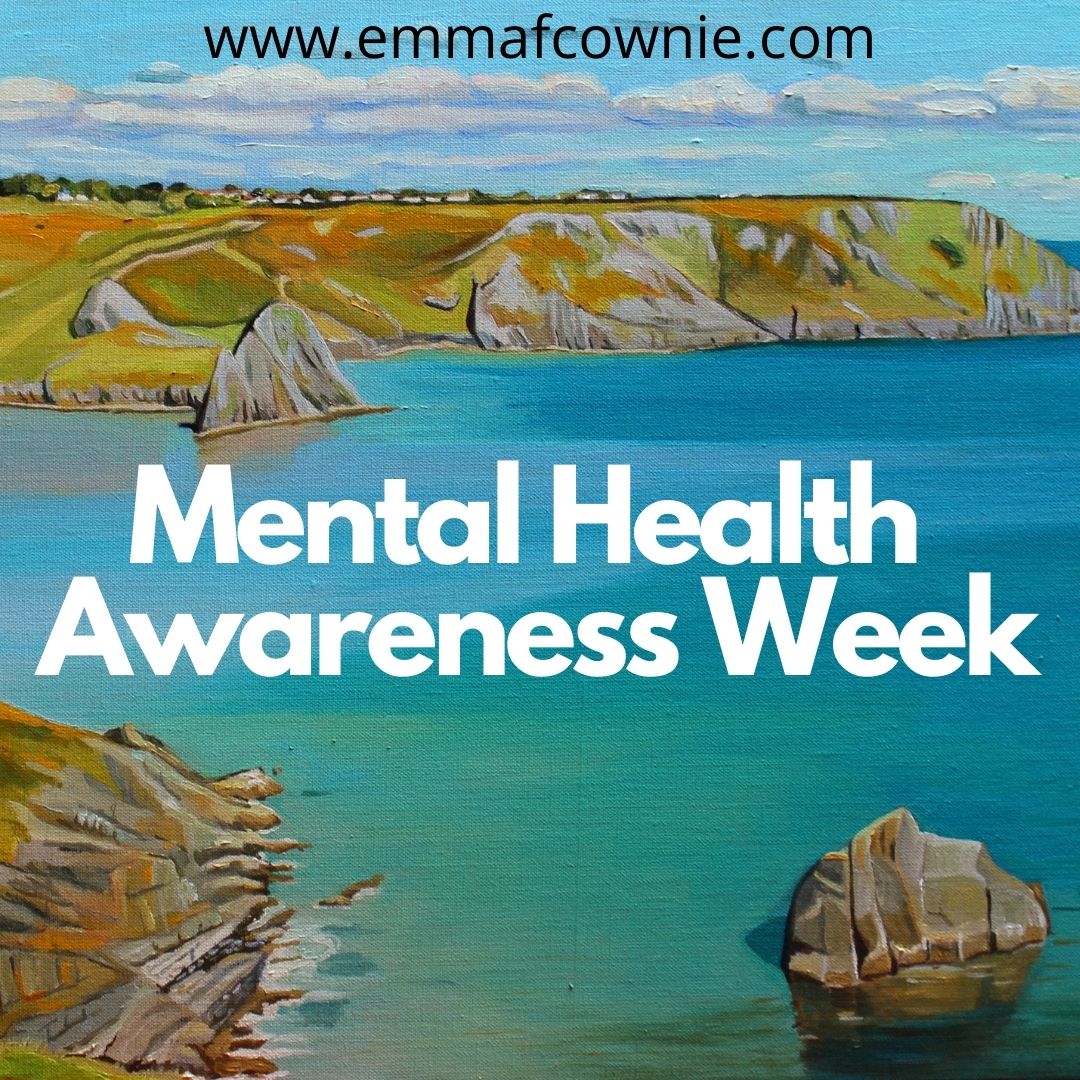
Artfinder: Mental Health Awareness Week
This Thursday, I got my chance to see behind the scenes of these sorts of events and talk about my experiences for Mental Health Awareness Week with On Thursday I did something I have never done before. I did a presentation to a bunch people in London via the internet. During the darkness winter days of lock down I have sat at my computer and listened to quite a few people give presentations on subjects as diverse as Art (Jennifer Pockinski, Elizabeth O’Reilly), Irish Language (Manchán Mangan), Irish Bogs (Creative Rathangan Meithea), Irish Cottages (Ulster Architectuaral Society) and Literature (Gabriel Byrne) and thoroughly enjoyed them.the team behind the online gallery, Artfinder (www.artfinder.com). I was also featured in a news blog on their website. During the pandemic many people are probably used using Zoom or Teams for their work meetings but I have never had this experience before. I think this is why I suggested a quick trial hook up the day the before. I had also seen things go slightly awry during those webinmars. My personal favourite was when the speaker’s laptop battery suddenly died and he had to rush off to find another laptop and the chair had to fill in for ten minutes whilst he did this!
Googlemeet and Zoom
I am so glad that we did a practice run with Jane and Kirsty. We started with Zoom. The sound on my laptop was dreadful and everything sounded like it was underwater. Jane and Kirsy sounded like a couple of unintelligable dolphins! Between my old Laptop and a ropey internet connection (Now TV, or “Not, Now TV” as we like to call it in this house), it wasn’t working. I wanted the throw the laptop across the room, cry and/or swear a lot. Obviously, I did neither.
What I wanted to do to my laptop
Eventually, Kirsty, the tech genius, came up with the idea of doing the meeting with Google Meet. “It is very low tech”, she said. “That’ll suit me just fine, I am low tech”, I said! The rest of the test worked well and we had a chat about what it was like working remotely.
On the afternoon of the presentation I waited nervously for the meeting to start and even said a prayer beforehand. Then all these youthful faces pinged onto the screen. More and more until it was full with 9 boxes and more names listed along the top of the screen of people I could not see. I am not sure if the prayer helped because I still had problems getting my screen to share my powerpoint. Thankfully Michal (the CEO) talked me through which buttons to press , in which order and we were finally in business.
Not the Artfinder Team – but my screen did look a bit like this
I then had that wierd moment before you start speaking that seemed to stretch on for ever. I looked at my screen. All I could see was my presentation, no faces now, which was odd too. I took a big breath and began.
OK – I am just going to give you the highlights.
In 2006 I started having panic attacks on the motorway – I saw a couple of (not very good) therapist/hypnotherapists and bought a lot of books on panic attacks. It did not solve my problem. I avoided motorways.
2012 Minor Car Accident – which led to me developing PTSD & Burn Out (also known as a “Breakdown”). This resulted in hypervigilance/nightmares/flashbacks/inability to concentrate/exhaustion. I found a very good therapist and had EMDR therapy (Eye Movement Desensitization and Reprocessing) and during the course of this therapy started painting every day. It was a very slow recovery and it took a year to return to work part time
How art has helped me with my recovery / mental health over the years: – I find it calming, restorative, meditative and it boosts my fragile self-esteem. It also improves my concentration & energy levels. It provides a positive focus to my life, I find the colours therapeutic and painting also provides an intellectual challenge as there is a lot of problem-solving in painting. It also provides social connections through blogging & social media
As this was a presentation to Artfinder staff I talked about how important Artfinder has been in my journey into becoming a professional artist.
My husband, Séamas, joined the Artfinder site on my behalf in April 2013. He also set up a website a blog for me.
My first sale on Artfinder was in June 2013. It was a giclée print of “A Tenby Reflection” for £39
I sold my first painting via Artfinder July 2013
In the last 8 years I have sold over 800 works via Artfinder and gained over 6000 followers, which makes me the most followed artist on the site!
I left teaching in 2017 and became a full-time artist – I put a lot more time and energy into my painting, my website, blogging and social media sites
Early Work
Tenby Reflections (2013) My first sale on Artfinder
Perpetual Light (2013)
The Light Refracted
Winter Morning Light on Parkmill
A Slender Light
Gower Paintings
Evening on Three Cliffs
Coloured Sands at Three Cliffs
Ireland
Around Cloughcor (Arranmore)
From Cloughcor To Maghery (Arranmore)
Mental Health, the Covid-19 pandemic and other emergencies
PTSD – I tend to think of the worse possible outcome to most things at the best of times. I usually have to talk myself down from my initial extreme reaction, but for once in early 2020 I was RIGHT! This new virus was an end-of-the-world scenario!
I kept a diary to help cope with the sense of panic and anxiety I was experiencing and then. I took my dogs for a walk in the woods on my own (Séamas was in Ireland)
I tripped and broke my leg and had to wait 5 hours for the emergency services to rescue me. You can read that long story here.
I spent 9 days in hospital waiting for an operation to pin my leg.
During my long recovery from this experience, I reflected on the differences between how we all, myself included, treat physical and mental health issues. With physical health issues there is the physical pain (there was certainly lots of that), the practical difficulties of getting around, frustration at the loss of independence and the physical exhaustion as your body heals. I also discovered that this sort of trauma was easy to talk about. There was a lot of public sympathy & concern from people.
It was a lot easier to deal with than mental health issues. I was delighted to realise that I dealt with the trauma and pain with (mostly) good humour and fortitude – although that wore off a bit when my rehab took a whole lot longer than I was expecting. I felt mentally sound even if my body wasn’t.
In contrast, when I experienced my mental breakdown, there was a lot of isolation, shame, fear, embarrassment on my part as well as physical exhaustion. I had always been a tough, independent and reliable person and I hated that my breakdown changed that. I still struggle with accepting my limitations. It was clear that a lot of other people felt sorry for me. That was not easy to bear either.
One of the few positives of the pandemic is that people have been more open about how they have struggled with their mental health. I think that it has shown people that a lot of mental health issues are related to having to bear “unbearable” situations. My huband, Séamas, says I didn’t have a breakdown down but a break through. My life, as it was, was making me ill and it had to change. During the pandemic that unbearable situation was universal. Everyone had to deal with having our freedoms curtailed, especially the freedom to see our family and friends. Many people people discovered that the joy of doing things with your hands/body such as gardening, yoga, painting, baking saved their sanity. I know that in my darkest hour I was making scones with Séamas! Art continues to keep me sane.
I answered a number of questions from Michal and staff at Artfinder. What came up: Had I painted before the 2012 accident? What can Artfinder do to help people with Mental Health Issues? How do you help someone with mental health issues? Different therapies and medications and how they might work for person and not for another.
The presentation wasn’t recorded, and in a way I am glad about that. I don’t think I would have been so open about my experiences if I thought what I said could be picked over and examined by people who weren’t present at the time. It was a strange situation to give a talk to a group of people I couldn’t really see. When I have given talks before I have had people’s faces and body language to help gauge their reactions to what I was saying. This time I didn’t. I wasn’t quite sure what to make of the whole thing afterwards because of this although the staff were all very positive. I hope that my audience got something out of the experience!
I will finish with a quote from “Anthem” by the Canadian singer and poet, Leonard Cohen.
Ring the bells that still can ring
Forget your perfect offering
There is a crack, a crack in everything
That’s how the light gets in.
On Thursday afternoon I went on my first proper “Walk” with a capital W since I broke my leg and ankle last spring (read about my horrible adventure here). It’s not that I haven’t visited parts of the coast since March 2020. I took numerous short strolls along flat grassy parts of Gower (Mumbles, Oxwich and Pennard) last autumn before we were launched into the never ending autumn/winter lockdowns. Thursday was the first time I really challenged myself and ventured along tracks that I would not have thought twice about walking along before. We left the dogs at home to give our full concentration to walking (and not tripping up).
Life recovering from a broken leg and ankle is all about surfaces and angles. A lot of my walks involve looking at the ground. I make myself stop when I want to look at the scenery. Rough ground can be challenging for my ankle. Going down hill is a lot harder than going up. I often think of my ankle as being like my sewing machine foot when I try and make it sew thick fabrics! Unfortunately, my sewing machine foot has been known to fall off. I am not sure if that’s a reminder to take care or its just not a great analogy.
For non-sewers, a sewing machine foot
My ankle doesn’t just have to contend with up and down movement but side to side movement too. I have done a lot of practicing standing on my left leg and on my toes. My muscles are 90% there but not quite what they once were. I have been told that I have to keep doing the exercises until the left leg/ankle is as good as the right one.
Cefn Bryn at our backs and the “cottages” of Penmaen.
Anyway, Thursday was election day. Something I had completely forgotten. I usually get out and vote first in the morning but I had been waiting in for a delivery of paint and it had slipped my mind. That is until, we arrived as Penmaen and saw the “Polling Station” sign in the car park. “Oh, no!” I wailed. “The suffragettes will be spinning in their graves. I have to vote!” “Perhaps, you could vote here?” my husband, Séamas, suggested hopefully. “No it doesn’t work like that, you have to vote in your own area with a piece of paper and a pencil. It’s not that hi-tech, yet”. “Oh” he said.
My journey around the coast near Penmaen
We usually launch ourselves down an uneven track towards the coast but Séamas was worried that the uneven gravel would be too much for me. I agreed.
The very uneven track
So I thought about it, and came up with an alternative route. We turn off the the right and along a wide grassy path across some fields. This was a nice gentle stroll. I paused and admired the view. Behind us was Cefn Bryn and the cottages that line the main road. They are hardly visible from the road, partially hidden by stone walls and trees. From here you could see that these houses all have very large windows from which to see the magnificent views. I wondered how many of them are holiday homes and how many are lived in all year around.
Cefn Bryn at our backs and the “cottages” of Penmaen.
The waters of Oxwich Bay sparkled off in the distance. The tide was in.
The Track from Penmaen Towards Nicholston Woods (Oxwich in the distance)
Once we walked across the field I faced my first challenge as the path dropped away down hill. Gower really isn’t accessible to the disabled, is it? I thought to myself. That’s why you only see the really elderly at Rhossili where they have a massive car park and wide tarmac paths.
I shuffled cautiously down this part of the track (we just came from up there)
Our solution was for Séamas to walk right up in front of me so I could rest my hand on his shoulder for extra balance if I needed it. That worked surpingly well. I found that so long as I went really slowly, and I mean REALLY slowly, shuffling really, I was fine. We finally reached the coastal path and turned left.
The fab coastal path (with sign)
Me on the Nicholston Woods section of the coastal path
Here the path enveloped in Nicholston Woods. Stretches of the path had bluebells scattered amongst the trees.
Me pausing, as I look at the next bit of path
The next section seemed to plunge off into the distance and I almost lost my nerve. As I said, down hill is a lot harder than up hill for me. “We could shuffle down on our bums, if its too difficult?” I suggested. “No, it will be fine if we go slowly” said Séamas. So we did our slow shuffle again, with Séamas in front: “I can fall onto you I said”. Thankfully I didn’t need to. There are no photos of this part except the last bit where I got more confident again as it was uphill.
Careful now!
The View Towards Great Tor
At the top there is a beautiful old wooden gate where you can pause and take in the view of Great Tor. Adders (Britain’s only poisonous snake) have been seen along this part of the path already this year. I saw one once many years ago near here. It wasn’t interested in us, it just moved away quickly. We didn’t see any today.
The undulating track (no adders today)
The next part of the track was easy but lengthy and I could feel myself tiring a little. I was cautious about over doing it and not being able to get back to the car. PTSD makes me conjure up the worst scenarios in mind at a moments’ notice. I briefly, I imagine the amubulance and emergency services having to rescue me all over again and me having to explain why I thought a coastal walk was a good idea. Time to rest and stop thinking daft thoughts. Séamas is with me. I am not alone. I have not broken my leg again. We find a bench and look at the view and listened to the birds singing.
Looking back
And up!
Some wonderful fluffy clouds
Now I know I should be sensible and just turn back and go home but I really want to see Three Cliffs. It’s been so long. I have learnt that if I want to go far with this leg/ankle the trick is to go slow and steady. Speeding off does it no good at all and it start to hurt. So we carried on. A little more slowly.
It’s further than I remember
Marching off again, slowly!
Finally. This is the view I came for! I sat down and rest and looked across the bay. We watched the cloud shadows as they moved across the land. It was wonderful.
Cloud Shadows, Three Cliffs, Gower
Finally, we decided to return back to the car. I decided to face the uneven track. As its uphill, it might be OK and it was.
All up hill (that’s fine by me)
Yes, still very uneven
I had to stop and rest several times, but I made it! I was disappointed to discover that I had walked less than 2 miles. I felt like a much bigger adventure than that! It was an important step to restoring my confidence again.
When we get home I staggered off to the local polling station to vote. All covid measures were in place. All the doors were open, there were big circles on the ground to tell people where to stand in socially distanced queue. Fat chance! As usual, there was me and the election people and no one else. The majority (60%) of people in my area don’t care about the suffragettes and don’t bother voting. The masked-returning officier was behind a screen, she did not touch my polling card. I went into the polling booth to cast my vote but found the usual pencil on a string was missing. This threw me. The returning officer had a collection of pencils on her table. I dug around in my bag for a pen. I noticed that one of the candidates lives in Penmaen. I wonder if we passed their house today. So at least one of those houses is lived in all year around. I cast my votes and folded up the three sheets of paper and pushed them into the large black metal box. The suffragettes can rest easy.
I waited to see if my leg and ankle would hurt afterwards. They weren’t too bad although both legs ached a bit from unaccustomed walking and that kept we awake in the early hours until I took a painkiller. I was too tired to paint. I am still feeling very tired three days later, but I think I will be back to normal tomorrow.
This week I passed an important blogging milestone. On Tuesday moring I was greeted with the message that my wordpress site had passed 100,000 all-times views!
Wow!
My husband, Séamas, set up this wordpress site for me over seven years ago. When I took it over full-time in 2015, I had 91 followers, now I have just over 800! Views for my site have steadily been growing but 2020-21 was a bumper year.
Breaking my leg last year provoked the most comments by far!
Comments
I would like to say a great big thank you to every one who visited my website, bought my work, read my blogs and left comments!
It seems that I like animals almost as much as I like Art. Turns out that Wayne (Barnes) of Tofino Photography is my chattiest follower. He certainly makes me laugh! He takes wonderful photographs of the incredible wildlife of Western Canada – eagles, bears, wolves, orcas and humming birds! Take a look here.
A Candian bear catching his lunch: Image by Wayne Barnes
Thank you to everyone who has visited my website and blog. Whether you have just stopped by to look at my paintings, read my blogs but especially those who “like”, comment and buy my work. Without you I could not continue to make art.
I am sometimes asked if I hold workshops or produce intructional videos, and unfortunately, the answer is that I don’t as I am usually busy painting (and blogging). There is so much already available on the internet that I don’t feel I can compete. Others have done it better already!
So I have put together, instead, a short list of tips and links for any one who is interested to help them develop. Please feel free to comment or suggest your own. There are no affliate links in this blog. I have included websites and video clips that I have found personally useful.
My Top TEN TIPS
Paint, paint and paint some more.The more you paint, the more your work will improve. Most artists keep a sketch book and sketch and paint in their spare moments. It is important to pratice without worrying too much about the expensive canvas you are painting. I used to work in oil pastels on paper when I was younger but now I try to paint in oils most days. I have also experimented with water colours and acrylics. It is only by doing and looking that you will develop as an artist
Look at Art. Decide what you like. Look at the works of many artists. Think about what they are doing and how they do it. You don’t have to copy them but you can be inspired by them.
Albert Marquet, Fécamp, 1906
I particularly like pre 1950s artists (especially post impressionists like Matisse, Marquet, Derain, Bevan, Gilman) for their use of colour and portayal of light.
Fairfield Porter The Harbor – Great Spruce Head 1974
Edward Hopper – Hodgkin’s House, Cape Ann, Massachusetts
There are many fascinating interviews with artists on Savy Painter that are well worth a listen!
Beach House by Randall Exon, 2009
It is important to see paintings “in the flesh too”. Van Gogh and Monet need to be seen in real life to appreciate their scale, and how they have used the paint. I once saw a Picasso in Swansea’a Glynn Vivian Museum, and its presence quite blew me away. It was very big. I got a powerful sense of an artist who knew what he wanted to achieve and knew exactly how to do it. If I had just looked at online I would got none of that. I save images of work I like on my pinterest account.
Someone else took a photo of the Picasso and posted it on trip advisor
Paint – buy the best paint you can afford. Try out different brands. A paint may have the same name but look very different depending on the brand. Only buy Artist’s oil paints. The student version are cheaper and inferior. They are fine for underpainting only. They fade. My favourite brands include Lefranc and Bourgeois Extra Fine, Lukas 1862 Finest Artists’ Oil Colour, Sennelier Finest Artist’s Oli Colour, Talens Rembrandt Artists’ Oil Colour, Schmincke Norma Professional Artists’ Oil Colour, Michael Harding Artists’ Oil Colours. It took me a long time to really understand what colour opacity and the transparency of paint meant in terms of my painting. I am still learning how to use this knowlege.
Transparency of Oil and Acrylic paint
Canvas– invest in good quality canvas. I love linen canvas as they are really strong and hard wearing. In my early days, I painted on cheap cotton canvases that years later would tear easily. It was quite heart breaking to realise that I had wasted my creative energy on an inferior product.
Loxley Linen canvas (clear gesso)
I particularly like the natural ones painted with clear gesso. If you buy the white ones, it’s helpful to paint the canvas with a coloured ground before you start painting. Here’s a excellent video on how to do it.
Composition – shapes and how they are arranged, lines and their direction.
Henri Cartier-Bresson, County Kerry, Ireland, 1952
I like looking at how photographers like Henri Cartier-Bresson, Vivian Maier, William Eggleston and Harry Gruyaert used light, colour and composition in their work.
William Eggleston
“If the arrangement of the big shapes is strong and coherent, it’ll carry the painting. You are 90 percent of the way toward achieving a composition – and consequently a painting – that will work from “Mastering Composition“by Ian Roberts
Down to the Pier, Gola by Emma Cownie (Private Collection)
6. Tonal value – The value of a color is how dark or how light that color is. It is easy to see value shifts looking to an image in black and white or in grayscale; it is a little trickier to see it in color.
Colour – warmth/coolness of colours and their intensity
Get a Colour Wheel
Colour Wheel
Brown isn’t on a lot of colour wheels
There is more than way to mix a particular colour. Sometimes its a matter of trial and error. Practice mixing colours and understand why some combinations (the three primary colours for example) result in mud. Mixing “warm” and “cool” colours doesn’t work either. See an explanation here. Remember that brands vary. I have found that not all “Vandyke Browns” are the the same.
The Yellow House, Emma Cownie (Private Collection)
8. Simplify, simplify, simplify. Yet don’t forget the details!
Catherine Kehoe
9. Using Source Material (photographs)
Don’t be afraid to change what is in the source photos you use, leave out things, simplify forms. Sometimes a really good photo doesn’t make a really good painting. I take photos with the express idea of using them for painting, that means they are not necessarily good photos but they have the information I need.
Peggi Kroll Roberts – demonstrates a “high key” painting, where values are kept at a narrow range, in the lighter shades of value.
10. Watch videos and save them – If you want to know how an artist does something, look it up. It might help, it might not. I have found that looking up a technique say “scumbling” is more useful that “how to paint clouds” because I have realised that I have to find my own way of doing something. I save links on my pinterest account.
Finally, find your own voice. Forget all of the above points and just create. Don’t copy. By all means steal good ideas. You have to have your own style, like you have a style of hand writing you have a style of painting. Let it develop. Good Luck.
Early Morning Shadows at Low Tide, Three Cliffs (Gower)
We are back in South Wales and have been getting out and about taking photos, especially with a drone. This will help enhance composition in my landscape paintings of the Gower Peninsula.
It was freezing cold but the birds were very busy. There is a sign near by asking people not to feed the birds but the locals take no notice (note the bird feeder). I am glad because I loved watching the birds, especially the tiny coaltits. My camera work isn’t much good but at least you know its real and AI generated slop.


 Old Farm Buildings, Bloddy Foreland