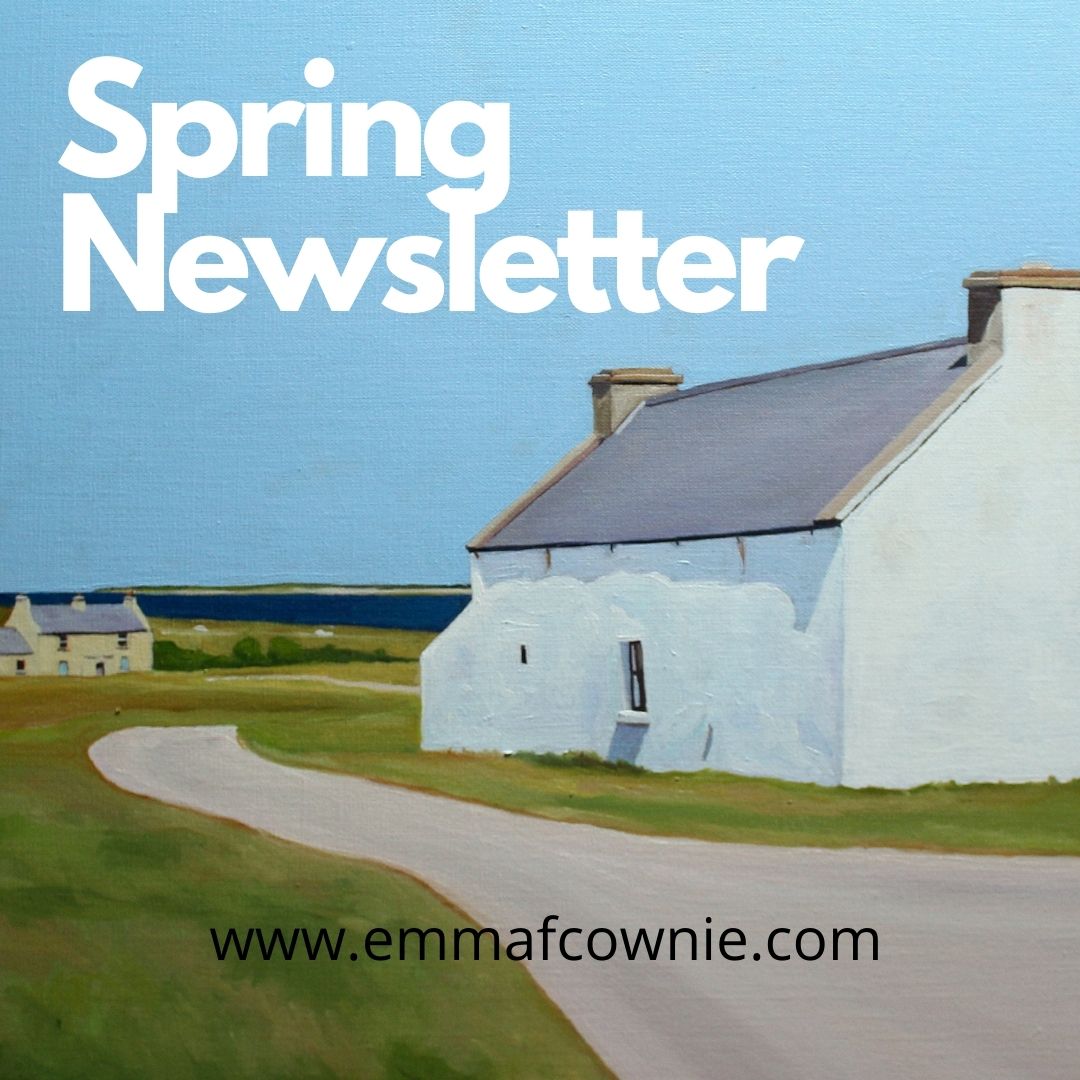
Caravans tucked away on coastal inlets and islands are not an unsual sight in Donegal. I am always impressed by their presence as there are no roads for lorries and it must have taken a good deal of effort and ingenuity to get it there. Getting to have a “Staycation” in 2021 amidst all the uncertainty of vaccine rolls out & third (or is it fourth?) waves looks like it will take an equal amount of effort! So instead join me in imagining the view from the static caravan’s wide window across the rugged terrain of Gola Island on this late spring morning.
The other day, I was walking home from buying bread in my local Co-op, when I spied a ladder reaching across my path. Ladders and solitary magpies usually provoke a struggle in my mind. What to do? Avoid it? There wasn’t much space. I would have to go out of my way to walk under it. There were two mask-less builders nearby too. There was a brief clash of science and superstition in my head but they actually coincided nicely. So I took a route which led me into the middle of the road. I usually salute magpies, but not so anyone sees me doing it. Yes, I am a reluctant believer in (some) superstitions.
My mother isn’t very superstitious; she merrily says “thirteen, lucky for some”. My grandmother, whose family had originally come from rural Bedfordshire, was a fervent believer, though. She’d believed that seeing a chimney sweep would bring luck, she would eagerly race across a road to touch a sailor’s collar for luck (they never minded and apparently they happily grinned at her) and incredibly spat three times if she ever saw a haywagon in urban Cardiff. All are such rare sights today, you can see why they such beliefs have died out, along with the idea that if you dropped a glove it was bad luck to thank the person who picked it up and handed it back to you. Most people are familiar with superstitions surrounding lucky black cats (lucky or unlucky if they cross your path, it varies on where you live), the number thirteen, throwing salt over your left shoulder, avoiding ladders and various numbers of magpies. Maybe less familar is the the belief that if someone going on a journey forgets something, they should not turn back, because if they did, it would bring bad luck. If you were living in an Irish house, up until quite recently however, many more aspects of your daily life in the home would have been guided by these sorts of beliefs.
Piseoga, or superstitions, were ancient customs, some of which probably predate the coming of Christianity to Ireland. The Catholic Church, often incorporated these beliefs and rituals, into their pantheon of saints and feast days; converting magical wells into holy wells and goddesses into female saints. Many fairy “forts” are actually prehistoric burial cairns but thousands more were early medieval ringfort settlements, built during the Christian era, in the 6th-10th centuries. I was interested in this topic, because I was trying to get a better understanding of how the old houses I was painting had been constructed and how they were lived in.
Cappeen Ringfort in Co Cork. Photograph: National Monuments Service
There is an article by the folklorist, Kevin Danaher, called “The Luck of the House” (Published in Ulster Folklife, Volume 16, 1970), but unfortunately, I could not get hold of it. I decided instead to do some research of my own. The folklore accounts below describe these traditions in greater detail and are based on information supplied by schoolchildren to the Irish Folklore Commission in the late 1930s. Fortunately, these accounts are published online and you can read what the school children wrote in their own hand.
People believed in two realms; “This world” which was visible and inhabited by mortals and along side it there coexisted another “other world” where the Sí, or ‘good people’, (na daoine maithe in irish) who lived in an invisible preternatural world. We might call them fairies or part of the fairy host (an slua si in irish). The fairies were believed to be the Tuatha de Danann, one of the first tribes to arrive in Ireland, who had been defeated by the later Milesians. They were believed to inhabit ring forts and old burial grounds and to travel on paths invisible to human. They lived parallel lives to humans: they kept cows; enjoyed whiskey, hurling, Gaelic football, music, singing and dancing; liked gold, milk and tobacco; and hated iron, fire, salt, urine and Christianity. There was lots of evidence of the existence of the sí in the human world including unexplained accidents, spoiled food, poor harvests and ‘bad luck’. Farm produce (especially milk and butter) and farm animals were constantly under threat from fairy activities and various practices and folk magic were necessary to avert interference, throughout the year.
Where (not) and when build your house
In County Leitrim, when a site for a new building had been decided upon, four corner stones were put in place and left for a month. If the stones were “In anyway moved out of the position in which they were placed” it was taken as a sign that the site was on a “fairies pass“, or a path that fairies regularly used.
Brightening Up (Arranmore, Donegal) SOLD
Another location was found for the new house. It was commonly believed that “no one ever interferes with these forts because the old people said it was not right to do anything with them. The old people always said it was not right to cut a tree or take sand or stones out of it because the fairies would follow you for ever and also there would not be any luck in the house for so many years”. In 2017 recurring problems with the Kerry/Cork N22 road were blamed on the fairy forts in the area by a local politician. The British press dubbed this a “fairy curse.”
The Red Roofed House, Arranmore (Private Collection) SOLD
Friday was regarded as a lucky day for beginning some particular sorts of work such as ploughing, sowing or reaping corn, and house-building, or moving into a new house. In Galway, people believed that it was very unlucky, however, to start any special work such as house-building and ploughing, on a Saturday.
How to protect your house
It was common to bury a symbolic object in object within the structure of the house – this is called foundation sacrifice, a practice common throughout the world. The most widely secreted items were horse skulls, it is also
An English florin from the reign of Victoria
known that cooking pots, a cow’s head or a hen’s head have been used. Cats (living ones, I am sad to say) were buried within the foundations. In more recent times a coin (in particular an English florin as it had a cross on it) or a religious medal would be placed in the foundations. In some parts of the country on St Martin’s Day (11th November) it was believed that if “fowl was killed and blood was sprinkled on the four corners of the house and on the door in honour of St Martin, that the house would not suffer any disease.” The blood was also collected and used to make a sign of the cross on the family’s foreheads, again as a protective talisman.
Duchas.ie
Crosses were a very popular talisman used to protect the home and the byre, where the animals were kept. In County Roscommon, people made crosses of straw and rushes. They wove the straw around two sticks which were in the form of a cross. They pegged the crosses which were about six inches long to the roof. These crosses were supposed to keep bad luck from the house.
Brigid’s cross (Image from Wikipedia)
Cross making was often done on saint’s days such as St Patrick’s and Saint Brigid’s. St Brigid was believed to protect the house from the threat of fire. At Christmas, in Co. Limerick. “everyone gathered holly and put some in the cowhouses and in the stables and in every house in the farm-yard”. There were several other crosses hung up on the walls of the bedrooms, they were made from pieces of cloth and timber, and some of them were made from stone. These crosses were meant to bring good luck to the house.
In County Offaly, people made a cross of wet bog mould and left it to dry. “When it is dry they put it in a wooden frame and nail it up to the chimney. This is said to bring luck to the house.” When there is a thunder storm it is the custom to leave a window open on each side of the house and to put the tongs into the centre of the fire. This was said to keep away the dangers of lightning. Archaeologist, Marion Dowd, has discovered that other objects such as prehistoric stone axes would hidden in around houses and farm buildings, as “thunderstones”. These objects were believed to protected the farmstead from the dangers of lightning.
A Late Bronze Age axehead found in 1955 in the wall of a derelict dwelling house in Co. Clare. (Photograph: Marion Dowd)
Another way to protect them home thunderstorms (or rather lighning and fire) was to plant Sempervivum tectorum, also known as the Common Houseleek or St Patricks’ Cabbage, the “forever alive plant of house roofs,” on the roofs. This plant was believed to have the power to protect against lightening, storms, fire, witchcraft and other evils. It was also a useful way to fill a hole, I suppose.
Common Houseleek (Sempervivum tectorum)
The Hearth
The fireplace, or hearth, was in a very real and emotional sense, the heart of the house. There were many sayings about fire such as “when a sod falls from a fire it is a sign of a stranger coming to the house, if the sod that falls from the fire is black the stranger will be dark, but if the sod is red the stranger will be fair.”
Doors, windows and chimneys were points of contact between the human and supernatural worlds. It was widely believed that if a visitor went in one door of a house and out the other he would unknowingly carry away the luck of the house. On New Year’s Eve in Co. Louth, people would up at one o’clock in the morning to open the door to let the old year out and the new year in.
It was commonly believed in many parts of Ireland that if a red haired person came in on New Year’s Day, there would be bad luck in the house until that day twelve month again. If a black haired person came in there would be good luck in the house for that year. Many people, especially northerners and Scots, would recognise this as a form of “First footing“. As a young man, my dark-haired father, used to have to take a lump of coal across the road to Mrs Reece’s (my mother’s mother, and yes, they lived across the road from each other) to perform “First Foot” on New Year’s Day in Cardiff. It was also considered bad luck (and probably downright inconsiderate to those who might be nursing a hangover!) to visit their neighbours’ houses on New Years Day in Louth. In Co. Mayo it was considered wrong to go to bed and fall asleep on New Year’s Day. It was said, if you did you would be “sleeping for the whole year”.
Women wouldn’t sweep the floor away from the hearth to the door. They always swept it up from the door to the hearth because it was believed they might sweep out their good luck. When a family moved house, it was the custom that the broom (and the poor cat) would be left behind. People would not let anyone light their pipe with a coal from the fire while butter churning was going on in the houses. Churning was a common household chore, especially during winter months, and it was surrounded my many rituals and supersitions to prevent the fairies stealing it (there is more about these below). Similarly, coals from the fire were not to be taken out of the house for fear the good luck of the house would go with the person who took them.
Interior of cottage with family. Aran Islands, Co. Galway, c. 1900
On the Bonfire Night it, which was on the 23rd June , the night before St Johns Day. It was the custom in Co. Roscommon that when the Bonfire is quenched to bring some of the ashes into the house, because it is supposed to bring good luck upon the house. It was believed that the family would have “turf in plenty” the year after (turf was commonly burnt on the fire for heating). When a person returned from a funeral at which he helped to carry the coffin, in Roscommon, he put a grain of salt into his mouth and the rest in the fire for fear of having bad luck.
Keeping the house clean
It is believed that if water which feet were washed in was thrown outside the back door on a Saturday night the fairies would put good luck on the house. On May Eve it was customary to remove the bands off the spinning wheel in Co. Roscommon as people believed the “Good People” worked the wheel during the night. They also paid a visit in November, in Co. Sligo, when it was customary to leave the door open, water in the kettle and to clean the hearth because it was believed that the fairies used to come in on this night and if they did not get these things done they would bring bad luck on the house. However, a baby was never left alone in the cradle for fear the fairies would come and take it away!
Dunmore Lane (Private Collection) – Painting of a cottage interior SOLDOn the eve of May day. The people in County Louth gathered may flowers primroses and gorse, and those were thrown on top of the houses and hung in bunches over the door. This was done so as to keep off the fairies who would put bad luck on the house during the year. It was said that was unlucky to bring hawthorn blossoms into the house (I have heard that said too). There was a pink flower called “Burn the house” which is also said to bring ill-luck into the house in Co. Meath. The boor tree, or Elder, is said to be unlucky in Donegal. It was said that “if you burn a branch of boor in the fire you will bleed from the mouth. They say this to keep children from bringing boor tree bushes into their houses”. However, a whitethorn bush was brought to the house in Co. Clare, as it was believed to bring luck to the house for the year.
Animals
A Donkey Shoe
Horse-shoes are regarded as omens of good luck, and so when people found a horse-shoe on the road they always brought it home and hung it up, because it was thought to bring good luck to the house. Donkey shoes were also tied to the back door for luck. A piece of iron, usually a donkey’s shoe, were also put under eggs to bring luck and also help protect birds from being killed in the shells by thunder and lightning. In Co. Roscommon, old people used to hang a horse-shoe before the cows head as it was supposed to bring luck on the house.
Arranmore Donkey, Ireland
In Donegal, it was believed that if a black cat came to a house it brought good luck. If the cat went away again the good luck left with it! If crickets came to a house it was believed that they brought good luck, but like the black cats, if they left the luck left with them being replaced by bad luck. If a cock crowed three times in front of the door of a house in daytime it was said to bring good luck. However, if the cock crowed in the night time, that was a different matter, as it was the sign of a death.
The Sitting (Private Collection)
Cows were never given names except the black cow. It was believed that if you were humming a song when milking a cow, she would give the milk more freely. When people were milking cows, passerby were meant to call out “God bless you“. A visitor to a pig house was similarly meant to say “It’s a fine pig God bless it”. In Co. Sligo, when cattle were taken to the fair on May Day, horse shoe nail was tied onto each animal. “This was done to prevent the fairies from bringing away the cattle.” It was believed that if goats were kept among cattle they helped ward off disease.
When people were “setting” an egg, that is putting it the in a warm environment to hatch or under a broody hen, they nearly always sprinkled holy water on them. The hens were worth watching as their actions could also hint at the future. When hens pecked themselves it was taken as a sign of rain. They must have pecked themselves often! When there was a wisp trailing after a hen’s foot it was believed there would be a funeral. Eggs or fowl were never to be given away without getting some coin usually a penny. Otherwise the luck was bekieved to leave the house. An oft- repeated phrase (which I had had said to me as a child) was, “A whistling woman and a crowing hen they are neither good for God or men”
Tame geese flying directly over a house was believed to bring ill luck to that house. When a robin was seen round the house was meant to be a sign of snow. It was sensibly thought that to strike an animal with a broom brought misfortune. People were also warned against chasing or killing black rabbits as they were actually fairies, or a human being who had been changed to take on that form.
Illion, Arranmore (Private Collection)
Milk and making Butter
There is a proverb that states, a long churning makes bad butter. Milk was not to be given away on May Day. If this happened there would not be much “butter on the milk” for the year. On May Eve the in Co. Clare, the fairies went around looking to steal the farmers’ butter from the dairies. If the fairies saw bread left on the table they would take it and leave sods of turf instead. On May-day, in Co. Clare, it was believed that if a person came into the house when butter was being made, and did not help, it would bring bad luck for the year.
Image 1: Jean François Millet Woman churning butter. Image 2: Ralph Hedley The Butter Churn 1897, wikimedia commons
If a person was seen coming home from a well on May morning with a bottle of water, it was a custom to spill the water and break the bottle, otherwise, farmer would not have butter for the year. In Donegal, to prevent the fairies from stealing the butter, a “certain man” was supposed to go about from house to house with a donkey’s shoe. When the household would be churning this man would put the shoe in the fire, then he would then take it out and put it under the churn. They thought that this practice prevented the (butter) fairies from stealing the butter.
Marriages
In many parts of Ireland, marriages were not “for love”. The bridegroom used to send a man called the Matchmaker to the bride’s house to make a match and to secure a fortune for him. The location of the marriages changed over time in Co. Laois, originally they were performed at home, then in the priests houses, and finally in the church. In Galway it was customary for the the party to be held at the bride’s house before the wedding, in the daytime. Then went to to the church and get married and returned to the groom’s house for a night party, where they used to have a big supper and a dance till morning.
In Galway, the month of May was considered to be unlucky for marriage and also Friday and Saturday of each week. It is considered unlucky (and expensive, I should think) for two members of the same family to marry within the same year. In Kerry no marriages took place in May, August, or September because they were believed to be unlucky months. Marriages do not take place on Mondays, Wednesdays, or Fridays either was they were believed to be unlucky days.
According to Aiden Gallagher, on Arranmore Island, Donegal, most couples got married in the two weeks before Advent and Lent as marriages were not allowed during those two religious periods. Weddings were held late in the evening and it was not unusual to have five or six weddings at the same time. Candles were used in the church – as there was no other form of lighting – and sometimes a sister swapped places when one did not like the match. There was always a big age gap, men would be in their 50s and the woman maybe in her early 20s. “No romance, just business” as he says. The first Sunday in Lent and in Advent was known locally as “Domhnach na smut” the Sunday of the long faces – for those who had not been matched!
In Westmeath, people used to get green rushes and leave them on the table a month before they got married. If the rushes were withered on the day of the wedding it would bring good luck to the house.
Green Rushes
Folklore is really history from the ground up and we can see that people who lived in rural Ireland had a close relationship with the natural (and supernatural) world. This has only been a selection of some of the many stories I came across in the Schools Collection. There were more about Halloween and Christmas that I did not have space for here. Whilst some might regard such supersitions as nonsense, they served a useful purpose in respecting and preserving the past. Sadly, such beliefs that stopped farmers ploughing up fairy forts (aka archaeological sites such as ringforts) are fading and it is not unusual for developers and more often than not, the government, to destroy ancient sites when building new roads. This was the case with Dublin’s orbital motorway the M50 which ploughed through the site of Carrickmines Castle.
Curtuan ringfort cut in half by a motorway. Photograph: Ordinance Survey Ireland
The whole family had their part to play in keeping malevolent forces at bay, and encouaging good fortune, whether it was the wife and daughters in the house, or the farmer and his sons in the fields or byre. In a world where there was much uncertainty and calamity were common occurrances, these folk beliefs helped give people a sense of control and connection with each other, their neighbours as well as the supernatural. That supernatural world included God, and all the angels and the saints as well the “other world” which included the dead and the “good people”. They were full and busy worlds. The understood that the present was deeply rooted in the past and could foreshadow the future. It is important that we do the same and work hard at preserving the past (especially the “fairy forts” and vernacular houses) for future generations. When they are gone they are gone and we will have lost far more than material objects.
An excellent article on the building of vernacular houses and the luck of the house see – Barry O’Reilly, “Hearth and home: the vernacular house in Ireland from c. 1800” Proceedings of the Royal Irish Academy: Archaeology, Culture, History, Literature Vol. 111C, Special Issue: Domestic life in Ireland (2011), pp. 193-215
Here is a short series of paintings based on the shadows in a backlane in Swansea. The photographs I used for these paintings were taken a couple of years ago. I came across them in my folder of printed images and decided I wanted revist my “urban minimal” themes. The light in St Thomas is quite different to that in Brynmill, where I am at the moment. I don’t know if its because the sea is closer to this part of Swansea, or because Kilvey Hill has a particular angle of steepness, but on a sunny day the light is luminescent.
I particularly wanted to used a glazing medium called liquin, to see if I could add depth to my shadows. I first did an under-painting using red ochre and sepia and then used the medium to add colour to shadows.
Back Lane, St Thomas (Swansea)(2021)
As I grew in confidence I used more liquin medium to paint the drying washing on the line and shadows on the stone wall.
Hung Out to Dry (St Thomas, Swansea)
I think the darker shadows were more successful than the lighter ones.
Backlane Basketball (Swansea) 2021
I particularly enjoyed the contrast between the neat house with its clean, fresh drying washing and the apparent ugliness of the rough breeze-block wall in the backlane. This painting is very hard to photograph because of the very light and very dark colours. Some part of it end up too light or too dark! I think I got about right but I am still not happy with the final image. Just a reminder that you need to see a painting in real life to really appreciate it.
Too Dark!
Too Light!
Just right? A Soft Breeze (St Thomas, Swansea) 2021
Last night I dreamt I was making a turquoise green rug. Odd as I have no plans to make a rug.
We have all shifted from being bit-part players in the Hollywood film “Contagion” to being Bill Murray in “Groundhog Day”. Although numbers of new cases have fallen in Wales, Covid is still very close. Our neighbours came down with it two weeks ago. So lockdown still feels very necessary, even if it seems unending. There have been times it has felt unbearable. When my parents’ second Pfizer vaccination was moved from early January to March I was very disappointed. When I read that the Prime Minister’s father, Stanley (who has broken lockdown rules more than once), got his second jab in mid January I was very angry. I had to cook some scones to distract myself from my feelings of anger, fear and frustration. They still haven’t had their second jab. Who knows when our vaccinations will take place. Online calculators predict mid to late April for the first one and then July for the second one. I seems so far away so I try and put it out of my mind and live in the day. It’s not always easy.
During the first lockdown, I couldn’t leave my bedroom, as I had a leg in plaster. Then in the summer, once I was able to get back into my studio, I was kept very busy with a series of painting commissions. I worked on them one after another using other people’s images. I had to squeeze “my own” work in between them. I did not have a lot of time to reflect on what I was painting until now. I haven’t had a commission since before Christmas and this has given me a lot of freedom.
This freedom has also presented quite a few challenges. Lockdown means that I cannot go out and take new photos of Gower, and I definately cannot leave South Wales. I am working from photos taken over a year ago. Some of the images are much older than that. I trawl through my collection again and again, hoping for something to the catch my eye, something that I had previously missed. I recently painted a series of “rural minimal” paintings based on the island of Gola, off the coast of Donegal.
Then I try and forget them as I dont want to copy them. I decide that I need to achieve both simplicity and “depth” in my work. I am not exactly sure how to do this. So I keep painting.
All the time I am thinking and ruminating. I have recently returned executing underpaintings in red ochre and sepia. I have done this before. It’s not a straight forward process. Sometimes, I feel like I have made a small but important breakthrough, and at others I feel like I have hit a dead end. Often I feel like I am hitting my head against a brick wall. It’s like that uncomfortable feeling of boredom, before you think of what to do next.
Sketch of Tenby Harbour from 2019 using red ochre and sepia paint
Boredom and forced inactivity is very good for creativity, so long as you put away your phone. Scrolling isn’t good for creativity. It seems that in the absence of stimulation the brain will fill in the gaps for you. Maybe brain was keeping me busy by making a rug in my dreams? People with something called Charles Bonnet Syndrome, which involves visual hallucinations for people who have lost their sight, have had worsening symptoms during the pandemic. Not so good.
I also read this week that scientists believe that about 42,000 years ago the earth’s magnetic poles flipped and flipped back again. This event is known as the “Laschamps excursion”. It had a catastrophic effect on earth as the protective shield magnetic fields, which usually provide protection against damaging cosmic radiation, was disrupted. This resulted in huge electrical storms, widespread auroras, and lots of cosmic radiation. It possibly also played a role in a major events ranging from the extinction of Australian megafauna, accelarating the growth of ice sheets, shifted rain belts and helped bring about an end to the Neanderthals!
Researchers have called this danger period the ‘Adams Transitional Geomagnetic Event’, or ‘Adams Event’ for short – a tribute to science fiction writer Douglas Adams, who wrote in The Hitchhiker’s Guide to the Galaxy that ’42’ (i.i. 42,000 years ago in this case) was the answer to life, the universe, and everything.
Why? Because out of this apocalyptic era came the emergence of red ochre handprints left on cave walls in places like modern day Spain, France and Argentina. Red ochre – the same pigment I use for my underpaintings.
Red Ochre
It has been suggested that humans may have used the pigment as a sunscreen against the increased levels of ultraviolet radiation hitting the Earth as a result of the depletion of ozone. The ancient greeks and romans used kohl eyeliner for a similar reason, although the ancient Egyptians used it for fashion purposes too.
Kohl Eyeliner – Not just fashionable!
There seems to have been an increasing use of caves between about 42,000 and 40,000 years ago. This was possibly as shelter from the more intense sun. We know that something important happened around the same time, as there was a surge in figurative artworks, including cave paintings, rock sculptures, and bone, antler and ivory carvings that date from this period.
Swimming Reindeer carving
It has previously been argued that this was due to a change in the human brain (listen to the episode on the Swimming Reindeer carving in the BBC’s series History of the World in 100 objects) but it may well have been that stone age people experienced a form of lockdown sheltering in their caves from the extreme sun.
Paleolithic Art in the Roucadour cave
Perhaps they were already doing these things but now left tangible evidence of it amongst the rocks. Not only did they decorate these places, they also made music and no doubt held ceremonies (or maybe parties) ate, had sex, and left carvings. The time in the caves probably helped bind communities. I am quite envious of the face-to-face socialising they must have had. It may well be that Neanderthals and humans also got it together in the caves as suggested by a jaw bone of part human/neanderthal ancestry that has been found in a Romanian cave, dating from this period. Afterall, a tiny percentage (1.5 to 2.1) of Neanderthal-inherited genetic material is found in all non-African people.
(Image credit: The University of Tübingen) Flute made from vulture bone
It seems very odd to ask if lockdown can be good for us. Obviously it’s good for our physical health, reducing the levels of covid and deaths in our communities, whilst we wait to be vaccinated. It has undoubtedly done a lot of damage to people’s mental health, not to mention their waistlines. It has ruined a lot of businesses that rely on social interactions. Many people have really struggled with the limitations of life, my parents have not been in a shop since last March. Many people have also struggled with being forced-fed a daily diet of fear by news bulletins. Young people in particular have sufffered during a lockdown that largely protects their elders, not their peers. It can have an upside for creativity. I suspect, however, that that thousands of books, essays, diaries, plays, sketches, paintings, songs, pies, cakes, puzzles, X-box games and even rugs (turquoise or otherwise) have been written, draw, painted, made, read, eaten and listened to during this lockdown. It has been suggested that Shakespeare may well have written Macbeth and then King Lear in plague quarantine. After the boredom and frustration comes creativity.
My work recently has undergone two small but important shifts in focus.
The first is a compositional one.
I have decided to revisit some of the “rules” I first used in 2017 when painting my Welsh “Urban Minimal” paintings (see my paintings for my exhibition in the Cardiff MadeinRoath festival here).
My “rules” for composition and painting this project were:- no cars, no people, bright light. There must be shadows – at diagonals if possible and simplified forms – there must be as little detail as possible. I want to explore the interplay of the geometry of shadows and man-made structures – the tension between the 3D buildings and the 2D shadows. Simplified blocks of colour.
A Selection of my “Urban Minimal” Paintings
I later extended these “rules” to painting the villages of Gower, labelling them (half jokingly) “Rural Miminal” (read more here).
Lately, I have been reflecting on my recent body of work and have realised that many of these ideas got lost in the heady excitment of exploring the new landscape (and skies) of Donegal. Also much of my energy got diverted into recovering from my operation and subsequent recovery after I broke my leg/ankle. I spent several months painting watercolours in my bedroom (as I could not reach my oil paints in the attic)and that led me to think more about composition and simplifying forms.
Watercolour of houses on Gola Island
When I finally made it back to my easel, I could only manage short bursts of paintings so I focused on smaller pieces. The clear blue skies outside my window in Wales may well have influenced my fascination with the weather back in Donegal. Note that my use of colour has changed, they have softened, become more subtle. That’s because both the light and the landscape in Donegal is quite different to Wales. It’s also because I was observing more carefully.
Clouds of Donegal
This brings me on to my second shift. Colour. I was always aware that I played around with colour, brightened them just a little, to create cheerful and vibrant works. For many years I painted cheerful paintings when I, myself, was anything but.
Bright and Cheery!
Painting saved my sanity after a breakdown and going back to a teaching job that I found stressful. The bright colours were a bit of an emotional crutch, perhaps? I am not sure. They may have also been a result of hastiness/laziness, over-confidence with a dash of insecurity.
My Colour Wheel
But change has been coming for a while. I was aware that I sometimes struggled with getting the colour of distant mountains correct. Often the problem lay in the fact that some of my colours were too strong and they needed softening.
I read somewhere that distant colours needed not blue or purple added into in them (as I had thought) but it’s complementary colour. That’s the colour’s opposite number on the colour wheel.
I bought a colour wheel to try and perfect those muted tones and watched a few videos on painting about tone and value. They didn’t really hit home with me. My colour wheel did not have brown on it, I noticed. I had to look for another one.
My distant hills improved. I held my paint brush up close to reference image more often before I placed it on the canvas. I used to only do that occassionally. Now I was trying to do it all the time. Work was slower as I thought and carefully considered my colours.
Tormore Island from Rosbeg, Donegal (SOLD)
I saw a video that reinforced this growing fixation with getting colours exactly right. I saw a video on artist Mitchell Johnson’s Instagram Stories feed. I don’t know who made the video, otherwise I would include it here. I watched many times. Why was watching this clip so fascinating? I was getting excited about watching paint dry!
The tutor had three pieces of coloured card and he mixed the same exact shades of paint so that the paint seemingly “vanished” into the card. The cards were an acidic green, greyish blue and bluish grey. The colour combination he mixed were fascinating as he added colours that I thought were not going work and yet in the end they did (often a dab of orange did the trick). I noticed that he was using a small pallette knife to do the mixing. I ordered some palette knives to mix my paint with too. I have found that I can mix a larger quantity of paint. It means that the colour remains consistent.
The tutor made the comment that his students often asked him “Isn’t this close enough? Will this do?”. “No” he said. That sunk home. I knew I was guilty of thinking “This will do”. No more.
So I set to combining these two “shifts” in thought. The return to simplified forms and the focus on naturalistic/realistic colours.
My first effort was a large painting of the townland of Maghery in Donegal. One or two houses in the middle distant were edited out to simplify the composition. We decided to call this “The Polite houses of Maghery” because they have all been built looking away from each other! My husband says he finds this painting very calming.
The Polite Houses of Maghery – Emma Cownie
I then revisited Gola Island to simplify my compositions futher. I had to resist the impulse the darken the shadows; to strengthen the colour of the pale pink sky, to add lots of yellow and bright greens to the grass. I think the result is also calming. It is ever so less frantic and a bit more chilled than my previous paintings of the island. There are still details, in the tiny reflections and pools of light on the doors and sills. You cannot have colour without light.
Traditional Two-storey House, (Gola)
The Dusty Road (Gola), Donegal, Ireland
I suspect that these paintings better reflect my post-broken-leg state of mind. I go every where slowly and carefully (at the pace of a tortoise, according to my husband). I look at the ground to ensure that I do not trip. I gave up drinking coffee and caffeinated tea to reduce my swollen ankle so I am no longer pepped up on caffeine either. I always am mindful of where my feet are. I am now mindful of my colours too! Slowing down has helped me see colours better.
There are still many challenges to be solved. How will I include clouds in my rural miminal paintings? Will this approach work on a overcast day? Those are problems for another day!
We are in the midst of lockdown in Wales, the schools are shut and the good news is that the covid numbers are falling. They need to fall a lot further because when the schools and the university students come back they will shoot up again. I had in a mind a longer blog post, but I find that after I have got up, done my yoga/ankle exercises and painted in the morning light, that I am too tired for much else. That post will have to wait a little longer.
So I have decided to show you my most recent work. I have been painting Tenby, which I can only visit in my imagination.Tenby is a harbour town and resort in southwest Wales. It’s known for its 13th-century town walls and its stretches of sandy shoreline, including Castle Beach.
I have been working on a triptych (which is three paintings) but I have only finished two of them, so its a diptych (two)! I will add the third one when I have completed it. I was trying to find unusual angles to paint. As much as I love painting Tenby and its colouful houses and boats, I need a fresh angle to present my brain with a new set of challenges to solve. This first painting, the challenge lay in how to paint the headland off in the distance and balnce it with the very dark shaows in the foreground. In the end I simplified the details and make sure that the tone was cool with warm grey and mauve. I was particularly pleased with the shadows on the beach and the blue house.
Out of the Tenby Shadows
My second painting is a view of the pier or quay from Castle Hill. This is a headland on which the ruins of Tenby Castle overlook the harbour. I liked the fact that this was the “underside” of the view we usually see of the harbour. The pier is a working pier as can be seen from the lobster pots stacked at the far end. It’s also where the Caldey Island boat picks up supplies for the islanders and the abbey every day (so long as the wind is not from the South West or over 20mph). Apparently royal mail has continued to visit throughout the pandemic, so that the monastery shop has been able to continue to operate. The boat that takes visitors to the island leaves from Castle Beach round the corner. The island is usually open from Easter to September for visitors, I don’t know whether that happended this year. A visit to Caldey in the boat was a pretty outdoor affair in ordinary times, so maybe they will start again in the summer, who knows.
Tenby Pier, Wales (Sold)
I will add my third painting when I have completed it.
Update:Here’s the third and final painting of the three.
We are all glad to see the back of 2020 but I am pausing for a moment to reflect on some of my painting sales over the year. Sadly, my accident and having my leg in a cast meant that I couldn’t get up the steep stairs to my attic studio (or anywhere else) to paint any oil paintings for over three months but things have ticked over during 2020.
I would like to say thank you Rob and David who waited a very long time in the cold with me for the ambulance to come, to the paramedics and firebrigade who got me out of the woods, to NHS staff at Morriston who fixed my very broken leg and looked after me, as well as to the Physical Therapists who gave me lots of advice on exercises over the phone. I still have a way to go!
I have to say an absolutely massive thank you to my brillant husband, Séamas, who trudged up and down two flights of stairs with trays of food many times a day (and lost weight doing so) for months. He kept my spirits up when I got frustrated and tearful. It wasn’t that often as I was so glad to be home but it was all hard work for him in the midst of a pandemic! He also kept the show on the road by packing up and arranging the shipping my paintings. He was, and remains, utterly wonderful!
Here’s a selection of some of my sales from 2020
Some of my “people” paintings sold in 2020
Some of my paintings of Wales sold in 2020
Some of my paintings of Ireland sold in 2020
A Selection of Commissions from 2020
My top four personal favourites of 2020
Owey in Late Spring – Top of my personal favorites of 2020!
Here’s to a happier and healthier 2021 to everyone!
It’s been a really tough year (breaking my leg an’ all) but the wierd thing is that it has been an incredibly tough for everyone. Thank you all for your support. It has really made a difference. I really appreciate the comments and “likes”, and even the people who read my posts and never leave a trace (except in my stats)!
My leg and ankle are recovering from my accident this springand although I can walk a faster than I used to, I still cannot walk long distances which means that a lot of my favourite Gower walks are off limits to me. I find staying indoor too much isn’t good for my mental health (especially during the Pandemic) and it is vital to get out and see different places nearby. Fresh air is good for the soul, the mind and more importantly it blows away the virus!
This blog is about a very short road trip around parts of the Penrice estate down to Oxwich Bay we did this week. My husband drove and I took the photographs. Penrice Castle was built by the Mansel Talbots. They were one of the most powerful families in South Wales and certainly one of its biggest resident landowners and MPs for Glamorgan in the Victorian era. The “new” Castle at Penrice was built by Thomas Mansel Talbot in the 1770s, as an alternative residence to the rambling old house at Margam. Thomas, who had travelled to Euope and considered himself a man of great taste had a neo-classical villa built. He also had the land around the house landscaped and a park laid out to improve the romantic scenery that had first attracted him to the place. His son, Christopher Rice Mansel Talbot, who was born at Penrice in 1803, modernised the old Aberavon Port and renamed it (modestly) Port Talbot as an industrial hub for South Wales. The house at Margam was also pulled down and a new mansion was built there between 1827 and 1830 near the ruins of the old abbey.
I will the road trip start with a map. All road trips need a map. There is an excellent map of Gower at Mapsta here. Our trip starts at the top left hand side of the map where a lane turns a sharp left from the A4118 road down a narrow single track lane. A word of warning if you fancy this road trip. This is not a trip for a large vehicle. Most of the lanes are single track and are very narrow. We spent most of it praying that we did not meet any thing coming the other way, and we drive a tiny Kia, as it would have possibly meant a ggod deal of reversing! Thankfully we didn’t.
Penrice Loop #1
.
Home Farm Penrice (SOLD)Down long narrow lanes past a parking spot for a woodland walk at Mountybank (see estate map)Map of the Penrice EstateUp a steep and winding lane past Penrice VillagePenrice, GowerAlong wet and winding lanes past Pitt FarmThe road then bends and drops back down towards Oxwich VillageWe past a series of sturdy cottages and then turn left at the junction in Oxwich
The carpark is free in the winter during the week (possibly only during pandemics)This morning’s heavy rain has left puddles everywhere but there’s still a beautiful view across the bay to Great Tor and Three Cliffs
We saw people. There were not too many but enough to watch. There was even a small wedding party having their photos taken on the beach off in the distance. It was heartening to see people managing to commit to a future together come what may! It must have been next to impossible planning their day as we have had a national lockdown, a local lockdowns and a mini-firebreak and there are rumours of another lockdown after Christmas.
A wedding party off in the distanceCan you see them now?
On the way back home, we continue anti-clockwise on our loop back up a steep hill to the main road past Underhill Cottage. It was originally the Head Gamekeeper’s cottage. It has a lovely, sunny position overlooking the beautiful Oxwich Marsh and the sea with Nicholaston Woods behind. These days it is a holiday cottage. It is possibly one of the few sorts of holidays you could be confident of not getting cancelled these days (if you live locally, that is).
Underhill Cottage (Oxwich, Gower) SOLD
Buy my book “Footnotes: An Artist’s Walk around the Gower Coast” here
We are back in South Wales and have been getting out and about taking photos, especially with a drone. This will help enhance composition in my landscape paintings of the Gower Peninsula.
It was freezing cold but the birds were very busy. There is a sign near by asking people not to feed the birds but the locals take no notice (note the bird feeder). I am glad because I loved watching the birds, especially the tiny coaltits. My camera work isn’t much good but at least you know its real and AI generated slop.