I love looking at maps and finding out the names of places. This is particularly true of the islands that litter the coast of West Donegal near the Rosses. I am always asking my husband, what island is that? He’s usually pretty good at knowing the names (I check on a paper map later). In the summer I spotted a house on a tiny slip of an island to the south of Arranmore. Can you see it in this photograph below?
View from Arranmore
Closer. See it now?
Inishkeeragh
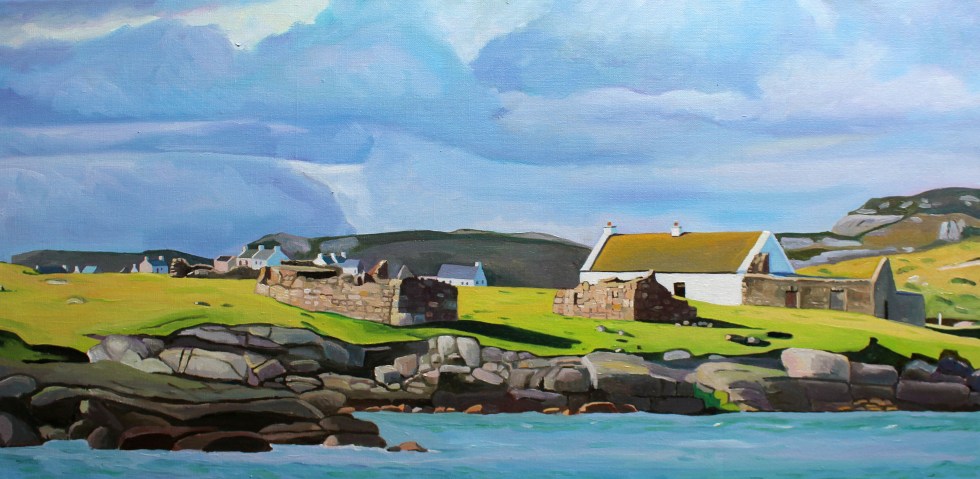
I thought it was just one lone house (was that another house at the other end of the island, maybe?). What glorious solitude! What must it be like to stay on that island all with the spray of the sea so close looking at big Arranmore? This is my painting of the island. I was curious about the feint outlines of ruined houses I could see either side of the restored summer house. I wondered about them and their families.
Over to Inishkeeragh (SOLD)Map of Inishkeeragh (Google)
This is Iniskeeragh. Ireland (like Wales) is rich in descriptive place names. They usually describe are named after features of the landscape, such as hills, rocks, valleys, lakes, islands, and harbours. In Irish, its name is “Inis Caorach” which means “Sheep or Ewe Island”. So either sheep were kept on the island (it seems pretty small for that) or its a shape reminded people of a ewe, which might be more likely?
Inishkeeragh (Google)
After some research (online and in books) back home I discovered that the island had at least 12 families living there permanently, it also had a schoolhouse. I find this incredible for such a small, lowing lying island. It’s 650m x 300m (2132ft x 984ft) in size. I tried to work that out in football pitches. It’s the equivalent to 40 football pitches, so maybe its not as tiny as I think. It is very low. It’s no higher than 11 feet above sea level. Yet you can read their names in the 1901 census here. The family names of the farming families are familiar Donegal ones: Gallagher, Boyle, Sweeney, Rodgers, O’Donnell and a sole Bonner, Grace (35) who was listed in the census as a knitter, she was one of only 2 knitters on the island.
Ruins on Inishkeeragh:- Photo credit Roger Curry
These Donegal islands may seem remote to modern eyes, but they played their part in the culture and history of modern Ireland. Gola Island, Gweedore, may well have served as the model for Robert Louis Stevenson’s Treasure Island. Two men from Gola, Patrick McGinley and Charles Duggan, were aboard the Asgard, the yacht that brought arms into Howth in north county Dublin in 1914, in preparation for the Easter Rising of 1916. Tiny Inishkeeargh also had its connection with the wider world. Writer and political activist Peadar O’Donnell (1893-1986) was a for a time teacher’s assistant at the school on the island and he set his second novel, The Islanders, here. Peadar went on to become one of Ireland’s foremost radicals of the 20th-century.
School House:- Photo credit Roger Curry
Life was tough on the island. Roise Rua described her work on the island kelp-making as “tedious and exhausting”. The tenants had to pay rent of £50: £26 for the use of the land and £24 for the use of the seashore – making kelp, picking winkles or shellfish, dulse and the like.” Sadly, like many other Donegal island communities, such as Owey and Gola, the people of Inishkeeragh was forced to relocate to the mainland in the 1950s.
Inishkeeragh Village:- Photo credit Roger Curry
Sea levels played a big part as at least twice in the twentieth century an exceptionally high tide coinciding with a bad gale forced the islands to take refuge in the two houses that had lofts. They apparently spent hours “in terror, fearing the overloaded floors would collapse.” A storm in 1953 washed away the pier and the government of the day would not pay for it to be repaired. This meant that subsequent storms swept through the houses and within 5 years all the families were forced to leave the island.
Inishkeeragh – Photo Credit: Roger Curry
There was a reunion of Inishkeeragh families and their descendants in 2015 on the island. Internationally renowned Country singer, Daniel O’Donnell, was part of the celebrations (his mother was born on nearby, Owey Island).
Daniel O’Donnell and the Inishkeeragh Reunion
You can see the photos of the day on their facebook page here. You can visit the island with Arranmore Charters, be sure to book beforehand.
Addition sources for Inishkeeragh (Inis Caorachin) came from:
I had been trying to finish it but the weather and the light were so bad here in Wales over the weekend, I had to leave it until Monday. I struggle to see greens in poor light and as the grass at the bottom of the painting was so important to the success of the image, I decided to wait until I could see it.
It was a year ago that I painted my first painting of Donegal. Here it is. It is a small one.
Old School, Owey Island
It’s quite a modest painting. You could say that I started off tentatively. I was feeling my way. The light in Donegal is very clear and the scenery is beautiful. That’s an overused word in this age of social media, but it is beautiful.
My husband, Seamas (he likes counting things) tells me that I have painted over 50 Donegal paintings (including 3 commissions). That pretty much averages out at one a week. I am pleased to say that I have already sold over half of them.
I discovered that I had to use a different palette from the one that I use in Wales. The greens and yellows were more yellow ochre than lemon yellow and the sea was more turquoise (but not quite as turquoise as I first painted) thanks to the clear water.
On The Way To Arranmore
From Ferry Coll SOLD
Over to Owey Island, West Donegal, Ireland
I loved the rocky landscape of the Rosses. It was a landscape like no other I’d seen before. Someone has said to me that it’s quite alien, like a moonscape in places. I love the granite rocks. We have a massive one behind our cottage in Donegal. I feel very affectionate towards it. It’s a protective presence, especially when it’s windy.
Over to Tullyillion
Of course, when you are in a different country to the one you were brought up in, everything seems fascinating. I have loved painting both the modern Donegal houses as well as the old cottages.
From Cruit Island
Over to the Rosses
House by the Wild Red Flowers (Arranmore)
I will freely admit I am quite obsessed by landscape spotted with old cottages on the Donegal islands, on Arranmore and Gola in particular.
Spring Light on Gola
Across to Inishbofin
This Beauty That will Pass
A House on Gola
Up From the Pier (Gola)
Oileán Ghabhla (Donegal)
Around Cloughcor (Arranmore)
Cottage on Inishcoo
On Eighter Island
The Red Roofed House, Arranmore (Private Collection)
I haven’t really got to grips with the mountains of Donegal. What I mean is that I need to visit them a lot more, walk up them and get to know them better. So far I have just admired the “Seven Sisters”, including Mount Errigal and Muckish from a distance.
Across to Dunfanaghy
Mount Errigal from Ballymanus Beach, Donegal
Over to Kinclassagh
The Pig’s Back (Muckish) Donegal
Swirling Clouds Round Errigal
Of course, the real joy of Donegal is the clouds. The changes skies. I am used to it raining, (I have lived in Wales for over 25 years) but the light is different by the North Atlantic Ocean. It is often more slivery, and more changeable.
From Magheraclogher Beach (Bunbeg)
Near Dunmore Strand
Rain over Dunfanaghy
Two Cottages
I think about Donegal every day when I am in Wales. My husband will place his current favourite Donegal paintings in the bedroom and in the lounge so he can look at them whilst we still have them.
Here’s my most recent painting Donegal painting. I am currently working on a painting of Arranmore Island, unfortunately, it rained so much here yesterday, the light went and I have yet to finish it.
Back Road to Burtonport
Commissions are usually pretty interesting because they will challenge me in some way or another. This particular commission’s challenge was about scale. Now, I don’t usually paint large paintings because I just don’t have the space to store many of them. I have a few but I am not keen to paint many more as and I find it difficult to paint in a crowded attic studio, both on a practical level (if you look at my photos carefully you can see its crowded in my studio) and also psychologically (it starts to bug me). So if a commission requires me to go large I am quite excited by that prospect. Excited and a bit scared.
This commission was based on a relatively modest-sized painting I had recently painted of Gola Island, Donegal. This is 41x33cm, that’s 16 x 13 inches for non-metric people.
Up from the Pier (Gola)
As you can see from the studio photo, the original fits on the seat of a chair. It is a favourite of mine. I have many favourite paintings, this is my current one.
The commission canvas size was to be 120 x 80cm (47×32 inches). Which is pretty big for my little studio. The canvas I could cope with, but the cardboard box it was arrived in is annoying me as it’s ended up by the railings by the steps to the attic. It’s in my way.
So I pondered the issues with scaling up this painting. The joy of small paintings is that you can hint at all sorts of things with a brushstroke or two and the brain will do the rest of the work. There’s no hiding place when the canvas is over a metre in size.
Up from the Pier (in-studio)
So the first change in my approach was scale. I printed out my reference photo on a much larger piece of paper. My original photo wasn’t much bigger than 10cm (4 inches) square. Don’t ask me why. I like to print off a lot of images at one time and then ponder which one I want to actually paint. For the commission, the photo was closer to A4 size (7×11 inches) and amazingly, I could see much more detail! So I focused a lot of attention on the buildings and caravan on the horizon. I paint with a small brush get the details of the light on the houses and ruins.
Sketching out the commission
I generally work from left to right when I am painting so as not to smudge work with my hand and the next part I worked on were the rocks and the grassy verge to the left of the track. The real joy of painting vegetation in Donegal is the many varied greens and yellows. I love picking out the different hues. I have to make sure that my colours match the colours in the reference photo as closely as possible. It sounds daft, but I hold up the paintbrush next to the photo to check I have the right tones.
The grass and bracken in the main part of the painting were carefully reconstructed. Saying that I use much larger brushes than I do for my smaller paintings. I make sure that blocks of yellow ochres and green grass or darker bracken are in the right place. There are both warm and cool greens here. There are splashes and smudges of oranges, pinks, jade and turquoise in there too. I am trying to convey not only colour but the shape of undulating land; where the grass has grown up and in some places, covered completely the old stone walls. The island is covered in lots of wooden fence posts, but I don’t want to paint in all the wires as the eye wouldn’t see them all in that much detail so I pick out just a few of them. I wanted to recreate the spirit of the smaller painting rather than create a new painting so I have to adjust a few patches of grass, on the left-hand side of the painting, so their bluish tones echo the first painting and balance the colours in the whole. The tiny golden yellow flowers that are gathered at the bend in the pinkish track are added.
The sky is painted last. Sometimes I paint skies first, especially if it is a cloudy or stormy sky, but in this case, it’s a blue powdery summer blue and it comes last. It has the effect of bringing the whole painting together.
The commission next to the study painting of Gola
So the final stage is to sit with the painting and check that it has the same “vibe” as the smaller study painting. I think it has. I regard it as a big beast, but one I like.
I wonder what it would be like to have a massive studio where you could store bigger paintings? Would I paint larger paintings? Well, in the winter when light is short I would still paint smaller works that could be completed relatively quickly, but in the summer months when I have acres of daylight? You bet.
The artist (*ahem*) with the two paintingsThe Commission piece finished 120x80cm
The ferry to Tory Island runs all year round. In the summer months (June onwards) there are extra sailings. We had decided to get an early boat as Seamas, my husband said the weather forecast was for sunshine in the morning, cloudy around midday and then sunshine in the afternoon. I think we are learning to take weather forecasts for Donegal with a pinch of salt. Some forecasts for “cloudy” days translate into blue skies with a few clouds, others into a damp drizzle. We were optimistic but when we arrived at Magheroarty Pier it was overcast. Once we had parked in the generously sized car park, we had to hurry to get the boat. Magheroarty Pier is tidal, so sailings have to leave on time, time and tide wait for no man, etc.
Car at Magheroarty (Muckish Mountain in distance)
We were not quite the last people on the boat but all the downstairs seat were full so we stood on the top deck, me leaning against the body of the ship and Seamas found a large metal box to sit on, the dogs sat close to him. We could feel the movement of the boat as soon as the ferry left the shelter of the harbor at Magherorarty and at times we had to hang onto a metal grill that housed a lifeboat ring.
Queen of Aran – Ferry to Tory
Two men who were standing nearby to us were talking to each other in Irish. Tory Island is probably the strongest Irish-speaking area in the country. It sounded a bit like a Scandinavian language at times – a third Irish speaker stood to one side, listening. They each looked very different from each other in appearance, one was very blonde, one was dark-haired and the third had white hair. The dark-haired man had freckles and light eyes. It is a “look” I have seen a lot in Donegal, Seamas says it’s common in County Derry too.
Map of Tory Island
The trip took just under an hour. The motion of the boat made me feel quite ill by the time we reached firm land. I think being on the top deck made me feel the motion of the baot more than if I have been on the lower deck. It took me at least 30 minutes to shake the feeling of a dodgy stomach. Someone, later asked if we had felt ill on the crossing, and laughed when I said I had. It’s not unknown.
One of the tors of Tory Island
Tory Island lies 8 miles off the coast of Donegal. The origin of the name of Tory Island (Oileán Thoraí in Irish), isn’t universally agreed on. Yes, the word Tory may come from from the Middle Irish word tóraidhe; modern Irish tóraí; meaning a robber or bandit. Ever wondered why one of the oldest British political parties, the Conservatives, are also known as the “Tories”? The term was originally a term of abuse and meant “an Irish rebel”. The insult goes back to the era of Oliver Cromwell’s brutal campaign in Ireland when a band of Irish guerilla fighters was known as Tories.
Another explanation for the name, however, is that it may mean the “island of Tors”. The shape of the island from a distance is a tower, and its northern coastline is peppered with massive tors. This seems just as likely. I suspect that people, however, prefer the story of the name meaning Pirate Island instead of the Island of Tors as it’s more exciting. The remote location of the island has meant that the islanders have had (and continue) to rely on their ingenuity and resourcefulness.
An Baile Thiar
They have lived on the margins of the so-called “civilized world” and kept to their own rules and customs, which were not necessarily those of the mainland. Famously they refused had fallen behind with their rents and rates and a British gunboat, HMS Wasp, was sent in 1884 to forcibly collect the arrears and evict the tenants. Luckily for Tory, it hit a reef near the island and sank rapidly (not so good for the 52 who died). The locals put this stroke of fortune to the power of their cursing stone! This event is one of many Donegal stories about the spooky powers of Tory Island. You can read more in the National Folklore Collection UCD Digitization Project.
One custom that marks Tory as different from Ireland is that they have a king. It’s not a hereditary position, rather one chosen by consensus as a leftover from the days of Gaelic chieftains. Patsy Dan was asked to become king by the children of the previous king Padraig Og Rodgers in the 1990s.
King of Tory (from Wikipedia)
He was a talented musician and painter and acted as a very successful ambassador for the island. At a young age, he had befriended English artist Derek Hill, who regularly painted on Tory and he helped set up a gallery on Tory, where island artists sell their work. He was clearly an energetic man, as was known for personally greeting all the visitors to the island as the ferry arrived from the mainland. He apparently made a point of shaking hands with visitors and saying “Welcome to my island.”
Sadly, Patsy Dan Rodger, died last year and now rests in the churchyard. I saw his grave decorated a wooden cross and with stones around it. I did not take a photo because it felt like it would be an intrusion on the island’s grief. The island is without a king for the time being.
The island itself is a strange mix of very old and modern. People have lived here for over 4500 years. There are a few old cars and vans driving back from the harbour after picking up stuff at the pier.
Tory feels a long way from the mainland, although you can see the coast of mainland Donegal when the weather is clear. It is less than 2 miles long and only half a mile wide. My overwhelming first impression (once the cars and vans had driven off) and we had walked out of the tiny West Town (An Baile Thiar) was of birdsong.
Sparrows, larks and other moorland birds just singing their hearts out. The landscape is full of bold little brown birds, pipits and larks. Some of them even come near to you and sing, possibly as a challenge. We walked along a single tracked road eastward towards the other settlement or “clachan” on the island. We passed a Second World War torpedo that had been painted bright red and erected by the side of the road.
Tory Island (mainland Donegal in the distance)
I marveled at the ground on Tory. To the south of the road, it seemed to be a dried bog and the north it was very stony ground, reminding me of a hardcore carpark. How had anyone, let alone over 200 (at one point it rose to 400) islanders managed to eek a living from such a tough terrain? I have looked at the small stony fields in Galway and thought how tough life must have been for the farmers, but this was much worse. The potato was a versatile crop and remarkably the blight that brought the Great Hunger to mainland Donegal, did not reach the island. Of course, the Tory islanders did not live from farming alone, they were also fishermen and brewers of poitin whiskey.
There was a group of German tourists ahead of us (they all seemed to be wearing blue jackets for some reason). They veered off the road to the left towards what looks like a dip in the earth. We followed them, so see what they have gone to look at and discover that is a massive hole with a cave down to the sea. I would not have guessed this was here from the road.
Cave to the sea
We carried on up to the northern edge of the island. What a view! I am not good with heights as the best of times and I felt quite ill looking over the edge. I lay down on the grass to take photos. The reddish cliffs and cream coloured sea stacks were stunning.
Tory Island Sea Stack Tory Island
We spent a lot of time walking along the cliffs and back again, taking in the views.
North Coast of Tory Island
There were sea birds flying and squawking. Lots of gulls and razorbills and one lone puffin to be seen. The birds of Tory are the highlight of the visit for me.
We then find the weather has closed in on us. We could see the mist and cloud descending on the lighthouse to the west of us, at the other end of the island. I’d foolishly hoped it would stay on that side of the island!
On the island, weather changes from moment to moment. I am reminded of the sign outside Derek Hill‘s house warning that “Winter weather can happen at any time in Donegal”. Yes, it can.
Mainland Donegal has vanished in a cloud of rain. We get increasingly damp, but not quite soaked through. There’s no shelter anywhere. No trees. No bus shelters (what an utterly daft idea, here). We have a lively discussion about the conditions (I keep thinking of that weather forecast of sunshine in the afternoon) and I optimistically suggest that it will pass soon enough. I am encouraged by the fact that the group of German visitors (off in the distance) haven’t given up and are scaling the heights of Ardil Iril, and are looking over the cliff. So we carry on and by the time we reach Port an Duin, which has a small concrete pier, the rain has halted.
Old winding gear at Port an Duin
We sit down on some rocks and eat our sandwiches and crisps. The dogs get some too and a drink of water from their bowl that I am carrying. The weather brightens up considerably as we climb up to the highest part of Tory. This is Dun Bhaloir (Balor’s Fort), which is an early Iron Age Fort, which is covered in piles of massive rocks, which were part of the defenses. Balor apparently was a fearsome cyclops warlord who could kill a man dead with a single glance of his evil eye!
On Dun Bhaloir, Tory
From here we can get a view of the rest of the island snaking off to the west. It has brightened up now and we take off our coats. The dogs are getting hot and panting.
Tory Island From Dun Bhaloir
There’s a discussion about the return time of the ferry as Seamas’s smartphone has died (and I don’t have one). We’d asked about the times when we got off the ferry but after the long walk we aren’t sure of what we were told, was it 2.30 or 3.30? We could see the ferry heading back to the mainland at 1.30 so I reason that it will be at least 2 hours before it returns. However, we would easily be able to see it returning so we would just need to keep an eye out for it. So we started plodding back to An Baile Thiar and the pier. We were all very tired now. So we start the walk back to the harbour in An Baile Thiar.
Bench on Tory Home maintenance on Tory
We made it back to An Che (the pier) and could see the approaching ferry in plenty of time. I got some extra water for the dogs from a tap in the parish hall. This time we got seats on the ferry so I don’t feel queasy on the journey back. The German tourists are also on the ferry.
As we were coming towards Magharoarty harbor, three dolphins surprise us all appearing in the sea alongside the ferry. I saw a flash of strong blue-grey bodies and then the three of them arching in and out the water behind the ferry. All the passengers on the boat were very excited (as was I). These are my first wild Donegal dolphins. I spend a long time looking at my photos afterward, reliving the experience. I wish the photos were better.
Three dolphins from a distance Closer Up: Donegal Dolphin
I left with an impression that Tory wasn’t like the other Donegal islands. It felt a lot further away from the mainland for a start. Life was (and probably still is) tough here. When the rain covered the island we might as well have been a thousand miles from the mainland. I know that is true of all islands to some extent, but you really felt it here. We visited in summer, I can hardly imagine what it is like in the winter, surrounded by the raging Atlantic Ocean. I didn’t get to speak to anyone, beyond a “hello” but the islanders are very clearly very independent and resilent. Looking over my little guide book to Tory I realise that there was lots more to see on the island, that we didn’t have the time or energy to see, namely the lighthouse on the west end of the island, Derek Hill’s painting hut, the Art Gallery, or the round tower or the curious T-shaped “Tau” Cross.Next time, I visit, I will bring more sandwiches and a hat in case it rains again.
On a grey overcast day, when the clouds seemed always about to descend on us, we drove to a smart red Georgian house by Lough Gartan, near a place called Churchill (Irish: Mín an Lábáin). This is Glebe House.
Glebe House, Donegal
It had been the home of the English-born artist Derek Hill, who died in 2000. He had bought this massive estate in the 1940s for the bargain price of £1000. There was a sign in the car park, I wish I had taken a photo of it now, which pointed out the guests who were planning to explore the extensive grounds to be well-prepared as “Winter weather can happen at any time of the year in Donegal”.
Lough Gartan, near Glebe House
We had a tour around the house. There were about 10 of us in our group. What a house! It was a riot of colour and packed with fascinating objects and artworks. I loved the design and feel of the house.
William Morris Tiles, Glebe House
If was an interior designer, I’d use it as a source of inspiration. I spent a lot of time, thinking, I’d love a chesterfield sofa like that, or the patchwork quilt is to die for! It was beautiful, artistic and decidedly a home too.
Morning Room, Glebe HouseThe Dining Room, Glebe House
We were, unfortunately, hurried around the house and asked not to take photographs (I took a few before this message got through to me). The explanation given for this was there were plenty of good photos on the website. It wasn’t about flashlight damaging the artifacts, as no one was using flash photography. I suspect, however, it was so that they could speed us around the house as quickly as possible. I went to the website, afterward expecting a feast of photographs, but was disappointed by the limited number of images. There was nothing wrong with the photos, it’s just that there were not enough of them. There were so many fascinating objects and paintings in the house that weren’t properly documented on the website.
Dining Room, OPW, Official websiteDrawing Room, OPW, from the official websiteCecil Beaton’s Portrait of Greta Garbo
At the end of the tour my head was buzzing with the names of so many artists, whose works hung on the walls of the house (Picasso, Victor Passmore, Francis Bacon, James Dixon, Edward Landseer) and stories about the rich and famous friends of Derek Hill’s who came to visit, including Hollywood star Great Garbo who only ate slice apples. Actually, little is known about her 1967 visit and that gap was filled by writer Frank McGuinness’s play “Greta Garbo Came to Donegal“.
Derek Hill came from a very wealthy family and (based on this tour) never seemed to struggle much in life – there were famous friends and artists aplenty. The house was richly decorated in William Morris prints, wallpaper, and carpets. I really liked the richness of the colours of his house but was disappointed that were not given more time to take it all in. Sadly, there isn’t a photograph of his richly wallpapered bathroom on the site.
Photos OPW from Glebe Gallery website.
I wondered if he was gay on the basis of his taste for lavish decorations and he didn’t have any girlfriends, or wives, just female friends – the snakeskin slippers under the bed, the flashy cravat collection also gave me a strong hint in that direction. Maybe there was a hidden struggle in Derek Hill’s life, after all. Homosexuality was illegal for much of his life in the UK and Ireland (it was decriminalized in the late 1960s and early 1990s respectively), and general social acceptance is a relatively recent phenomenon. There were creative men who risked prosecution, such as Francis Bacon and Cecil Beaton, by persuing sexual/and romantic relationships, but it was emotionally difficult for them and their lives were often fraught with guilt and shame. Others, like Hill, probably avoided the complications by becoming what was known as “confirmed batchelors.“
His jacket hanging in his wardrobe was very poignant as it still held the shape of his body, 19 years after his death. It reminded me of Dylan Thomas’s suit that hangs in the Dylan Thomas Centre in Swansea, in Wales. Derek Hill made his living from painting portraits of rich and important people. None of those paintings were here. His portraits of Donegal people are excellent. They were the best paintings in the house by far. The portrait of his head gardener (Below) caught the wiriness and strength of his physique well.
OPW From the Derek Hill Collection
There is a great little coffee shop in a courtyard near the house. Its walls were also covered in original paintings, some by Derek Hill, others by the artists from Tory Island that he befriended and encouraged on his regular summer visit to the island.
Inside the Glebe House Coffee ShopOutside the Glebe House Coffee Shop
With more research that I discover that there was a lot of “emptiness and disappointment” for Derek Hill. The British artistic establishment and critics dismissed Hill’s landscapes as out of date because they were too representational. Welsh artist Kyffin William’s work was dismissed on similar grounds. British galleries refused to buy his portraits, although the best of them (see below) are powerful works.
It is clear that Derek Hill loved Ireland and Donegal and its people, in particular. In 1981, Derek Hill donated Glebe House, its contents and the gardens to the people of Ireland. His studio and guesthouse were transformed into the Glebe Gallery displaying items from the Derek Hill Collection. He moved into a small cottage on the estate for the remaining 19 years of his life. It is clear that Ireland loved him back. In 1998 he was granted honorary Irish citizenship. in 1998, President McAleese told him that he had become “more Irish than the Irish”.
The title of this post comes from a 2005 albumby American musician, Robert Rich.
The inspiration for this album comes from mundane everyday experiences that culture usually overlooks, such as footsteps, casual voices and other ordinary sounds. Although I am sort of “New Wave” (that’s sooo old now, you’ll probably have to look it up) in my musical tastes, I have a sneaky liking for experimental music, if its “live”. I like how it encourages you to pay attention to all the sounds around you, instead of tuning them out with your thoughts. Its sort of mediative. The ordinary appeals to me.
The other day I finished one of my paintings, placed on the other side of my studio to inspect and found myself quite-spell bound by it. I could not stop starring at it. This is not always the way I am with my finished work. More often when I have been excited about a painting, finishing it is a bit of an anti-climax. Maybe, it wasn’t quite what I thought it was going to be. All I can see are the errors. The solutions that weren’t quite right, or not as good as they could have been.
So what was this painting that had me transfixed? You’ll probably laugh when you see it. It was a little painting of two blue tits on a branch. Not a spectacular painting, in any sense, I know. I realised, however, that what had me transfixed were the details. This is really geeky stuff. A shadow under one of the bluetits fell onto the branch below in a really pleasing way. It’s hard to show it here.
Two Blue Tits (detail)Two Bluetits
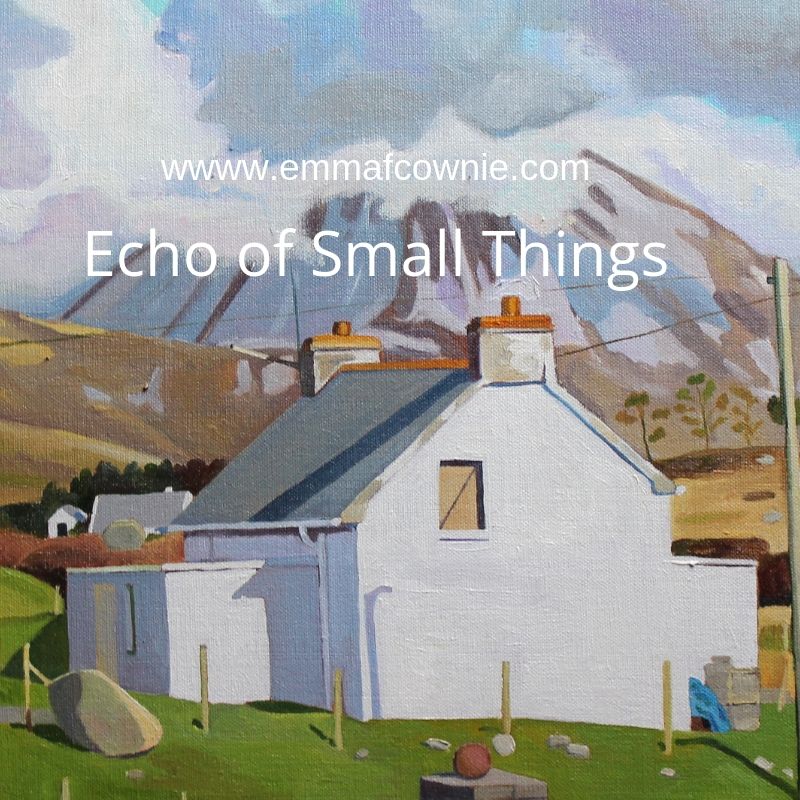
This is my most recent painting below. I choose to paint this because I liked the juxtaposition of the mountain behind the semi-derelict house.
Near Dunmore Strand
I didn’t realise at first that the gable end window is boarded up. It could be mistaken for a blind. Maybe it is a roller-blind pulled down.
Detail (work in progress)
I think the back door is also boarded up. These things are not immediately apparent. There is a large boulder to the left of the house. There is also a pile of building bricks and a tarpaulin in the yard to the right-hand side and old rope in the drive. This is a house at the start or midway through renovations. The details I really relished painting were the shadows of the chimney, roof and the telegraph wire that dissects the window at neat diagonal. It’s only by paying attention to these details that the Donegal light can be properly conveyed.
I have always had a fascination for the ordinary details that are easily overlooked. I want to convey what a scene looked like at that moment. If you were really paying attention. Yet, I am not a painter who works in the hyper-realist style. I am not skillful or patient enough for that. I often cringe when I see my paintings close up because I think some of my brushwork is crude. Yet, “perfect” representation can seem dead and unlife-like.
I think in the errors, the gaps, our brains fill in the gaps the image can come alive. I like that my paintings aren’t just copies of what I can see but an interpretation; the colours brightened, edges sharpened or softened, some details omitted to make for a simpler composition. Deciding what to leave out or simplify is as important as what you decide to include. Rather like Robert Rich’s “Echo of Small things”
I love the Donegal islands for their peace and quiet. Oh, the relative absence of cars, the abundance of nature but I particularly love their houses. You may have noticed that I painted quite a few of them, lately; lovely long strings of houses.
Across to Inishbofin SOLD
I love their simple clean lines. I enjoy the old-style aesthetic. In Donegal, houses were whitewashed and woodwork was painted red. You still see a few houses like this. Sometimes you might see one with a thatched roof. Usually, their thatch has been replaced with tiled roofs.
Traditional Donegal House (with a thatched roof)
When is a house a cottage? When it’s small and old and hand-built by its inhabitant, I suppose. In England, the term cottage originates from the Anglo-Saxon term for the peasant or “cottar”, in Irish the word for these houses is “teachin” or “teach beag” which means small house. You can watch a short film on how to say “teach” in Irish here, you may think that word looks like an English word, but it’s pronounced very differently in Irish.
Cottages literally grew out of the landscape that surrounded them. It stands to reason that in the past homes were built from local materials. If the stones and wood had to be carried by donkey or man-power it wasn’t likely to come from very far away. Stone would predominantly be used in coastal and rocky areas, muddy clay in the midlands and even turf in boggy areas.
Cottages came in different sizes; from the tiny laborer’s cottage or Bothán Scóir (a one-roomed house with mud floors and often not even a window); the byre dwelling (a slightly larger cottage that was shared with the animals) to the thatched mansions – two-storey thatched farmhouses that were often extended from single-storey cottages as the occupants become wealthier.
In Donegal “direct entry” houses were typical, where the front door open directly into the room with the fireplace. The most popular form of cottage is that with the living area at the center with the hearth fireplace and a bedroom on either end.
The fireplace or hearth usually formed of stone and located at the center of the house with a bedroom behind it to further absorb the heat. Most families lived in a single room.
Traditional large fireplace (Kerrytown, Donegal)
Interior of cottage with family. Aran Islands, Co. Galway, c. 1900
Note the bed by the fire
In rural Ireland, they did not usually own the land it stood on. This is why landlords could evict tenants for non-payment of rent (usually, if they wanted to replace people with more profitable sheep), even those the occupants had built those houses themselves. In the case of John George Adair of Gleanveagh, he had the houses pulled down after the tenants were thrown out! This was common eviction practice. Anyone who has seen the excellent film Black 47 will know that this practice, could and did, lead to the death of old and frail tenants in winter.
Over to the Rosses (Donegal, Ireland) SOLD
Houses were designed through necessity. The general rule was that the front door of the cottage faced south, to shelter the house from the prevailing westerly winds. Windows were small in order to retain heat in the winter and to keep cool in the summer. Ground floor windows usually faced to the south, not on the gable ends.
Meadow Cottage – note the first-floor window in the gable end
There were often small windows on the first floor of the gable walls where there were loft accommodations. The walls of a cottage were typically about 600mm thick to support the roof and beams, this led to the attractive deep window reveals found in most cottages.
Cottage with outhouse (Gweedore)
You may have noticed that many old Irish houses are not one single unified block, but are made up of several extensions, a kitchen at the back, an extra room to the side. Homes were enlarged when money was available. Often this money was earnt far away from home as hardship forced family members to look for seasonal work far away in Derry, Tyrone or even in Scotland.
A House on Gola SOLD
Modern houses in Donegal, like modern houses in most places, are comfortable, spacious with plenty of windows. Older people, here as elsewhere, I suspect prefer bungalows for their lack of stairs.
New Houses, Letterkenny, Donegal
Yet, there is still a space for the old style. On Cruit Island there is a holiday village of new-build holiday homes in the “old” style.
They are single story with thatched roofs but they are large, comfortable, and furnished with wooden rocking chairs, and folksy bedspreads. They also have a beach a stone’s throw away. Obviously, there are real old houses you can stay in on Cruit Island too.
Donegal thatched cottage #2 SOLD
I sometimes wonder if I am painting a “fake” version of Ireland. I am giving the impression that all of Donegal is covered in little quaint white houses? It isn’t, but they are there. Especially in the Rosses and on the islands. Not all of the houses are quaint in North-West Ireland; the “bungalow blight” that affects parts of Donegal has been commented on by others. I suppose I am drawn to the clean lines of the old houses.
On the Way to Arranmore (SOLD)
This is a theme I have explored in a different context, previously. A couple of years ago I explored the “Hollowed Community” of Brynmill and painted the Edwardian terraces that surround my home in Swansea. I was also interested in a lost community. The old way of life (pre-internet) that is fast vanishing, where your neighbors lived next to you for years, not for weeks or just the summer months.
Gola is a Donegal island I painted and thought about long before I set foot on its shores. I have written about it beforehere.Last month I was fortunate to visit it. The wind had woken me in the night. The early dawn had me awake by 6.30. I felt so tired and my limbs ached that I drank the last can of caffeinated energy drink that was sitting in our fridge (leftover from the epic drive up north).
We drove the 40-minute drive from Burtonport to the little harbour at from Magheragallon Pier, Bunbeg. The final part of our drive was along single-track road across flat grasslands which were home to both a graveyard and a golf course. That sounds grim but there’s plenty of space for both here.
View of Gweedore from Magheragallon (Machaire Gathlán)
It was the most perfect of days. The sun was shining, the sea was sparkling and flat and the sky was a hazy light blue. The sand was very light, but not white. The sea was incredibly clear and on a clear day like this, you could easily see the seabed, giving the sea a beautiful turquoise colour.
“The Cricket” at Magheragallon Pier (Machaire Gathlán)
The pier is well set up for waiting travelers with benches and a portaloo. We sat on a bench and waited for Sabba the boatman to give to signal to get on board. Seamas, my husband, tells me that Sabba the boatman has been sailing since aged 7. He has a facebook page herewhere he will post times of sailings and photos.
Fisherman off Gola
It’s only a 15 minutes crossing. As soon as we set foot on the island, I am struck by the sense of peace here. Most of the sounds you are of nature. Birds singing. Sheep bleating. The wind. That’s it.
Gola Pier
This is because there are very few motor vehicles here, one or two cars and some tractors.
A fine red tractor
Gola is in the Donegal Gaeltacht, where many people speak Irish. They are brought up speaking Irish at home and in school. So the signs are in Irish. Some have English translations, but not all did.
In 1911 as many as 169 people lived here but in the 1960s people started leaving as jobs and a better standard of living on the mainland and abroad had a stronger appeal than full-time life on the island. Only a handful of people live here all year round now.
Gola is part of the Gaeltacht
It’s so peaceful. The land is covered vast stretches of long yellow prairie-like grass spotted with rocks and a few sheep and their sturdy lambs. The houses are scattered across the island along tracks.
Boat for Sale on Gola
Some of the houses are modern, others have been renovated and are still lived in during the summer months at least, others are boarded up but many lie ruined, without roofs or reduced to crumbling walls.
Houses on GolaHouses on Gola
It was interesting to see the houses on Gola close up after looking across the water at them from Dunmore strand (see painting below). The houses are spaced much further apart than I supposed them to be. I was not satisfied until I had walked all the way to the southern tip of the island, so I could turn and look back at the houses. In this way, I could make sense of what I saw in early spring.
Spring Light on Gola
The houses are close but not that close. All of their front doors face southwards, towards the mainland. Mount Errigal and Muckish are off in the distance. I didn’t realise that you could see Muckish this far south. I suppose I have had never been here on such a clear day before.
Gola – View Towards the South West
I tried to take a photo of two camera-shy woolly donkeys in a field. They took exception to my presence and brayed very loudly at me. I got the message and left them in peace. Even the sheep eye you up, they are not used to strangers. They seem to look at you as if they are saying “You are not our farmer, what are you doing here?”.
Donkeys on Gola – No photos please!Port an ChruinnCottage to Let
Houses facing the mainland
On they way back to the boat we pass the infomation centre – an Teach Beag – its a large shed with tables outside. We are hot and I fancy a cup of tea. I try out the one bit of Irish I know on the man behind the counter “Dia duit” (“Hello”) I say. He then says something back to me which I dont understand. That stumps me. Turns out that he just said “Hello” back to me (“Dia is Muire duit”). I need to get a few more phrases/word in Irish under my belt!
This is Paddy Joe, who is 73 years old and still volunteers for the local lifeboat (training and teaching younger volunteers). It is noticeable how fit and active people in Donegal are, especially the men. We talk in English. I love listening to his accent, Irish is his first language. It’s musical. Part Ulster accent, part something else, something almost Scandinavian. Certainly, of the north. It sort of reminds me of the halting accents of Welsh-speaking farmers in North-Wales, as they seem to trip over their words as they think the right word in English.
Paddy Joe tells a story of going fishing down the Kerry coast and stopping in a pub for a drink. There are Irish speakers there but they do not understand the Irish speakers from Donegal, and the Donegal Irish speakers do not understand them either! I know that its similar in Wales, where Welsh speakers from the North use many different words from those in the West or South.
Some of the few trees on Gola
We decide to catch the 2 o’clock boat back as we have eaten all our sandwiches and the next boat is at 6pm. There is plenty more island to explore on another visit. We haven’t seen the sea arch at Scoilt Ui Dhúgáin, the lake Loch Mhachaire n nGall.
Clear Seas off Gola (Bloody Foreland in the distance)
The boat is setting off, when Sabba spots two girls who came across with us at 11am. He returns to shore to pick them up. They get on the boat looking very relieved. They clearly didn’t fancy waiting until 6pm for the last boat back. The sky is starting to cloud over as we cross and by the time we reach Magheragallon Pier it is overcast.
I have been back in Wales for three days now and the big difference from Donegal is the temperature and light. It is much warmer in Wales. Last week I was wearing a jumper – here I am in a T-shirt. In Wales, last night it was very dark by 10 pm. In Donegal, however, the light seemed unending. I struggled to sleep, despite being very tired, because although the sunset was after 10pm, it didn’t seem to get properly dark until after well after 11pm. Then it started to get light pretty soon after 4am!
I would sometimes wake in the early hours and look at the dark as a novelty. That’s something I’ve never done in Wales. Yet, I got used to this abundance of light. I made me feel active. With no television to slump in front of, I would find myself doing things after tea, such as the evening I found myself sanding a table at 9pm. I got used to life without news on the radio, although I did listen to some podcasts I had downloaded before I left Wales.
The day we visited Arranmore Island was a sunny Saturday. No jumper, just a shirt. There are two ferry companies that operate from Burtonport Harbour, the Red, and the Blue. They run all year round. In the summer months, they put on extra sailings. We plan to catch the 12.30 ferry, which is the Red Ferry. That’s the favourite colour of Seamas, my husband’s, beloved football team, Liverpool, so he’s happy. The ferry is very busy. It’s delayed by 10 minutes as the last car fills the boat to capacity. There are lots of teenagers and families on board. We stand by the rails as all the seats are taken.
Arranmore Red Ferry and an Oystercatcher
The journey to Arranmore is always a treat. The ferry is speedy. It takes not much more than 15 minutes to complete the three-mile journey. I love looking at the islands (and their houses) that lie alongside the route.
Rutland Island is one of the largest of these and lies to the west. There are some very beautiful modern houses on Rutland, alongside ruins which date from the 18th century. These were part of the planned settlement built by William Burton Conyngham. He also owned Arranmore Island. In my painting “From Ferry Coll” (below) you can see the remains of the fish landing and processing complex on the left side of the painting. There was also once a post office, houses, and a school-house here.
From Ferry Coll (SOLD)
On the eastern side, lies the islands of Edernish, Inishchoo, and Eighter. Here there are old cottages tucked in amongst the rocks. There is sparkling sunshine, but once we leave the shelter of the islands, the sea becomes quite choppy.
On the Way to Arranmore (SOLD)
When we arrive at Arranmore harbour there are lots of friends and families waiting for the ferry. There is a lot of waving and photos taking whilst we wait for the cars to drive off the ferry. Then the people can get off the ferry. There are lots of hugs, laughter, and chatter as the passengers finally get off the ferry. It’s a delightful scene.
Arranmore is well worth visiting. It is the second-largest Irish island (the largest is Achill, in County Mayo, if you want to know). It is seven square miles in size and it is dominated by an imposing hill called Cnoc an Iolair (“Hill of the Eagle”, 750 feet) which can be seen from most of the coast of Gweedore ad the Rosses. It has both sandy beaches along the south coast (three of them) and imposing sea cliffs (120 meters) along the west and north side of the island. Many of the islanders are native Irish speakers.
Many islanders used to support themselves through fishing, wild salmon in particular, but in 2006 the EU banned salmon fishing. This has caused a great deal of hardship and anger. It has also meant that many of the young people have been forced to move away in search of work, so the population of the island is dwindling and aging. You can watch a beautiful short film, “A Foot of Turf” about island life here.
Fortunately, the island has recently undergone huge technological advancement and has become the recipient of Ireland’s very first offshore digital hub. In celebration they wrote an open letter to American and Australia, hoping to entice new businesses to the island. Sadly, the story went viral and got distorted in the process. British tabloids, in particular, decided to reframe the story as the island being desperate for immigrants, “begging US citizens to move there” and decided to be offended that they “forgot” to invite British people, writing headlines like: “Anyone but the English”. This caused a great deal of distress on the island as this wasn’t what was intended at all. The letter was meant to appeal to American businesses to help boost the economy by giving islanders jobs – and visit the island.
So we are visiting the island. First, we made our way eastwards, towards the lifeboat station. We then backtracked and walk up the road past The Glen Hotel, which was the island’s first hotel in 1928. It was once the home of John Stoupe Charley, a Protestant from Antrim, who bought the island in 1855.
View Above the Glen Hotel, Arranmore
It was a long hilly road with a beautiful view across to the mainland. There were many old cottages and outbuildings here. The road was generally quiet but we were periodically passed by several cars. I like to take note of where cars are from, in Ireland registration plates in include letters to denote the county of registration. There were many with “DL” Donegal plates, but also plenty with “D” Dublin and Northern Ireland plates. Although I’d seen plenty of German and Dutch vehicles driving along the Wild Atlantic Way (past our house) there were none on this stretch of Arranmore road.
Over to the Rosses (Donegal, Ireland) (SOLD)
It’s considered good manners in Donegal (and elsewhere, of course) for the driver and pedestrian to acknowledge each other when the car has to slow to pass and the pedestrian has to clamber into the grassy verge. In Donegal, the driver will lift the index finger of his right hand. The pedestrian will similarly lift his or her finger but not necessarily raising the hand to do so. Smiles will be exchanged too. Nothing to exuberant, but friendly. It’s rare that this doesn’t happen, sadly it does on occasion and then it is followed by a short discussion between Seamas and myself about the drivers of particular makes of cars and/or people from NI/Dublin/hirecars.
Me on Arranmore Island, Donegal
We get so far and decide to retrace our tracks and walk in a big loop along the west side of the island, which provides us with sweeping views across to Burtonport and Dungloe. If you look carefully in the photo below you will be able to see the old courthouse to the right. This was built at Fal an Ghabhann (Fallagowan) around 1855.
Old Courthouse, (Arranmore Island) SOLD
Eventually, the road wound downhill. We could hear the sound of singing on the wind. A choir singing? We eventually came to a large white Community Hall, the doors were open and inside were lots of young people singing in Irish. These were some of the hundreds of teenagers who come to the island as part of a summer scheme to learn and improve on their Irish language skills.
As if to reinforce this, a tall teenage boy passes us and greets us in Irish. Seamas manages a greeting but then tells me that the lad had used a different form of words to the one he’d learned over 30 years ago. It seems that the Irish language is very similar to the Welsh, in that it has many regional variations in terms of accent, pronunciation, and words used.
House By The Red Wildflowers (SOLD)
We finally made it back to the harbour and had two delicious cheese paninis in the sandwich shop.
Here comes the Blue Ferry!
The journey back to Burtonport harbour on the Red ferry was very enjoyable, with the passengers still in a buoyant holiday mood, waving at the passengers on the Blue ferry as we passed. A holiday maker’s car alarm kept going off. His embarrassment levels pretty much matched that of his children’s amusement.
I kept a lookout for dolphins or seals but saw none. Only sea birds. An American told me that he’s seen Minke Whales in Clew Bay recently. We had seen dolphin on the way back from Tory island. He had a theory that there was a bumper crop of fish 8 miles out at sea, which was where the wildlife were. Usually, the waters around Burtonport would have plenty of seals and dolphins. That’s something to look forward to seeing another time.
For more on Arranmore and other Donegal islands in general doub;e click on the link