Posted on 18 Comments

Rural Minimalism (Revisited)

Rural Minimalism

My work recently has undergone two small but important shifts in focus.

The first is a compositional one.

I have decided to revisit some of the “rules” I first used in 2017 when painting my Welsh “Urban Minimal” paintings (see my paintings for my exhibition in the Cardiff MadeinRoath festival here).

My “rules” for composition and painting this project were:- no cars, no people, bright light. There must be shadows – at diagonals if possible and simplified forms – there must be as little detail as possible. I want to explore the interplay of the geometry of shadows and man-made structures – the tension between the 3D buildings and the 2D shadows. Simplified blocks of colour.

Urban Minimal Paintings by Emma Cownie
A Selection of my “Urban Minimal” Paintings

I later extended these “rules” to painting the villages of Gower, labelling them (half jokingly) “Rural Miminal” (read more here).

Lately, I have been reflecting on my recent body of work and have realised that many of these ideas got lost in the heady excitment of exploring the new landscape (and skies) of Donegal. Also much of my energy got diverted into recovering from my operation and subsequent recovery after I broke my leg/ankle. I spent several months painting watercolours in my bedroom (as I could not reach my oil paints in the attic)and that led me to think more about composition and simplifying forms.

Watercolour of houses on Gola Island

When I finally made it back to my easel, I could only manage short bursts of paintings so I focused on smaller pieces. The clear blue skies outside my window in Wales may well have influenced my fascination with the weather back in Donegal. Note that my use of colour has changed, they have softened, become more subtle. That’s because both the light and the landscape in Donegal is quite different to Wales. It’s also because I was observing more carefully.

Clouds of Donegal

This brings me on to my second shift. Colour. I was always aware that I played around with colour, brightened them just a little, to create cheerful and vibrant works. For many years I painted cheerful paintings when I, myself, was anything but.

Bright and Cheery!
Bright and Cheery!

Painting saved my sanity after a breakdown and going back to a teaching job that I found stressful. The bright colours were a bit of an emotional crutch, perhaps?  I am not sure.  They may have also been a result of hastiness/laziness, over-confidence  with a dash of insecurity.

My Colour Wheel

But change has been coming for a while. I was aware that I sometimes struggled with getting the colour of distant mountains correct. Often the problem lay in the fact that some of my colours were too strong and they needed softening.

I read somewhere that distant colours needed not blue or purple added into in them (as I had thought) but  it’s complementary colour. That’s the colour’s opposite  number on the colour wheel.

I bought a colour wheel to try and perfect those muted tones and watched a few videos on painting about tone and value. They didn’t really hit home with me.  My colour wheel did not have brown on it, I noticed. I had to look for another one.

Colour wheel with brown

My distant hills improved. I  held my paint brush up close to reference image more often before I placed it on the canvas. I used to only do that occassionally. Now I was trying to do it all the time. Work was slower as I thought and carefully considered my colours.

Painting of Tormore Island from Rosbeg, Donegal
Tormore Island from Rosbeg, Donegal (SOLD)

I saw a video that reinforced this growing fixation with getting colours exactly right.  I saw a video on  artist Mitchell Johnson’s Instagram Stories feed. I don’t know who made the video, otherwise I would include it here. I watched many times. Why was watching this clip so fascinating? I was getting excited about watching paint dry!

The tutor had three pieces of coloured card and he mixed the same exact shades of paint so that the paint seemingly “vanished” into the card. The cards were an acidic green, greyish blue and bluish grey.  The colour combination he mixed were fascinating as he added colours that I thought were not going work and yet in the end they did (often a dab of orange did the trick). I noticed that he was using a small pallette knife  to do the mixing. I ordered some palette knives to mix my paint with too. I have found that I can mix a larger quantity of paint. It means that the colour remains consistent.

The tutor made the comment that his students often asked him “Isn’t this close enough? Will this do?”. “No” he said. That sunk home. I knew I was guilty of thinking “This will do”.  No more.

So I set to combining these two “shifts” in thought. The return to simplified forms and the focus on naturalistic/realistic colours.

My first effort was a large painting of the townland of Maghery in Donegal. One or two houses in the middle distant were edited out to simplify the composition.  We decided to call this “The Polite houses of Maghery” because they have all been built looking away from each other! My husband says he finds this painting very calming.

Painting of Maghery_Emma Cownie
The Polite Houses of Maghery – Emma Cownie

I then revisited Gola Island to simplify my compositions futher. I had to resist the impulse the darken the shadows; to strengthen the colour of the pale pink sky, to add lots of yellow and bright greens to the grass. I think the result is also calming.  It is ever so less frantic and a bit more chilled than my previous paintings of the island.  There are still details, in the tiny reflections and pools of light on the doors and sills. You cannot have colour without light.

Oil painting of Gola Donegal by Emma Cownie
Traditional Two-storey House, (Gola)
Oil painting of Road on Gola, Donegal, Ireland
The Dusty Road (Gola), Donegal, Ireland

I suspect that these paintings better reflect my post-broken-leg state of mind. I go every where slowly and carefully (at the pace of a tortoise, according to my husband). I look at the ground to ensure that I do not trip. I gave up drinking coffee and caffeinated tea to reduce my swollen ankle so I am no longer pepped up on caffeine either. I always am mindful of where my feet are. I am now mindful of my colours too! Slowing down has helped me see colours better.

There are still many challenges to be solved. How will I include clouds in my rural miminal paintings? Will this approach work on a overcast day? Those are problems for another day!

Read more about 

PTSD and my art https://emmafcownie.com/2016/04/ptsd-creates-the-need-to-paint/

Me and watercolours https://emmafcownie.com/2020/04/watercolour-painting-2/

My Urban Minimal paintings for the Madeinroath Exhibition https://emmafcownie.com/2017/11/paintings-of-swansea-2/

The Hollowed Community Exhibition https://emmafcownie.com/2017/10/exhibition-swansea-artist-3/

Composition and my work https://emmafcownie.com/2020/02/the-art-of-the-large-landscape-painting/

Coloir Wheel and Colour Mixing

Read more

Posted on 26 Comments

The Art of Composition (or how to avoid going off at a tangent)

Art of Composition

I have found that my energy is slowly but steadily returning after my operation on my broken leg in March (although painting light is shrinking with the shortening days).  I spent much of the spring and early summer sitting in my chair wishing I could go outside into the fresh air or climb the stairs to my attic studio. I painted watercolours instead, and thought a lot about colour and composition. I learnt to simplify my images and edit them with more ruthlessness than I had done before.

Gola Island
Gola Houses (watercolor)

I have attempted to carry these lessons into the compositions of my oil paintings. I suspect that I need to go further. I am always torn between a desire to accurately convey what is probably a well-known location to local people, and the need to create an effective composition. In otherwords I want to create an engaging painting, regardless of whether a viewer has visited Donegal or not.

Painting of house on Gola, Donegal, Ireland
Blue Door, Gola (oil on canvas) SOLD

Here’s an example of editing my composition. I used several reference photos for this painting of Bád Eddie (Eddie’s Boat) but you will see that I decide to leave out the all the lamp posts. I felt they made the picture look cluttered. I also left out the the skylights on a couple of the houses for the same reason. I did, however, decide to include a couple of series of fence posts on the right side of the painting as they lead the eye down the hill.

Bad Eddie at Bunbeg
One of the reference photos for Bád Eddie at Bunbeg
Painting of Bad Eddie, Bunbeg,Ireland
Bád Eddie, Ireland. (Oil on canvas) SOLD

I have gone further with my editing of the reference image in my most recent painting of Arranmore. This is a painting of a (probably abandoned) white house that I had painted a watercolour of earlier in the year .

Watercolour of Irish cottage, Donegal
The White house, Arranmore, Ireland (watercolour) 

A lot of the compositional work is done when composing the reference photograph, but there is often a bit more tinkering to be done to clarify the image further.

Landscape painting of Arranmore by Emma Cownie
The White Bridge, Arranmore, Ireland (100cm x 65cm) (Oil on canvas)

Here you can see that I have again removed most of the telegraph poles, just leaving one further down the road. The fence posts as usual, get to stay. The ones on the right led the eye down the road. The central part of the painting on the right side is too cluttered for my liking too. It’s very confusing for the viewer. I have since discovered that this is because there are too many “tangents“. The word “tangent” usually just indicates that two things are touching, but in art the term describes shapes that touch in a way that is visually annoying or troublesome. This also describes those telegraph poles I removed. It all makes for an image that is easier to “read”.

Tangent Chart – From emptyeasel.com

I also removed a several of the buildings so that there is a clear view over to the tiny island of Inishkeeragh with its solidary summer home. Finally, I also simplied the pair of yellow buildings to the far right. I found the semi-abstract result pleasing and I felt that the lack of detail balanced the detail in mud, rocks and grasses on the near side to the left of the painting. I like to balance detail with areas of flat colour, such as the roof of the house or the sea, as I think that too much detail all over makes the head sore. The human brain doesn’t process images in this way any way. Our eyes/brains will focus on one or two areas and “generalise” other larger areas of colour.

Thus, I hope I have created a succesful painting rather than slavishly copying a photograph.

White Bridge Arranmore, (in situ)

Read more about avoiding confusing tangents in compositions here  

and also in this article Compose: A Touchy Subject 

or watch this youtube clip

Posted on 35 Comments

Featured in The Opacas’ Music Video

Featured in The Opacas’ Music Video
I am very excited to have my paintings choosen to accompany the acoustic piano version the single, ‘Out Of My Mind’ by the Opacas.  Thank you The Opacas for inviting me to collaborate, and to Patrick Boyle in particular who made the beautiful video! 
 
Posted on 26 Comments

Bád Eddie, Bunbeg, Ireland

Painting of Bad Eddie by Emma Cownie
From Magheraclogher Beach (Bunbeg)
From Magheraclogher Beach (Bunbeg) (Private Collection)


I decided to apply the detailed techniques I have used for painting the hilly city of Swansea to the rural homes of the coastal townland of Bunbeg. I am usually drawn to painting old fashioned Irish cottages, as I like their clean lines and simple shapes. This time, I decided to challenge myself by painting modern Irish houses. The homes of this part of Bunbeg are almost all modern homes, although there are one or two old cottages tucked in amongst the two-storey houses. I found the arrangement of houses on the hilly a pleasing one. I was particularly keen on the road that snakes its way down the hill on the far left of the composition. I decided to leave out all the lamp posts as I felt the cluttered the scene. However, the real joy of the composition is rather unexpected (if you have never seen it before, that is) shipwreck on the right-hand side of the painting. Bád Eddie. 

Mageraclogher beach, Bunbeg,  on the West coast of Donegal,  is a vast, beautiful, and usually windswept beach. It is like a natural amphitheater. In its center,  fleetingly illuminated by the autumn light, just for a moment is the ruined hulk of a boat.

Painting of Bad Eddie, Bunbeg,Ireland

Bád Eddie, Ireland. 

This is a shipwreck, known locally as Bád Eddie, Bád meaning boat in Irish/Gaeilge.  I initially thought “Bad Eddie” was a nickname like Paul Newman’s character in the movie The Hustler, “Fast Eddie”. It made me think the wreck had been some sort of errant boat, but no it just means Eddie’s Boat in Irish. This is, after all,  Gaoth Dobhair (Gweedore), an Irish speaking area of Ireland. 

There are shipwrecks and there are shipwrecks. I am very familiar with images of bones of the Helvetia that have lain submerged on Rhossili Beach on the Gower Peninsula for over 120 years. Bád Eddie, however, is loved in a way that the Helvetia can only dream of.  She has starred in a pop video with Bono and Clannad, no less! She has had a film about her life made and broadcast on the TG4 the Irish language channel (see the film below, it is well worth watching), she has her own popular Twitter account too – Bád Eddie @CaraNaMara

Bád Eddie’s Twitter Page

Bád Eddie, isn’t her real name. She was actually named Cara Na Mara (Friend of the Sea). Her first career was as a fishing boat and she was originally built in Brittany, France, and bought by local fisherman Eddie Gillespie. In 1977 she needed two planks repaired and she was towed ashore onto Magherclougher beach and somehow got left. The repairs were never done and she has lain here for over 40 years.  So this, if there can be such a thing, is a  happy shipwreck. No one died when this ship was washed up. No one had to rescue the crew.  There are no sad memories, except for Eddie who never fixed his fishing boat.

Bád Eddie in her better days: From Twitter

In fact, Bád Eddie has helped create nothing but good memories.  Over the years she became the playground to the local people and families on holiday in Gweedore. She has featured in thousands of family holiday photos and locals include her in their weddings, communions, even christenings. Sadly, the Atlantic Storms have taken their toll on Bád Eddie, and there’s less on her today than when I saw her two winters ago.  

Decorated for Christmas: Image Donegal Daily
 

The locals love her and also recognize that she is a big tourist attraction and they want her preserved to keep that tourism alive. So there is an ambitious plan to create the first permanent sculpture in the sea in Ireland, a stainless steel full-size replica of the boat, incorporating what is left of the structure. I think a sea sculpture is a brilliant idea. There are some amazing sea sculptures in England,  “Another Place” by Antony Gormley at Crosby, Near Liverpool in England and “The Scallop” by Maggi Hamblin at Aldeburgh, on the Suffolk coast – both have had their share of controversy (The Scallop has been called “The most controversial piece of Art in Suffolk”) but  they have certainly increased tourism to their areas. I don’t imagine the Bád Eddie sea sculpture will cause too much controversy. The difficulty is around getting enough money together to build it.  The project has the support of Donegal County Council, but more funding is needed so a gofundme campaign has been set up.

You can support the campaign here https://ie.gofundme.com/f/bad-eddie


Read more about the campaign to save the wreck here.  

https://www.rte.ie/news/ireland/2020/0829/1162078-bad-eddie-donegal/

https://www.theguardian.com/world/2020/aug/31/donegal-locals-campaign-to-turn-beached-boat-into-work-of-art 

Watch Bono and Clannad  with Bád Eddie

https://www.youtube.com/watch?v=Ty2V7yRPbCc&ab_channel=ClannadVEVO

Wild Atlantic Way Stories 

Bád Eddie

Posted on 11 Comments

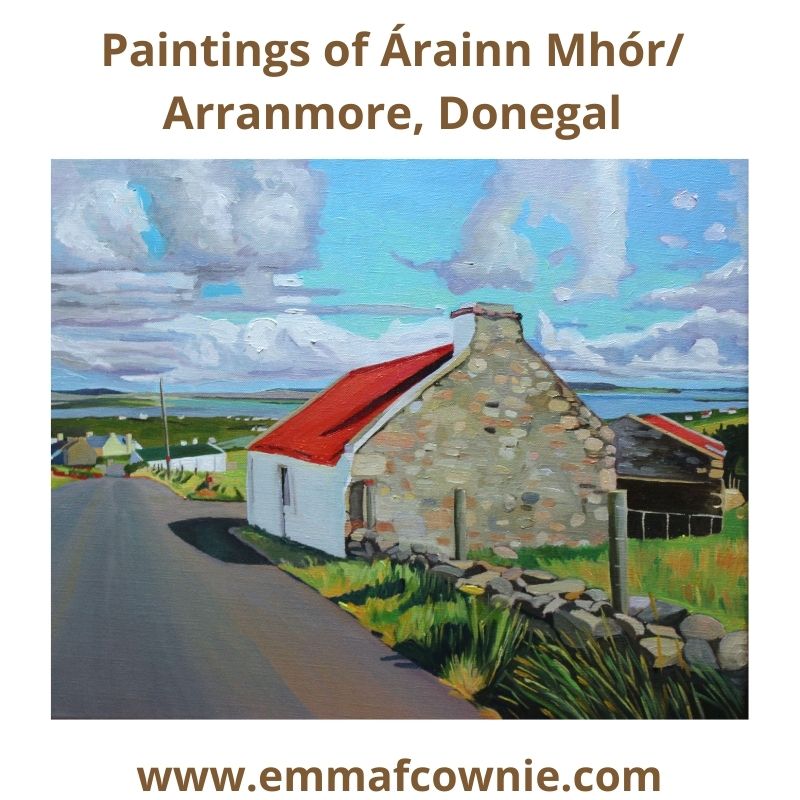
Paintings of Árainn Mhór/Arranmore, Donegal

Arranmore Donegal

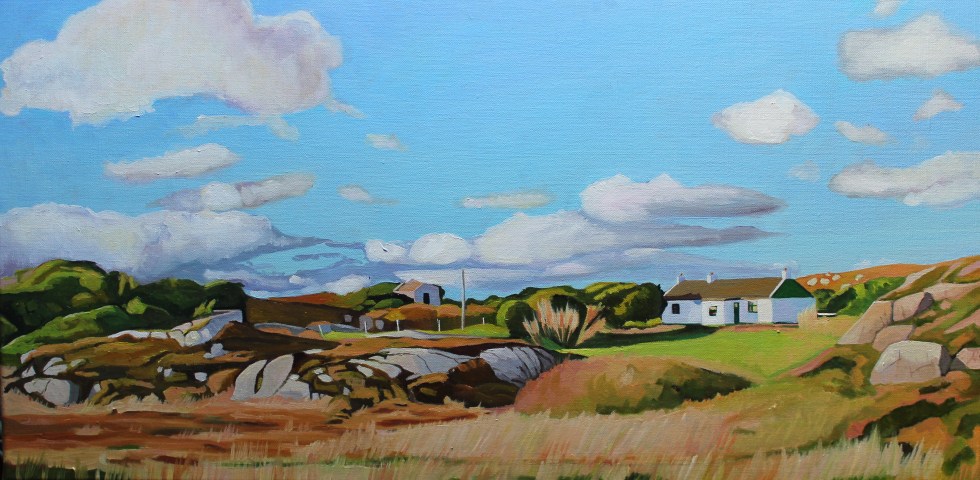
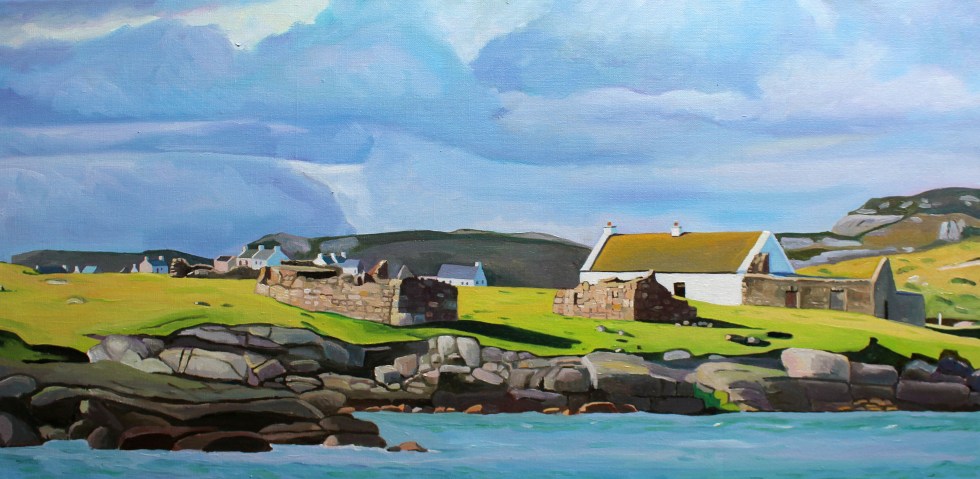
I recently join the Stair Árrain Mhór – Árrain Mhór History Facebook group and was overwhelmed by the positive response I received from the members when I put my most recent post online there. I was asked if I had any more paintings of Arranmore for them to see, so here’s a collection of all my paintings of the Island that I have completed in the last two years.

Where it reads (Private Collection) it means that the painting has been sold. I hope you enjoy looking at them.

To see my Donegal paintings for sale click here

Poll na mbadaí (Harbour of the Boats) Arranmore, Ireland.
Poll na mbadaí (Harbour of the Boats) Arranmore, Ireland (Private Collection).


Painting of old cottage on Arranmore, Donegal_Emma Cownie
Brightening Up (Arranmore, Donegal) SOLD


Darkening Clouds On Maghery
Darkening Clouds On Maghery, Ireland (SOLD)


Painting of Arranmore lane, Ireland by Emma Cownie
After the Rain, Arranmore, Ireland (Private Collection)


Landscape Arranmore Ireland
Stone Shed Arranmore Ireland (SOLD)


Landscape painting Donegal
View From Poolawaddy (Private collection) painted in early March 2020


Painting of The Two Tin-Roofed Sheds, Ireland
The Two Tin-Roofed Sheds, Ireland


Red Roofed House Painting
Rusty Roofed House, Arranmore, Ireland


Irish Landscape painting_Emma Cownie
The Two Red Roofed Houses, Ireland (Private Collection)


landscape painting of Arranmore Island_Ireland_Emma Cownie
Down the lane, Arranmore (Private Collection)


Painting of Arranmore, Donegal, Ireland_Emma Cownie
Cloughcor, With Errigal Behind (Ireland) (Private Collection)


Donegal painting
View from Arranmore (Private Collection)
Donegal painting of area around Cloughcor, Arranmore
Around Cloughcor (Arranmore) (Private Collection)


Painting of Donegal Island of Inishkeeragh_EmmaCownie
Over to InishKeeragh (Private Collection)


Donegal landscape painting for sale_EmmaCownie
Gortgar, Arranmore (SOLD)


From Cloughcor To Maghery (Arranmore) (Private Collection)


Painting of Donegal cottage
House by the Wild Red Flowers (Arranmore) (Private Collection)


Painting of Donegal. Arranmore.
Old Courthouse, (Arranmore Island) (Private Collection)


There are also some small watercolours I did when I could not get to my oil paints and easel due to a broken leg/ankle

Watercolour of an old white cottage with a new slate roof, Arranmore, Ireland by Emma Cownie
House on the hill,, Arranmore, Ireland (Sold)
Watercolour of Irish cottage, Donegal
The White house, Arranmore, Ireland
Watercolor of Old White Cottage, Arranmore, Ireland by Emma Cownie
Old White Cottage, Arranmore, Ireland
Watercolour of Arranmore, Ireland
Two Red Roofed Sheds, Arranmore, Ireland


Some of the above paintings are available to buy as prints on artamajeur.com.


Posted on 20 Comments

Poll Na Mbadaí (Harbour of the Boats), Arranmore Island

Poll Na Mbadaí (Harbour of the Boats), Arranmore Island
Poll na mbadaí (Harbour of the Boats) Arranmore, Ireland.


Here is my latest Donegal painting. I am delighted that it will be going to its new home in California, USA, very soon. 

A narrow lane curves down to a shining white cottage and outbuilding and to the right.  This is not a public road but a lane to the house, just around the bend. Here it is bathed in glorious winter light. The low sun creates long dark shadows along the lane. The sheep look up, they are not used to strangers (not like the sheep on the Gower that barely give visitors a second glance). On the horizon, you can make out the tiny but distinctive shapes of Muckish and Errigal mountains . You can just make out a line of fence posts that lead down towards the small natural harbour that gives its name to this place: Poll Na Mbadaí or Poolawaddy. The meaning of Poolawaddy (also spelled Pollawaddy) is often disputed.  In irish Poll a Mhadaigh, could mean Poll – the harbour, a Mhadaigh – of dogs or Poll na mbadaí, Poll – the harbour, na mbadaí – of the boats. I suspect that the harbour of the boats is more likely, as it is a natural harbour and pier, but I could be wrong. I only have a basic understanding of Irish but I like to try and read it because place names are very descriptive (as they are in Welsh too) and often poetic. A harbour of dogs is just as possible, after all, there are tiny islands nearby named Calf, Duck and Gull Island.

Arranmore Island map

It feels like it has taken me 7 months to get here. The last painting I finished just before I broke my leg in eraly March was also a painting of this area (see below). It has taken me so long to recover my “painting stamina” and gradually paint larger canvases (although some artists would not consider 80×60 cm “large”). I don’t think I will go any larger for now. I feel exhausted after finishing a large painting these days.

Landscape painting Donegal
View From Poolawaddy (Private collection) painted in early March 2020
 

I like to understand what it is that I am painting, to get a sense of its history and the people who live/d there. I might call a building an “outhouse” for example but very often that building was once a family home, a newer bigger one having been built next to it. It matters to me to know that. It helps me make sense of a place.  I only know only a little about the History of Arranmore, however, so what I have written here has been taken from articles I have found online (I have included links and a list of websites at the end). 

Life on the east side of Arranmore Island, where Pollawaddy is located, is marginally easier than on the west side. This is because Cnoc an Iolair, the highest peak on the island (reputedly once home to golden eagles), provides relative shelter from the prevailing westerly Atlantic winds.  This side of the island certainly seems more sheltered, gentler. 

Poolwaddy,Arranmore, Ireland
Poolawaddy, Arranmore, Ireland (from the other side of the bay). Calf Island is to the right of the bay.


After the Protestation plantation in the 17th century, Arranmore Island, Donegal’s largest island, like other large parts of West Donegal, had been given to the English Lord Conyngham. However, when the terrible potato blight leading to the Great Hunger (“an Gorta Mór”, in Irish) spread during in the mid-1840s he declared the island, which he had never set foot on in his life, as unprofitable and sold it to a Protestant man John Stoupe Charley of Finnaghy, Belfast on 29 June 1849. The new landlord came to live on the island, building a “Big House” (now the Glen Hotel) after 1855 just down the road from Poolawaddy. Very near Poolawaddy, RIC police barracks were built, presumbably built around at the same time to protect the landlord’s property. Interestingly, the RIC left the island after about 40 years and there is still no police station on the island (although the Guards do visit on a regular basis). 

Ruins of the RIC barracks: Image from thearranmoreferry.com


Landlord Charley decided to clear as many starving tenants off the land, so he demanded them to present the receipts of their rent payments or face eviction. Of course, few if any had been given written receipts, let alone kept them since most of them could not read or write. The choice they were faced with was either the poor house in Glenties or to emigrate to America in a ‘coffin ship’.  Many of these subtenants were evicted in 1847 and 1851. Many who made it into the new world settled on ‘Beaver Island’ (Lake Michigan, USA ). The two islands are twinned. The Árainn Mhór & Beaver Island Memorial, built in 2000, and the sign that Beaver Island is 2,750 miles away, is a memorial to this link. Many of the first islanders who emigrated to Beaver Island were from Poolawaddy.  Evictions carried on after John Charley’s death in 1879, when his widow Mary and his brother Walter Charley MP were left to manage his lands. The British government even sent a gunboat, “Goshawk” in 1881 to “assist … the serving of ejectment processes on the tenants in the island of Arranmore”!

Poolawaddy Pier, image from thearranmoreferry.com


The Islanders who left for America emigrated permanently, but seasonal emigration was a more common feature of island life, with many young people working as labourers for farmers in the Lagan, a fertile area in northwest Ulster, and also in Scotland as ” tattiehokers” for the summer.  Rósie Rua was one such youngster. She was born in 1879 and was reared on Aranmore Island by her mother and her step-father, the Butcher. In adult life, she gained renown as the best traditional singer in Aranmore and wrote a memoir of her life with the help of Padraig Ua Cnaimhsí. Unfortunately, the memoir seems to be out of print, but I could read some sections of it on google.books.

Róise Rua

In her memoir she describes how at aged nine she was hired out to farmers in the Lagan.  Her family home was not far from Poolawaddy and she describes catching the boat to Scotland to work as a farmworker or ” tattiehoker” for the summer.  She wrote that “the steamer had dropped anchor off Calf Island, and we saw the boats pulling out from the shore with their passengers. In no time at all, we were all down at Pollawaddy ourselves and one of the small boats brought us out. Lily was the name of the steamer.I was amazed at the size of her…just about a hundred passengers in all boarded the Lily at Calf Island.”

Róise Rya’s Home:Image thearranmoreferry.com


Rósie Rua has a singing festival, Féile Róise Rua held in her name on Arranmore. The first was held in 2019. Sadly the pandemic distrupted the 2020 festival. The festival went online on facebook and you can watch some of the performers here.  Fingers crossed the next one can go ahead in 2021!  I will leave you will a clip of Jerry Early singing “I’ll Go” (5.55 onwards). Just look at the view out of his window!


To find out more about Arranmore

https://en.wikipedia.org/wiki/Arranmore

http://www.welovedonegal.com/islands-arranmore.html 

https://thearranmoreferry.com/local-attractions  

http://www.grassroutes.ie/why-you-should-experience-arranmore-island-by-bike/  

http://www.oileanarainnmhoir.com/TheTownlands.htm 

About Róise Rua https://www.drb.ie/essays/augmenting-memory-dispelling-amnesia

A website showing the harbours in the area https://eoceanic.com/sailing/harbours/291/arranmore_island

Getting there from Burtonport:-

https://thearranmoreferry.com/ (blue ferry) 

https://arranmoreferry.com (red ferry)

See also a German site (google will translate into English) https://irish-net.de/Entdecke-Irland/Irische-Inseln/Arranmore-Island/ 

Posted on 30 Comments

Back in the studio!

Finally, I managed to scale the steep steps to my attic studio! One step at a time. Holding on the handrails.

Ah, what pleasure it was to be back in the attic. It has a view out the back of the house. It is a great pleasure to look at the wooded parks and hills of West Swansea instead of the unrelenting concrete streets and terrace houses out the front of the house. I have a number of commissions to fulfill but I wanted to “warm up” with some small paintings first as I have been working with watercolours for the past two months. Here’s a selection:-

My first reaction to oil paint was how slow it all is in comparison with watercolours. With watercolours, most of the effort goes into planning and preparation and then the execution of the painting itself is quick. Putting oil paint on the canvas was more laborious that watercolours. I also had to rummage around for looking for the right sort of paintbrushes, a few times. I could not quite lay my hands on what I needed. But,  ah! The paint did what I thought it was going to do. What joy! If I changed my mind about a composition or decided that something did not work I could wipe it off the canvas. It did not reproach me for making a mistake by showing it to the world for ever! Nice!

Anyway, I sat down and started a series of new Donegal paintings. Here they are.

Painting of Donegal Cottage
Wee House on Gola, Donegal (SOLD)
Painting of Storm Clouds Over Inshbofin, Ireland
Storm Over Inshbofin, Ireland (SOLD)

Painting of The Two Tin-Roofed Sheds, Ireland

The Two Tin-Roofed Sheds, Arranmore, Ireland

Painting of house on Gola, Donegal, Ireland
Blue Door, Gola (SOLD)

Landscape Arranmore Ireland

The Old Stone Shed Arranmore Ireland

These paintings are from the past few weeks. I have also worked on two commissions. It has been slow work at times as I often need a lunchtime nap to keep my energy levels up. I do my rehab exercises several times a day which can be very tiring. On a positive note, I finally got to speak to a physiotherapist, Josh, who has been very helpful. He has posted exercises to me and giving me guidance on how much to do.  I can walk upstairs reasonably well, but downstairs one step at a time. When I get tired my ankle gets sore and I limp. I try and avoid that if I can.

What did I learn from watercolours? That I can and should edit and play around with compositions more. I simplified my images as much as I could. I changed the skies or left out an inconvenient house. I found this freeing and I brought an element of this to my oil paintings. For some reason, I have felt to need to be truthful to the real-life locations I painted. I realise now that I don’t have to. I can happily leave out a telegraph pole or a lamp post if it confuses the composition.

What do I miss about watercolours? The tidiness. Clean clothes and hands. The lack of chaos. The speed. The brushes that don’t wear out by the time you have finished a large painting. The lightness. They convey the lightness of birds better than oil colours. Also the convenience, I could pack away all my paper, paints, and brushes in one big bag. I am looking forward to using them outside when I can walk much longer distances!

Emma Cownie Artist
Painting in the studio with my leg up!


Posted on 13 Comments

Cottage in Roshin Acres, Ireland

Painting of Irish landscape

This is only a short post because my cold from hell isn’t shifting and I have been ordered to rest by Séamas, which as you see, I am failing to do!

I like red and orange. Especially in winter. I have noticed that I like to paint red and orange things in wintertime. I previous years it has been red coats on the harbor beach at Tenby, or grandparents buying ice-creams in Brynmill Park. This year it’s the autumnal orange foliage of Donegal.

Painting of Cottage in Donegal, Ireland

Cottage in Roshin Acres, Ireland (SOLD)

I painted this small painting over a number of days, over Christmas. I would usually paint a picture like this in one day but the light kept going and I wasn’t very energetic so I decided not to rush it and wait until the next day. I think my patience was well-rewarded.

I have painted this house before, in a much larger painting. It’s interesting how the more distant view produces a cooler more airy painting. 

Painting of Donegal landscape, Ireland
Roshin Acres, Ireland

(SOLD)


Posted on 18 Comments

The Burtonport Old Railway Walk, Ireland

Paintings of Ireland

Autumn brings incredible colours to the west coast of Ireland. As the grass and bracken die off, they turn a fantastic shade of orange and pink. The pink granite rocks that litter the landscape accentuate the warm colours. They have provided me with much inspiration for my landscape paintings of Donegal, Ireland.

Painting of Donegal Ireland
Autumn in the Rosses, Ireland

This series of paintings has been inspired by the Old Railway Walk which starts near Burtonport, near Dungloe in Donegal. There are no railways in Donegal anymore. There used to be. The line to Burtonport was built in 1903 as a joint venture by the British government and the Londonderry & Loch Swilly Railway Company to attempt to alleviate poverty in north West Donegal.

Steam train at Burtonport, Donegal
Steam trains at Burtonport, Donegal

The trains used to carry fish from the port at Burtonport in Donegal to Derry, in the neighboring county. It also carried many seasonal workers to and from Derry and Scotland.  After 1922 the line crossed from one country into another; from the Irish Free State into Northern Ireland.

Donegal Railways in 1906
Railways in 1906: Credit: Donegal Daily.com

Gweedore train station (Mount Errigal in the distance)

In the 1940s, however, the Irish government decided to close down the railways in Donegal. I have never really found a clear explanation for why this happened but I am going to assume that the cost of running the line was an important factor. There were also concerns about the safety of the line.

Owencarrow Viaduct, Donegal

In January 1925 disaster had occurred on the at the Owencarrow Viaduct when winds of up to 120mph blew carriages of the train off the viaduct causing it to partially collapse. Four poor souls lost their lives.

Owencarrow Viaduct
Owencarrow Viaduct

After the Second World War, the Irish government presumably decided it would cost too much to continue the maintenance of the line and it was closed in 1947. The Burtonport-Gweedore section closed in 1940. There is a great graphic on the Donegal Daily here illustrating the shrinkage and disappearance of the railways. Donegal became a very remote part of Ireland, with no railways and no (still) motorways. Communication with the area improved in 1986, however, when Donegal airport started operations.

Painting of the Rosses, Ireland
The Railway Walk, Ireland

It seems that for half a century nothing much happened on the old railway line. In 2009, however, there was a heavy snowfall, and some of the old railway line was cleared to access water mains that needed repairing. The remaining section was later cleared and gradually developed as a walkway with the support of the local community. A massive effort has gone into creating this beautiful and peaceful walk.

The Burtonport Old Railway Walk

Here are some of my paintings inspired by my husband Seamas’s photographs of the railway walk.

Painting of Donegal landscape, Ireland
Roshin Acres, Ireland

Ireland landscape painting
Long and Winding Road, Ireland

There are many features of the old railway remaining which you can view along the way such as stations, gatehouses, accommodation crossings, lots of pillars, cuttings, embankments, a bridge and rusty gates. There are also lots of shelters for walkers to hide from passing showers to use.

Photo credit: James (Seamas) Henry Johnston

Youtube video- Siúlóid an tSean Bhóthar Iarainn—The Old Railway Walk by Ralph Schulz.

Find out more about the Railway Walk by clicking on the links below:-

http://www.therosses.ie/walking.html

https://www.ireland.com/en-gb/what-is-available/walking-and-hiking/walks/destinations/republic-of-ireland/donegal/burtonport/all/1-94786/

http://www.walkingdonegal.net/article/walking-the-line/

http://magherycoastaladventures.ie/sli_na_rossan.html 

Getting here: From Letterkenny and Dungloe – SITI Rural Transport – Tel 0749741644. From Dublin – Bus Eireann@ www .buseireann .ie From Scotland & Northern lreland – Doherty Travel (00353) 749521867

https://www.donegalairport.ie/  There are twice-daily flights from Dublin and Glasgow to Donegal airport via Aer Lingus and Logan AirDonegal Airport : 00353(0) 74 95 48284.


.

Posted on 18 Comments

A Donegal Year

It was a year ago that I painted my first painting of Donegal. Here it is. It is a small one.
Old School, Owey Island
It’s quite a modest painting. You could say that I started off tentatively. I was feeling my way. The light in Donegal is very clear and the scenery is beautiful. That’s an overused word in this age of social media, but it is beautiful. My husband, Seamas (he likes counting things) tells me that I have painted over 50 Donegal paintings (including 3 commissions). That pretty much averages out at one a week. I am pleased to say that I have already sold over half of them. I discovered that I had to use a different palette from the one that I use in Wales. The greens and yellows were more yellow ochre than lemon yellow and the sea was more turquoise (but not quite as turquoise as I first painted) thanks to the clear water.  I loved the rocky landscape of the Rosses. It was a landscape like no other I’d seen before. Someone has said to me that it’s quite alien, like a moonscape in places. I love the granite rocks. We have a massive one behind our cottage in Donegal. I feel very affectionate towards it. It’s a protective presence, especially when it’s windy. Of course, when you are in a different country to the one you were brought up in, everything seems fascinating. I have loved painting both the modern Donegal houses as well as the old cottages. I will freely admit I am quite obsessed by landscape spotted with old cottages on the Donegal islands, on Arranmore and Gola in particular.
donegal painting of Gola, West Donegal.
Spring Light on Gola
I haven’t really got to grips with the mountains of Donegal. What I mean is that I need to visit them a lot more, walk up them and get to know them better. So far I have just admired the “Seven Sisters”, including Mount Errigal and Muckish from a distance.
Painting of Irish mountain
Swirling Clouds Round Errigal
Of course, the real joy of Donegal is the clouds. The changes skies. I am used to it raining, (I have lived in Wales for over 25 years) but the light is different by the North Atlantic Ocean. It is often more slivery, and more changeable.   I think about Donegal every day when I am in Wales. My husband will place his current favourite Donegal paintings in the bedroom and in the lounge so he can look at them whilst we still have them. Here’s my most recent painting Donegal painting. I am currently working on a painting of Arranmore Island, unfortunately, it rained so much here yesterday, the light went and I have yet to finish it.
Donegal painting
Back Road to Burtonport