A year’s a long time in art. When I look back at my paintings from early 2019, it feels like I made them much longer ago than that! This selection of “popular” (most likes/biggest reach) is based on my Instagram account, there are many more images that I shared on Facebook, that were also popular but are not included here. The work in progress photos are often very popular, sometimes they are more popular than the final painting!
The most popular nine posts/paintings are all of Donegal, Ireland, paintings.
A selection of some of my most popular Donegal paintings from 2019
Here are my most popular posts/paintings of landscapes, people and animals of Gower, Wales and Stroud, England.
Some more of my most popular paintings from 2019
Finally, a selection of commissioned work. I particularly enjoyed painting the beautiful Maine Coon cats, especially as pet portraits are usually of the canine variety!
Selection of Commissioned work from 2019
My personal favorite from 2019 is this one. There is something about the neatness of the houses on the island that I relish in this painting.
Owey in Spring
Of course, the irony is that one of my most popular posts of 2019 on social media was not a painting but a photograph that my husband took on the spur of the moment of us in woolly hats (and my new Donegal jumper) on Christmas Day!
Seamas and me!
Here’s wishing everyone a Happy, Healthy and Prosperous 2020!
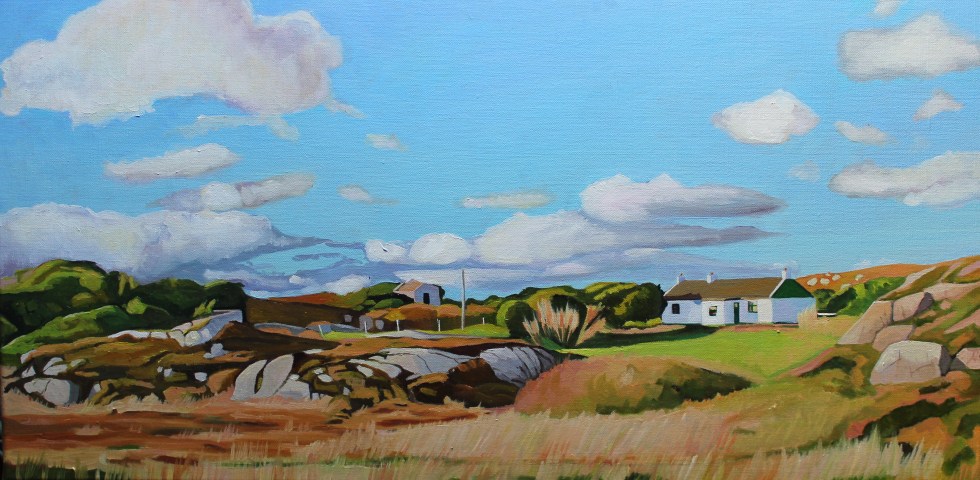
Autumn brings incredible colours to the west coast of Ireland. As the grass and bracken die off, they turn a fantastic shade of orange and pink. The pink granite rocks that litter the landscape accentuate the warm colours. They have provided me with much inspiration for my landscape paintings of Donegal, Ireland.
This series of paintings has been inspired by the Old Railway Walk which starts near Burtonport, near Dungloe in Donegal. There are no railways in Donegal anymore. There used to be. The line to Burtonport was built in 1903 as a joint venture by the British government and the Londonderry & Loch Swilly RailwayCompany to attempt to alleviate poverty in north West Donegal.
Steam trains at Burtonport, Donegal
The trains used to carry fish from the port at Burtonport in Donegal to Derry, in the neighboring county. It also carried many seasonal workers to and from Derry and Scotland. After 1922 the line crossed from one country into another; from the Irish Free State into Northern Ireland.
Railways in 1906: Credit: Donegal Daily.comGweedore train station (Mount Errigal in the distance)
In the 1940s, however, the Irish government decided to close down the railways in Donegal. I have never really found a clear explanation for why this happened but I am going to assume that the cost of running the line was an important factor. There were also concerns about the safety of the line.
Owencarrow Viaduct, Donegal
In January 1925 disaster had occurred on the at theOwencarrow Viaductwhen winds of up to 120mph blew carriages of the train off the viaduct causing it to partially collapse. Four poor souls lost their lives.
Owencarrow Viaduct
After the Second World War, the Irish government presumably decided it would cost too much to continue the maintenance of the line and it was closed in 1947. The Burtonport-Gweedore section closed in 1940. There is a great graphic on the Donegal Daily hereillustrating the shrinkage and disappearance of the railways. Donegal became a very remote part of Ireland, with no railways and no (still) motorways. Communication with the area improved in 1986, however, whenDonegal airportstarted operations.
It seems that for half a century nothing much happened on the old railway line. In 2009, however, there was a heavy snowfall, and some of the old railway line was cleared to access water mains that needed repairing. The remaining section was later cleared and gradually developed as a walkway with the support of the local community. A massive effort has gone into creating this beautiful and peaceful walk.
The Burtonport Old Railway Walk
Here are some of my paintings inspired by my husband Seamas’s photographs of the railway walk.
There are many features of the old railway remaining which you can view along the way such as stations, gatehouses, accommodation crossings, lots of pillars, cuttings, embankments, a bridge and rusty gates. There are also lots of shelters for walkers to hide from passing showers to use.
dav
Photo credit: James (Seamas) Henry Johnston
Youtube video- Siúlóid an tSean Bhóthar Iarainn—The Old Railway Walk by Ralph Schulz.
Find out more about the Railway Walk by clicking on the links below:-
Getting here: From Letterkenny and Dungloe – SITI Rural Transport – Tel 0749741644. From Dublin – Bus Eireann@ www .buseireann .ie From Scotland & Northern lreland – Doherty Travel (00353) 749521867
The Opening night of an “Open” exhibition is an affair full of nervous energy! This is because 90% of people in the room are artists who are all relieved/happy to have their work included in the exhbition in the first place and secondly have come to see where their painting/s have ended up? Are they in a corner? Can they be seen?
Open Exhibition is where the organisers invite or “call” for artists to submit their work (for a small fee). The best works are then selected to be included in the exhibition. There are massive national exhibitions (like the BP Portrait Prize) that are so massive that they have a preliminary round where digital photos are first sent for consideration. The Glynn Vivian, does it the old fashioned way by requiring artists to bring their paintings to gallery for submission. You can submit up to two works each. As, it’s only open to artists living in the Swansea area, it’s not too onerous to drop in the paintings.
All artists fear rejection. We are sensitive souls. So to have to face the prospect of being rejected (one or two paintings) isn’t pleasant. Inclusion isn’t automatic, even if your work has been included before (I was in 2017), especially as the people doing the choosing (or “curating”) change every year. This year’s curators were Richard Billingham and Durre Shahwar. Richard is a photographer and filmer maker who was nominated for the Turner Prize in 2001. Shahwar is a writer, editor, and creative facilitator. Thankfully they chose both of the works I submitted.
I had deliberately decided to arrive an hour into the Opening party as I remember it being very crowded to last time I came in 2017. It was still very crowded at 3pm and the numbers only really thinned out after 4pm. There were 245 pieces in the exhibition. The two rooms in the gallery were filled to the brim with paintings (and artists). were overwhelmingly 2D art. Paintings, sketches and prints, but there were films and sculptures too.
Crowded Glynn Vivian Open
Of course, the first thing I did was try and find my paintings. They were in the second room. I was initially surprised to see that they were not together but had been arranged separately as part of themed groups of colours. I thought that the arrangement worked well. It’s a funny feeling seeing your paintings in amongst lots of other paintings. It’s like a familiar face amongst a crowd of strangers.
There’s no way I can get a photo of both paintings, I thought. Actually, for a long time, I could not get a photo of each painting as the gallery was so crowded.
Spring Light on Gola (top centre)Spring Light on Gola (top centre)
For some reason, people stood in front of my second painting, Autumn in the Rosses for the longest time. Different groups of people too. So I had to wait quite a while to get a photo of it and even then I had a person’s shadow on it!
Spot my painting?Autumn in the Rosses (top left)
It wasn’t just me trying to get a photo of my work. These artists were very excited about being in the exhibition. Their joy was a delight to see.
“Textile Bouquet” by Eleanor Anne Owens
There was so much to look at in the exhibition. There was such a variety of work too. Here are just a few that caught my eye. The most affecting work were the two bird sculptures by Mike Hill. One was made of fishing tackle detritus and the other was in the shape of a cormorant smothered in tar. In fact, the tar-bird was so affecting that I had to fight back the tears. There were quite a few works that touched up the climate emergency and waste but these two, in my opinion, were the most powerful ones.
What are we Doing? What Have We Done? No.1 and No2.What are we Doing? What Have we Done? No.1 and No2.Dafydd Williams “A Coded Reverie”Steve Pleydell “Margot”Amanda Puleston “Doolin, Ireland” – It’s knitted art!
I particularly liked the animal/nature themed wall.
I also really liked Myles Lawrence Mansfield ” Rejections/Acceptance Machine”. I liked it even more when it was explained to me that it moved when you turned to handle! I always like things that do something. Thinking about it now, it may well have been a comment on the life of an artist!
Myles Lawrence Mansfield ” Rejections/ Acceptance Machine”
I had to pleasure of meeting fellow artist Wendy Sheridan in real life (after many online interactions via social media). She very kindly took my photo!
Me at the Glynn Vivian
I would highly recommend visiting the Glynn Vivian to see all the works in the Open Exhibition. It’s on until 23rd February (closed on Mondays) and is free!
I love looking at maps and finding out the names of places. This is particularly true of the islands that litter the coast of West Donegal near the Rosses. I am always asking my husband, what island is that? He’s usually pretty good at knowing the names (I check on a paper map later). In the summer I spotted a house on a tiny slip of an island to the south of Arranmore. Can you see it in this photograph below?
View from Arranmore
Closer. See it now?
Inishkeeragh
I thought it was just one lone house (was that another house at the other end of the island, maybe?). What glorious solitude! What must it be like to stay on that island all with the spray of the sea so close looking at big Arranmore? This is my painting of the island. I was curious about the feint outlines of ruined houses I could see either side of the restored summer house. I wondered about them and their families.
Over to Inishkeeragh (SOLD) Map of Inishkeeragh (Google)
This is Iniskeeragh. Ireland (like Wales) is rich in descriptive place names. They usually describe are named after features of the landscape, such as hills, rocks, valleys, lakes, islands, and harbours. In Irish, its name is “Inis Caorach” which means “Sheep or Ewe Island”. So either sheep were kept on the island (it seems pretty small for that) or its a shape reminded people of a ewe, which might be more likely?
Inishkeeragh (Google)
After some research (online and in books) back home I discovered that the island had at least 12 families living there permanently, it also had a schoolhouse. I find this incredible for such a small, lowing lying island. It’s 650m x 300m (2132ft x 984ft) in size. I tried to work that out in football pitches. It’s the equivalent to 40 football pitches, so maybe its not as tiny as I think. It is very low. It’s no higher than 11 feet above sea level. Yet you can read their names in the 1901 census here. The family names of the farming families are familiar Donegal ones: Gallagher, Boyle, Sweeney, Rodgers, O’Donnell and a sole Bonner, Grace (35) who was listed in the census as a knitter, she was one of only 2 knitters on the island.
Ruins on Inishkeeragh:- Photo credit Roger Curry
These Donegal islands may seem remote to modern eyes, but they played their part in the culture and history of modern Ireland. Gola Island, Gweedore, may well have served as the model for Robert Louis Stevenson’s Treasure Island. Two men from Gola, Patrick McGinley and Charles Duggan, were aboard the Asgard, the yacht that brought arms into Howth in north county Dublin in 1914, in preparation for the Easter Rising of 1916. Tiny Inishkeeargh also had its connection with the wider world. Writer and political activist Peadar O’Donnell (1893-1986) was a for a time teacher’s assistant at the school on the island and he set his second novel, The Islanders, here. Peadar went on to become one of Ireland’s foremost radicals of the 20th-century.
School House:- Photo credit Roger Curry
Life was tough on the island. Roise Rua described her work on the island kelp-making as “tedious and exhausting”. The tenants had to pay rent of £50: £26 for the use of the land and £24 for the use of the seashore – making kelp, picking winkles or shellfish, dulse and the like.” Sadly, like many other Donegal island communities, such as Owey and Gola, the people of Inishkeeragh was forced to relocate to the mainland in the 1950s.
Inishkeeragh Village:- Photo credit Roger Curry
Sea levels played a big part as at least twice in the twentieth century an exceptionally high tide coinciding with a bad gale forced the islands to take refuge in the two houses that had lofts. They apparently spent hours “in terror, fearing the overloaded floors would collapse.” A storm in 1953 washed away the pier and the government of the day would not pay for it to be repaired. This meant that subsequent storms swept through the houses and within 5 years all the families were forced to leave the island.
Inishkeeragh – Photo Credit: Roger Curry
There was a reunion of Inishkeeragh families and their descendants in 2015 on the island. Internationally renowned Country singer, Daniel O’Donnell, was part of the celebrations (his mother was born on nearby, Owey Island).
Daniel O’Donnell and the Inishkeeragh Reunion
You can see the photos of the day on their facebook page here. You can visit the island with Arranmore Charters, be sure to book beforehand.
Addition sources for Inishkeeragh (Inis Caorachin) came from:
It was a year ago that I painted my first painting of Donegal. Here it is. It is a small one.
Old School, Owey Island
It’s quite a modest painting. You could say that I started off tentatively. I was feeling my way. The light in Donegal is very clear and the scenery is beautiful. That’s an overused word in this age of social media, but it is beautiful.
My husband, Seamas (he likes counting things) tells me that I have painted over 50 Donegal paintings (including 3 commissions). That pretty much averages out at one a week. I am pleased to say that I have already sold over half of them.
I discovered that I had to use a different palette from the one that I use in Wales. The greens and yellows were more yellow ochre than lemon yellow and the sea was more turquoise (but not quite as turquoise as I first painted) thanks to the clear water.
On The Way To Arranmore
From Ferry Coll SOLD
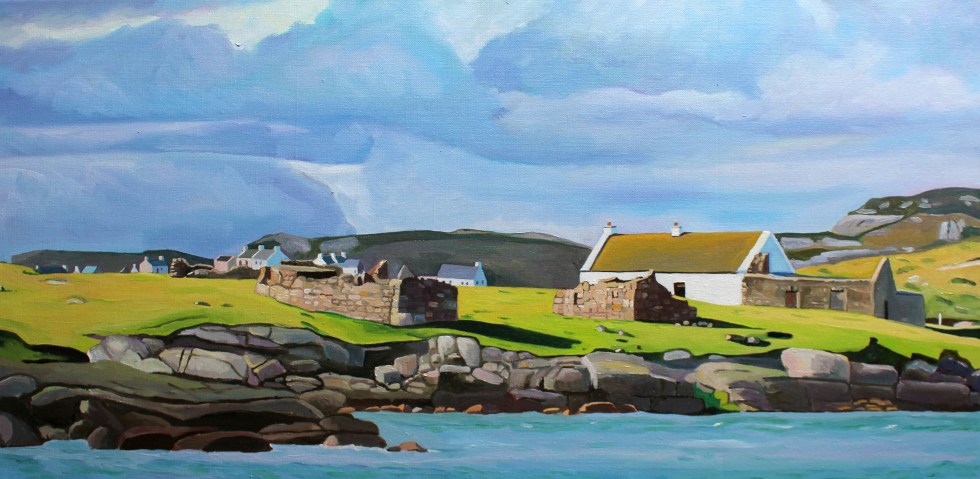
Over to Owey Island, West Donegal, Ireland
I loved the rocky landscape of the Rosses. It was a landscape like no other I’d seen before. Someone has said to me that it’s quite alien, like a moonscape in places. I love the granite rocks. We have a massive one behind our cottage in Donegal. I feel very affectionate towards it. It’s a protective presence, especially when it’s windy.
Over to Tullyillion
Of course, when you are in a different country to the one you were brought up in, everything seems fascinating. I have loved painting both the modern Donegal houses as well as the old cottages.
From Cruit Island
Over to the Rosses
House by the Wild Red Flowers (Arranmore)
I will freely admit I am quite obsessed by landscape spotted with old cottages on the Donegal islands, on Arranmore and Gola in particular.
Spring Light on Gola
Across to Inishbofin
This Beauty That will Pass
A House on Gola
Up From the Pier (Gola)
Oileán Ghabhla (Donegal)
Around Cloughcor (Arranmore)
Cottage on Inishcoo
On Eighter Island
The Red Roofed House, Arranmore (Private Collection)
I haven’t really got to grips with the mountains of Donegal. What I mean is that I need to visit them a lot more, walk up them and get to know them better. So far I have just admired the “Seven Sisters”, including Mount Errigal and Muckish from a distance.
Across to Dunfanaghy
Mount Errigal from Ballymanus Beach, Donegal
Over to Kinclassagh
The Pig’s Back (Muckish) Donegal
Swirling Clouds Round Errigal
Of course, the real joy of Donegal is the clouds. The changes skies. I am used to it raining, (I have lived in Wales for over 25 years) but the light is different by the North Atlantic Ocean. It is often more slivery, and more changeable.
From Magheraclogher Beach (Bunbeg)
Near Dunmore Strand
Rain over Dunfanaghy
Two Cottages
I think about Donegal every day when I am in Wales. My husband will place his current favourite Donegal paintings in the bedroom and in the lounge so he can look at them whilst we still have them.
Here’s my most recent painting Donegal painting. I am currently working on a painting of Arranmore Island, unfortunately, it rained so much here yesterday, the light went and I have yet to finish it.
Back Road to Burtonport
Donegal has lots of breathtaking scenery. I love the coast and the old white houses and a lot of my recent paintings have been concerned with depicting a more intimate impression of Donegal. I don’t like to get into a rut, and I will switch subject matter to challenge myself and keep my work “fresh”.
Painting mountains is one way of doing that for me. I have painted three pictures of the Derryveagh mountains since October 2018. They are based on a series of photographs we took on a trip to Horn Head. For an excellent interactive map of the area click here
Horn Head, Donegal
I had been worried about driving along precipitous cliff tops and we had parked up and walked up to Horn Head. The view was great but the overcast conditions did not make for particularly good photographs. We climbed up part of the spongey hill. I call it spongey because every time I put my put on something that wasn’t a rock, it sort of sank into the heather or boggy grass. It was very unsettling. So I leap from rock to rock. From here we took in the strong breeze and could see across to Dunfanghy.
There were also sweeping views across back towards Falcaragh and Bloody Foreland (Cnoc Fola in Irish). What a great name that is, it refers to the colour of the headland, not to some gruesome incident of the past. The light was in the “wrong” direction for decent photos but the view was lovely.
On the way back down to Dunfanaghy, the sun broke through the clouds off in the distance, we stopped and Seamas took some pictures. These are the photos the three paintings are based on.
These paintings are quite a commitment, in terms of effort and resources as they are physically large (for me, anyway) and mentally demanding. I usually like to paint bright and quite detailed landscapes. These paintings, in contrast, were an exercise in subtly and knowing when and where to include more or less details.
Across to Dunfanaghy SOLD
With all of them, I begin with the sky and work my way down the canvas. As with a lot of my work, I use the paint quite thinly and I find this helps keep the clouds feeling “light”. They are just layers of water vapor, after all. The linen canvas I use is primed with a clear primer so it is brown rather than white in colour. I find this brown works well as a base for dirty looking rain clouds!
My first two paintings I initially painted the distant mountains a range of graduating purples until I stood back and realised that they had to be lightened a lot. I spent a lot of time holding up my paint covered brush next to my reference photograph to compare the shades. I learned that the mountains had a lot of warm grey in them.
Wild Wind Over Dunfanaghy SOLD
The greens of the mid area and the foreground were much easier to gauge although I still visually checked that my tones were correct by holding the paint next to the reference image. The many walls and varying tones of the fields required a great deal of concentration. This was the most detailed part of the painting. I wanted the viewer to look into the distance rather than be distracted by detailed grass in the foreground. So the grass in the foreground is quite flat with only the odd change in colour to hint at roughness.
By the time I had painted the third, most recent, painting in the series, I had learned from experience to keep the colour of the mountains light. The falling rain over the far mountain meant that most of the tones of the grass and bogland were much more muted than in the earlier paintings. There was a lot of greys and purples in the grass and gorse.
Each of the three paintings, although they are of a similar view, each has quite a different feel to it. They remind me how on some days you can stand and watch the light and colours change second by second in Donegal as the clouds move and showers sweep in from the west. The last one does that the most. I think my next challenge will be to paint a mountain scene without any houses at all, just sky and mountain and resist the urge to add detail!
The title of this post comes from a 2005 albumby American musician, Robert Rich.
The inspiration for this album comes from mundane everyday experiences that culture usually overlooks, such as footsteps, casual voices and other ordinary sounds. Although I am sort of “New Wave” (that’s sooo old now, you’ll probably have to look it up) in my musical tastes, I have a sneaky liking for experimental music, if its “live”. I like how it encourages you to pay attention to all the sounds around you, instead of tuning them out with your thoughts. Its sort of mediative. The ordinary appeals to me.
The other day I finished one of my paintings, placed on the other side of my studio to inspect and found myself quite-spell bound by it. I could not stop starring at it. This is not always the way I am with my finished work. More often when I have been excited about a painting, finishing it is a bit of an anti-climax. Maybe, it wasn’t quite what I thought it was going to be. All I can see are the errors. The solutions that weren’t quite right, or not as good as they could have been.
So what was this painting that had me transfixed? You’ll probably laugh when you see it. It was a little painting of two blue tits on a branch. Not a spectacular painting, in any sense, I know. I realised, however, that what had me transfixed were the details. This is really geeky stuff. A shadow under one of the bluetits fell onto the branch below in a really pleasing way. It’s hard to show it here.
Two Blue Tits (detail)Two Bluetits
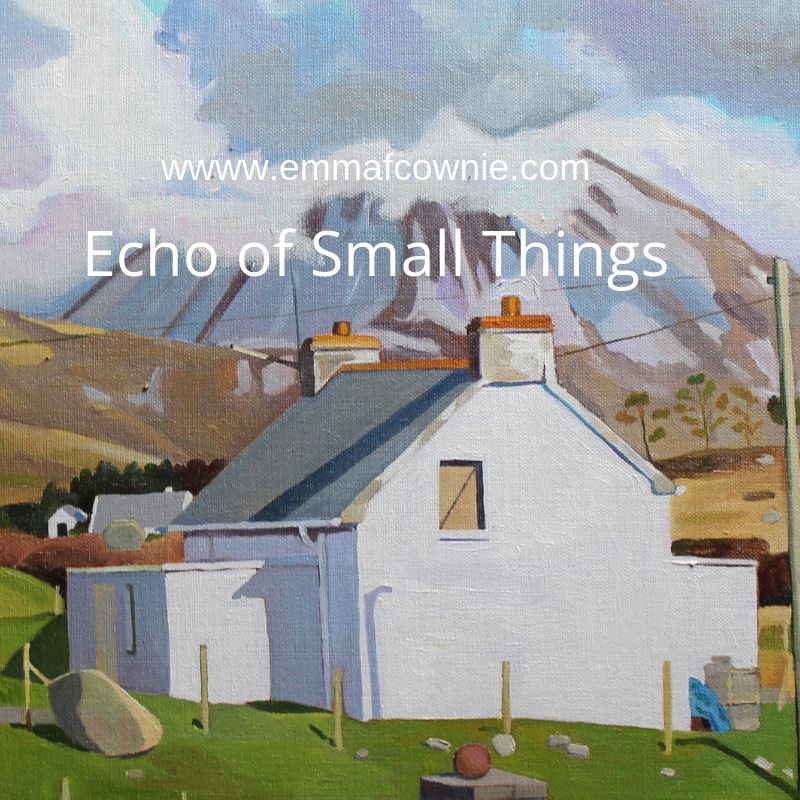
This is my most recent painting below. I choose to paint this because I liked the juxtaposition of the mountain behind the semi-derelict house.
Near Dunmore Strand
I didn’t realise at first that the gable end window is boarded up. It could be mistaken for a blind. Maybe it is a roller-blind pulled down.
Detail (work in progress)
I think the back door is also boarded up. These things are not immediately apparent. There is a large boulder to the left of the house. There is also a pile of building bricks and a tarpaulin in the yard to the right-hand side and old rope in the drive. This is a house at the start or midway through renovations. The details I really relished painting were the shadows of the chimney, roof and the telegraph wire that dissects the window at neat diagonal. It’s only by paying attention to these details that the Donegal light can be properly conveyed.
I have always had a fascination for the ordinary details that are easily overlooked. I want to convey what a scene looked like at that moment. If you were really paying attention. Yet, I am not a painter who works in the hyper-realist style. I am not skillful or patient enough for that. I often cringe when I see my paintings close up because I think some of my brushwork is crude. Yet, “perfect” representation can seem dead and unlife-like.
I think in the errors, the gaps, our brains fill in the gaps the image can come alive. I like that my paintings aren’t just copies of what I can see but an interpretation; the colours brightened, edges sharpened or softened, some details omitted to make for a simpler composition. Deciding what to leave out or simplify is as important as what you decide to include. Rather like Robert Rich’s “Echo of Small things”
Gola is a Donegal island I painted and thought about long before I set foot on its shores. I have written about it beforehere.Last month I was fortunate to visit it. The wind had woken me in the night. The early dawn had me awake by 6.30. I felt so tired and my limbs ached that I drank the last can of caffeinated energy drink that was sitting in our fridge (leftover from the epic drive up north).
We drove the 40-minute drive from Burtonport to the little harbour at from Magheragallon Pier, Bunbeg. The final part of our drive was along single-track road across flat grasslands which were home to both a graveyard and a golf course. That sounds grim but there’s plenty of space for both here.
View of Gweedore from Magheragallon (Machaire Gathlán)
It was the most perfect of days. The sun was shining, the sea was sparkling and flat and the sky was a hazy light blue. The sand was very light, but not white. The sea was incredibly clear and on a clear day like this, you could easily see the seabed, giving the sea a beautiful turquoise colour.
“The Cricket” at Magheragallon Pier (Machaire Gathlán)
The pier is well set up for waiting travelers with benches and a portaloo. We sat on a bench and waited for Sabba the boatman to give to signal to get on board. Seamas, my husband, tells me that Sabba the boatman has been sailing since aged 7. He has a facebook page herewhere he will post times of sailings and photos.
Fisherman off Gola
It’s only a 15 minutes crossing. As soon as we set foot on the island, I am struck by the sense of peace here. Most of the sounds you are of nature. Birds singing. Sheep bleating. The wind. That’s it.
Gola Pier
This is because there are very few motor vehicles here, one or two cars and some tractors.
A fine red tractor
Gola is in the Donegal Gaeltacht, where many people speak Irish. They are brought up speaking Irish at home and in school. So the signs are in Irish. Some have English translations, but not all did.
In 1911 as many as 169 people lived here but in the 1960s people started leaving as jobs and a better standard of living on the mainland and abroad had a stronger appeal than full-time life on the island. Only a handful of people live here all year round now.
Gola is part of the Gaeltacht
It’s so peaceful. The land is covered vast stretches of long yellow prairie-like grass spotted with rocks and a few sheep and their sturdy lambs. The houses are scattered across the island along tracks.
Boat for Sale on Gola
Some of the houses are modern, others have been renovated and are still lived in during the summer months at least, others are boarded up but many lie ruined, without roofs or reduced to crumbling walls.
Houses on GolaHouses on Gola
It was interesting to see the houses on Gola close up after looking across the water at them from Dunmore strand (see painting below). The houses are spaced much further apart than I supposed them to be. I was not satisfied until I had walked all the way to the southern tip of the island, so I could turn and look back at the houses. In this way, I could make sense of what I saw in early spring.
Spring Light on Gola
The houses are close but not that close. All of their front doors face southwards, towards the mainland. Mount Errigal and Muckish are off in the distance. I didn’t realise that you could see Muckish this far south. I suppose I have had never been here on such a clear day before.
Gola – View Towards the South West
I tried to take a photo of two camera-shy woolly donkeys in a field. They took exception to my presence and brayed very loudly at me. I got the message and left them in peace. Even the sheep eye you up, they are not used to strangers. They seem to look at you as if they are saying “You are not our farmer, what are you doing here?”.
Donkeys on Gola – No photos please!Port an ChruinnCottage to Let
Houses facing the mainland
On they way back to the boat we pass the infomation centre – an Teach Beag – its a large shed with tables outside. We are hot and I fancy a cup of tea. I try out the one bit of Irish I know on the man behind the counter “Dia duit” (“Hello”) I say. He then says something back to me which I dont understand. That stumps me. Turns out that he just said “Hello” back to me (“Dia is Muire duit”). I need to get a few more phrases/word in Irish under my belt!
This is Paddy Joe, who is 73 years old and still volunteers for the local lifeboat (training and teaching younger volunteers). It is noticeable how fit and active people in Donegal are, especially the men. We talk in English. I love listening to his accent, Irish is his first language. It’s musical. Part Ulster accent, part something else, something almost Scandinavian. Certainly, of the north. It sort of reminds me of the halting accents of Welsh-speaking farmers in North-Wales, as they seem to trip over their words as they think the right word in English.
Paddy Joe tells a story of going fishing down the Kerry coast and stopping in a pub for a drink. There are Irish speakers there but they do not understand the Irish speakers from Donegal, and the Donegal Irish speakers do not understand them either! I know that its similar in Wales, where Welsh speakers from the North use many different words from those in the West or South.
Some of the few trees on Gola
We decide to catch the 2 o’clock boat back as we have eaten all our sandwiches and the next boat is at 6pm. There is plenty more island to explore on another visit. We haven’t seen the sea arch at Scoilt Ui Dhúgáin, the lake Loch Mhachaire n nGall.
Clear Seas off Gola (Bloody Foreland in the distance)
The boat is setting off, when Sabba spots two girls who came across with us at 11am. He returns to shore to pick them up. They get on the boat looking very relieved. They clearly didn’t fancy waiting until 6pm for the last boat back. The sky is starting to cloud over as we cross and by the time we reach Magheragallon Pier it is overcast.
I have been back in Wales for three days now and the big difference from Donegal is the temperature and light. It is much warmer in Wales. Last week I was wearing a jumper – here I am in a T-shirt. In Wales, last night it was very dark by 10 pm. In Donegal, however, the light seemed unending. I struggled to sleep, despite being very tired, because although the sunset was after 10pm, it didn’t seem to get properly dark until after well after 11pm. Then it started to get light pretty soon after 4am!
I would sometimes wake in the early hours and look at the dark as a novelty. That’s something I’ve never done in Wales. Yet, I got used to this abundance of light. I made me feel active. With no television to slump in front of, I would find myself doing things after tea, such as the evening I found myself sanding a table at 9pm. I got used to life without news on the radio, although I did listen to some podcasts I had downloaded before I left Wales.
The day we visited Arranmore Island was a sunny Saturday. No jumper, just a shirt. There are two ferry companies that operate from Burtonport Harbour, the Red, and the Blue. They run all year round. In the summer months, they put on extra sailings. We plan to catch the 12.30 ferry, which is the Red Ferry. That’s the favourite colour of Seamas, my husband’s, beloved football team, Liverpool, so he’s happy. The ferry is very busy. It’s delayed by 10 minutes as the last car fills the boat to capacity. There are lots of teenagers and families on board. We stand by the rails as all the seats are taken.
Arranmore Red Ferry and an Oystercatcher
The journey to Arranmore is always a treat. The ferry is speedy. It takes not much more than 15 minutes to complete the three-mile journey. I love looking at the islands (and their houses) that lie alongside the route.
Rutland Island is one of the largest of these and lies to the west. There are some very beautiful modern houses on Rutland, alongside ruins which date from the 18th century. These were part of the planned settlement built by William Burton Conyngham. He also owned Arranmore Island. In my painting “From Ferry Coll” (below) you can see the remains of the fish landing and processing complex on the left side of the painting. There was also once a post office, houses, and a school-house here.
From Ferry Coll (SOLD)
On the eastern side, lies the islands of Edernish, Inishchoo, and Eighter. Here there are old cottages tucked in amongst the rocks. There is sparkling sunshine, but once we leave the shelter of the islands, the sea becomes quite choppy.
On the Way to Arranmore (SOLD)
When we arrive at Arranmore harbour there are lots of friends and families waiting for the ferry. There is a lot of waving and photos taking whilst we wait for the cars to drive off the ferry. Then the people can get off the ferry. There are lots of hugs, laughter, and chatter as the passengers finally get off the ferry. It’s a delightful scene.
Arranmore is well worth visiting. It is the second-largest Irish island (the largest is Achill, in County Mayo, if you want to know). It is seven square miles in size and it is dominated by an imposing hill called Cnoc an Iolair (“Hill of the Eagle”, 750 feet) which can be seen from most of the coast of Gweedore ad the Rosses. It has both sandy beaches along the south coast (three of them) and imposing sea cliffs (120 meters) along the west and north side of the island. Many of the islanders are native Irish speakers.
Many islanders used to support themselves through fishing, wild salmon in particular, but in 2006 the EU banned salmon fishing. This has caused a great deal of hardship and anger. It has also meant that many of the young people have been forced to move away in search of work, so the population of the island is dwindling and aging. You can watch a beautiful short film, “A Foot of Turf” about island life here.
Fortunately, the island has recently undergone huge technological advancement and has become the recipient of Ireland’s very first offshore digital hub. In celebration they wrote an open letter to American and Australia, hoping to entice new businesses to the island. Sadly, the story went viral and got distorted in the process. British tabloids, in particular, decided to reframe the story as the island being desperate for immigrants, “begging US citizens to move there” and decided to be offended that they “forgot” to invite British people, writing headlines like: “Anyone but the English”. This caused a great deal of distress on the island as this wasn’t what was intended at all. The letter was meant to appeal to American businesses to help boost the economy by giving islanders jobs – and visit the island.
So we are visiting the island. First, we made our way eastwards, towards the lifeboat station. We then backtracked and walk up the road past The Glen Hotel, which was the island’s first hotel in 1928. It was once the home of John Stoupe Charley, a Protestant from Antrim, who bought the island in 1855.
View Above the Glen Hotel, Arranmore
It was a long hilly road with a beautiful view across to the mainland. There were many old cottages and outbuildings here. The road was generally quiet but we were periodically passed by several cars. I like to take note of where cars are from, in Ireland registration plates in include letters to denote the county of registration. There were many with “DL” Donegal plates, but also plenty with “D” Dublin and Northern Ireland plates. Although I’d seen plenty of German and Dutch vehicles driving along the Wild Atlantic Way (past our house) there were none on this stretch of Arranmore road.
Over to the Rosses (Donegal, Ireland) (SOLD)
It’s considered good manners in Donegal (and elsewhere, of course) for the driver and pedestrian to acknowledge each other when the car has to slow to pass and the pedestrian has to clamber into the grassy verge. In Donegal, the driver will lift the index finger of his right hand. The pedestrian will similarly lift his or her finger but not necessarily raising the hand to do so. Smiles will be exchanged too. Nothing to exuberant, but friendly. It’s rare that this doesn’t happen, sadly it does on occasion and then it is followed by a short discussion between Seamas and myself about the drivers of particular makes of cars and/or people from NI/Dublin/hirecars.
Me on Arranmore Island, Donegal
We get so far and decide to retrace our tracks and walk in a big loop along the west side of the island, which provides us with sweeping views across to Burtonport and Dungloe. If you look carefully in the photo below you will be able to see the old courthouse to the right. This was built at Fal an Ghabhann (Fallagowan) around 1855.
Old Courthouse, (Arranmore Island) SOLD
Eventually, the road wound downhill. We could hear the sound of singing on the wind. A choir singing? We eventually came to a large white Community Hall, the doors were open and inside were lots of young people singing in Irish. These were some of the hundreds of teenagers who come to the island as part of a summer scheme to learn and improve on their Irish language skills.
As if to reinforce this, a tall teenage boy passes us and greets us in Irish. Seamas manages a greeting but then tells me that the lad had used a different form of words to the one he’d learned over 30 years ago. It seems that the Irish language is very similar to the Welsh, in that it has many regional variations in terms of accent, pronunciation, and words used.
House By The Red Wildflowers (SOLD)
We finally made it back to the harbour and had two delicious cheese paninis in the sandwich shop.
Here comes the Blue Ferry!
The journey back to Burtonport harbour on the Red ferry was very enjoyable, with the passengers still in a buoyant holiday mood, waving at the passengers on the Blue ferry as we passed. A holiday maker’s car alarm kept going off. His embarrassment levels pretty much matched that of his children’s amusement.
I kept a lookout for dolphins or seals but saw none. Only sea birds. An American told me that he’s seen Minke Whales in Clew Bay recently. We had seen dolphin on the way back from Tory island. He had a theory that there was a bumper crop of fish 8 miles out at sea, which was where the wildlife were. Usually, the waters around Burtonport would have plenty of seals and dolphins. That’s something to look forward to seeing another time.
For more on Arranmore and other Donegal islands in general doub;e click on the link
It was a long walk to the lighthouse at Whiteford Point on the northern tip of the Gower Peninsula. The last time I walked here, I just looked at the lighthouse from the beach. This time I wanted to get up close. We had left it late and the tide had already turned when we got here. The last stretch to the lighthouse is across lots of slippery, small rocks were surprisingly difficult to walk across. It took a good 20 minutes to make our way across them.
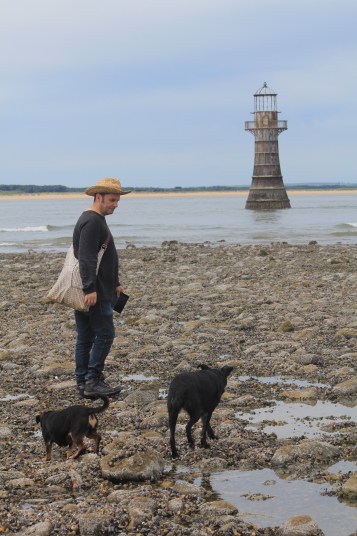
I was accompanied by Seamas, myy husband, and our loyal dogs, Biddy and Mitzy, who were not keen on the rocks but will follow Seamas anywhere.
Seamas (in hat) and dogs at Whiteford Lighthouse
The iron victorian lighthouse had cormorants perched on it when I got there (ahead of the others) but a motor boat came past and they all flew off!
Birds flying away from Whiteford Lighthouse
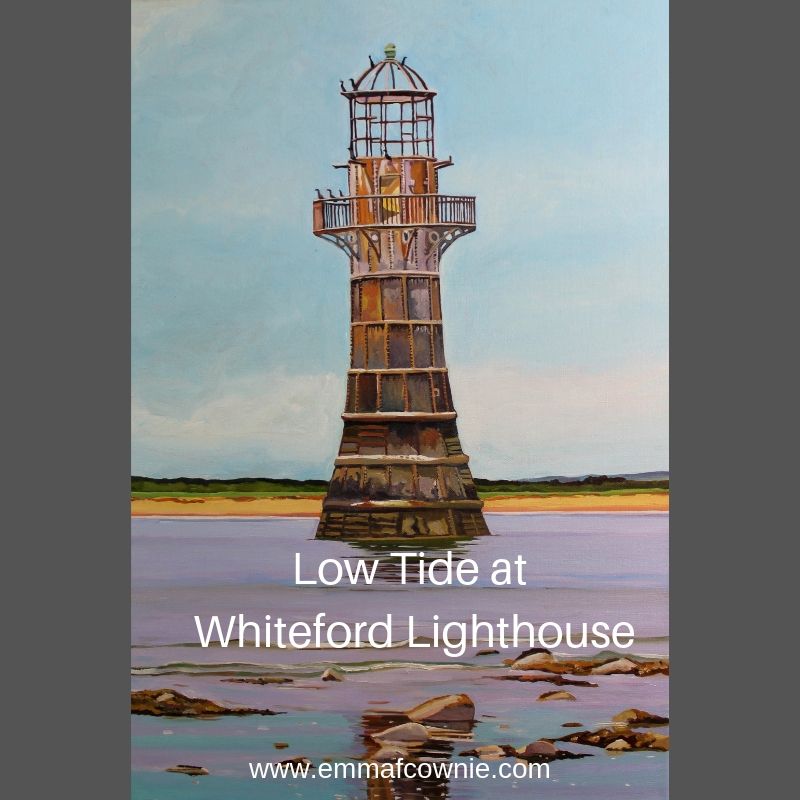
Here’s my painting. I love the colour of the rusted iron of the massive thing and the sea-life that clings to the lower half. It was a hazy day so the sky is bluish and the sea has a slight mauve tinge to it. The waves are gentle but advancing.