I have been on the Artfinder website since 2013, and during that time I have been fortunate enough to sell an incredible 788 artworks! I am very proud of the 254 5-star reviews that I have collected over the years via Artfinder.
So, I thought that I would share with you some of the customer reviews and messages I received last month from the collectors of my work on Artfinder. They are the icing on the cake for me and my husband Séamas, who has been working incredibly hard packing and shipping my work whilst I am recovering from my broken leg & ankle. I often think that my collectors describe my work better than I can and love reading what they say. I am very happy that my work is appreciated and enjoyed around the world.
After You Are GoneThe Red Roofed House, Ireland
Review by Maureen, I love these beautiful, atmospheric pieces. Emma captures her subjects to perfection. These two pieces are special to me as they remind me of my youth, growing up in an offshore Island in Ireland I look forward to seeing more of Emma’s work.
Winter Shopping
Review by Laurent- “This [“Winter Shopping”] is the third painting from Emma I have bought. As before, everything has been perfect… great communication, delivery in two days.. And it is a beautiful painting!
StormOver Inishbofin
Message: Dear Emma, The painting [“Storm Over Inishbofin, Ireland”] has just arrived safely. It is lovely and I especially like the contrast between the optimistic houses and the darkening sky! Best wishes, Katharine
Between Tides, Tenby
Review by Cameron, Have been viewing Emma’s works & style for a while now so grey happy to finally have 1 of her works hanging in my home [“Between Tides, Tenby”].
Hazy Tenby
Review by Elissa, “Love this painting [“Hazy Tenby”] which was despatched and received within a few days of ordering. Thanks so much, Emma”
Roshin Acres, Ireland
Review By Helen, “We were so pleased to purchase the painting [“Roshin Acres, Irealand”]. It is beautiful and when it arrived it was what we had hoped for when we purchased it. It arrived super quick”.
We are all told to stay local in Wales, until July anyway. I am still recovering from the operation to pin my broken leg so all of my journeys are very short, and very slow, anyway. I have been taking more adventurous journeys of the mind to Donegal, and to the little village of Maghery in particular.
It lies just a stone’s throw (4 miles or about a 10-minute drive) down the road from Dungloe (I regard Dungloe as the center of my universe when I am in Donegal because it has supermarkets like Lidls, Aldis, Supervalu, and The Cope). The Irish name for Maghery Glebe is An Machaire. We know that people lived here over 5000 years ago because they built stone circles, left tombs, a Crannóg, and a stone fort.
Maghery Beach with Arranmore in the distance
We have only ever been to Maghery twice. On both occasions, it was to visit Crohy sea arch. We failed to find the arch, but we did see some very fine sea stacks called Na Bristí on our second visit. We also found found two beautiful beaches, a Napoleonic signal tower, and Second World War look out post and my favouite, and an Éire Sign.
I would like to visit again, but instead, I can only visit online and “in paint”. The drive through the village has inspired my latest series of three paintings. (The first two paintings have gone to collectors in France and the USA). I was drawn to paint the pink and mauve old houses in particular, mixed in with the white stone cottages.
Driving into Maghery SOLDPink House Maghery – SOLD
Through Maghery, Donegal Ireland
Its only now that I realise the mauve house in my 3rd painting is a very similar colour to the early morning sand on the pristine beach nearby.
Maghery Beach, with Maghery village and Napoleonic signal tower
People have been looking out at the Atlantic Ocean and the surrounding land from the hills near Maghery for hundreds of years. They haven’t always been admiring the view, either. During the Napoleonic Wars, a signal tower was built on the headland in the years 1804-6.
Signal Tower at Maghery
This was one of a series of 12 towers built along the Donegal coastline, to watch out for invasion from French forces. We dont have these in Wales, although Wales invaded by a French force in 1797. That’s beacuse it was not built to protect the Irish population from the French, but because the British did not trust the Irish not to welcome the French with open arms. A few years earlier Irishman, Wolfe Tone, had attempted but failed to land a French force near Lough Swilly. The plan had been to throw the British out of Ireland. His landing failed but there was a successful landing of French forces further down the coast in Mayo. A brief declaration of an Irish Republic followed, but the Irish Rebellion ultimately failed, after a series of battles in Wexford culminating, in defeat at Vinegar Hill.
The signal tower is thus a symbol of deep mistrust by the British. This particular tower is well preserved and surrounded by walled farmer’s fields. The men who were garrioned here communicated with neighbouring signal towers by raising and lowering a large rectangular flag, a smaller blue pendant and four black balls in various combinations along a system centred on a tall wooden mast. This must have been very difficult if not impossible in poor weather conditions.
About 200 meters down the road is the Second World War Eire sign. I am not sure why but I was more excited to see this than the tower. Perhaps, because it was tucked away, designed only to be seen from the air. Perhaps also beacuse it is cut into the grass like a prehistoric chalk horse.
Eire 74 sign at Maghery
The letters spell the word Éire, which means “Ireland” in the Irish language. Over 80 of these numbered Éire signs were dotted around the coast of the Republic during the Second World War. I originally thought this was to warn German bombers that they were flying over a neutral country. This was important as neighbouring Northern Ireland, being part of the United Kingdom, was not neutral. I was wrong, the main purpose of these numbered signs was as a navigational aids for the Allied planes.
Although the Republic were offically neutral they were indirectly involved in the war. In the Spring of 1939, expecting another European War, the British Government had asked the Irish Government to set up a Coastguard Service. The Irish Government agreed to build a series of small concrete huts, known as Look Out Posts (or LOPs) along the coast. There is this one at Crohy and there was another on Arranmore Island near by. The letters Eire (without the accent on the “E”) were written in stone nearby to give aircraft an idea of where they were. The stones were painted white. The numbers (74 in the case of Crohy) were added in 1942 after the Americans entered the war in December of 1941. (Thank you to Séan Bonner for this information).
These huts were pre-built in parts and assembled on site by the army (as the Coastguard Service was under the control of the army). The Irish Government agreed to build the huts and set up the service but on condition that they only would supply radios to the huts in the event of a war. Coast watchers worked around the clock in pairs, reporting every activity observed at sea or in the air by telephone.
As the aircraft would have seen it (Photo Credit:Conor Corbet)
Allied aircraft were allowed to fly over the Republic through the “Donegal Corridor” to airbases in County Fermanagh. These airbases were crucial to provide “cover” for the shipping convoys that came across the Atlantic bringing industrial raw materials and food to Britian. Without fear of air attack, German U-boats would operate as ‘wolf packs’, picking off the ships one by one. All flights were meant to take place at “a good height”. If any aircraft crashed, as at least six did, if they could claim they were on a non-combative mission, they would be repatriated. While it was easy for Allied pilots to make that claim, it was not realistic for Luftwaffe pilots to do so, they tended to be interned. Ireland also helped Britain in secret by setting up an armed air/sea rescue trawler called the Robert Hastie at Killybegs, Donegal, to help any shipping casualties and to supply planes that had run out of fuel.
I didn’t realise it at the time but this is just an updated version of the Napoleonic tower. The ruins above the Eire sign is that of a coast watch station. Coast watchers worked around the clock in pairs, reporting every activity observed at sea or in the air by telephone.
Further along the road is Crohy Head. I think techically is Crohy Head, South. Although there is space to park and a sign announcing its presence, you can sense that the local authority are not all wildly keen to promote this attraction in case people fall down the steep field/cliff face trying to get a good look at it.
The Sign for Na Bristí
I am sitting here with my pinned leg resting on a chair, and it’s twitching unhappily at the sight of these photos now. My leg does not like to think about rough terrains right now. I can just about manage a slow walk around my local park these days (it’s going to be a long slow build up to full recovery). We must have been mad! I thought so at the time too. Still, my husband Séamas who climbed down to the beach to take some photos whilst I sat on the hill holding onto some yapping dogs. To my shame, there was an artist with his easel painting en plein air at the top of the field. I wonder if he could hearing me hushing the dogs and telling Seamas to hurry up.
Sadly, the light was, in my opinion, in the “wrong direction” and early morning would be a better time of day to catch the sea stacks. The sea arch, was just out of sight around the corner. I think that I will save up and buy a drone to take photographs from higher up without imperilling any of my (or my husbands’) limbs! Or a boat. Things to dream about from my chair.
Here is a marvelous drone photo of Crohy Head.
Sea Stacks and Sea Arch at Crohy Head (Photo: Gareth Wray)
Finally, I managed to scale the steep steps to my attic studio! One step at a time. Holding on the handrails.
Ah, what pleasure it was to be back in the attic. It has a view out the back of the house. It is a great pleasure to look at the wooded parks and hills of West Swansea instead of the unrelenting concrete streets and terrace houses out the front of the house. I have a number of commissions to fulfill but I wanted to “warm up” with some small paintings first as I have been working with watercolours for the past two months. Here’s a selection:-
Table Mountain (Crug Hywel)
My first reaction to oil paint was how slow it all is in comparison with watercolours. With watercolours, most of the effort goes into planning and preparation and then the execution of the painting itself is quick. Putting oil paint on the canvas was more laborious that watercolours. I also had to rummage around for looking for the right sort of paintbrushes, a few times. I could not quite lay my hands on what I needed. But, ah! The paint did what I thought it was going to do. What joy! If I changed my mind about a composition or decided that something did not work I could wipe it off the canvas. It did not reproach me for making a mistake by showing it to the world for ever! Nice!
Anyway, I sat down and started a series of new Donegal paintings. Here they are.
Wee House on Gola, Donegal (SOLD)
Storm Over Inshbofin, Ireland (SOLD)
The Two Tin-Roofed Sheds, Arranmore, Ireland
Blue Door, Gola (SOLD)
The Old Stone Shed Arranmore Ireland
These paintings are from the past few weeks. I have also worked on two commissions. It has been slow work at times as I often need a lunchtime nap to keep my energy levels up. I do my rehab exercises several times a day which can be very tiring. On a positive note, I finally got to speak to a physiotherapist, Josh, who has been very helpful. He has posted exercises to me and giving me guidance on how much to do. I can walk upstairs reasonably well, but downstairs one step at a time. When I get tired my ankle gets sore and I limp. I try and avoid that if I can.
What did I learn from watercolours? That I can and should edit and play around with compositions more. I simplified my images as much as I could. I changed the skies or left out an inconvenient house. I found this freeing and I brought an element of this to my oil paintings. For some reason, I have felt to need to be truthful to the real-life locations I painted. I realise now that I don’t have to. I can happily leave out a telegraph pole or a lamp post if it confuses the composition.
Wren
Watercolour painting of robin
What do I miss about watercolours? The tidiness. Clean clothes and hands. The lack of chaos. The speed. The brushes that don’t wear out by the time you have finished a large painting. The lightness. They convey the lightness of birds better than oil colours. Also the convenience, I could pack away all my paper, paints, and brushes in one big bag. I am looking forward to using them outside when I can walk much longer distances!
Watercolours are not usually my thing but circumstances have changed that, for the time being. When I came out of the hospital after my operation to fix my broken left leg, I knew that I going to off my feet for at least 6 weeks. I also knew that it would probably take another 2 to 3 weeks to be fully mobile again. I had all sorts of vague ideas about oil painting again but when I got home I realised that they were hopelessly impractical. My house is full of steep and narrow stairs, so that meant I was going to pretty much confined to my bedroom.
My husband, Séamas, went to a lot of effort to set up the bedroom ready for me. He dismantled the round kitchen table and reassembled it in the bedroom. He also brought up an armchair and two dining chairs for me to sit on and rest my recovering leg on. The table is not very big so that means that the only sort of paint I can hope to use in this limited space are watercolours.
Organised chaos on the ex-kitchen table
I have a love-hate relationship with watercolours. They are portable and come in cute little boxes but they are the least forgiving of all mediums. If you make a mistake it shows. I used to dabble in them many years ago but I always prefered to use acrylics, oil pastels and oil paints, because with all of those mediums you can scrape back or paint over mistakes. Not so with watercolours. They show you up are the second-rate artist you fear you are!
Cloughcor Cottage Arranmore
In my first efforts with the watercolours I used them in pretty much the same way I always had done.
Whilst I was reasonably happy with the foliage and grass in the picture, I thought the sky was too muddy.
Crug Hywel, Brecon Beacons
I decided I needed some technical help. So I got Séamas to go up to the attic and dig out my tiny Collins Gem book on Watercolour Tips by Ian King. What a marvel this book is!
It has many excellent pointers on mixing watercolour paint, making washes, the translucent nature of some colours, as well as the importance of simplifying the composition.
Four sketches of Table Moutain
So I took these points on board, in particular the importance of simplifying the image. I realised that less is more. It changed what I painted. I was much happier to edit my compositions in a way that I don’t usually in my oil paintings. So I decided to simplify my compositions as much as possible and paint a series of studies of the houses on Gola Island.
I was cautious, however, of unintentionally taking on another artist’s style of painting. I wanted the skills but not the style. I didn’t want to paint like these watercolourists, I wanted to paint my way, but in watercolours. I also wanted to keep the paint as “light” possible to keep the painting looking fresh and airy.
Gola Houses (watercolor)
It might sound odd, but I wasn’t familiar with the properties of the colours in my paint-box. Blue watercolour paints act differently to blue oil paints. I needed to experiment and learn how they were different.
In the end, to help me understand what each colour could do I painted each one on a piece of paper so I could look at it when deciding which color to use. This helped me enormously.
My watercolours
I also struggled with how to paint a “simple” wash for some time. One online artist recommended mixing up a lot of paint so that it was “like tea”. This did not do the trick for me. I was reassured by another artist that washes were actually pretty tricky and some colours were harder to use than others. I found this reassuring. I helped me keep perservering. There’s nothing like someone saying “Oh, but it’s easy” to make you want to give up when it’s not easy!
Eventually, after a conversation with my mother (who was a keen water colourist), I tried a different brush and also several pots of water. One to rinse my brush in, the others to dip my brush into before I put it in the watery paint mix. That seemed to work for me. I felt slightly more in control of the process and my skies were less lumpy.
I have a long way to go but I am lot happier with my paintings and I hope that I can use these skills to paint “en plein air” when my leg is better it is safe to go outside again, whenever that will be. Until then, I will keep practicing!
Post Office at Baile Ailean
I would like to thank Séan Ó Domnhaill for the use of his photographs of the red-roofed Post Office on the Outer Hebrides and the Isle of Lewis.
While the rest of the world is on coronavirus lock-down I am confined to my bedroom with my leg in a very heavy plaster. Moving from the bed to a chair involves a lot of hopping and a zimmer/walker frame. It all takes a lot of effort to achieve simple things that I never gave much thought to before.
I broke my left leg. I have broken both lower bones and dislocated my ankle. Six days ago I had an operation to pin the bones in my ankle. My brother asked if breaking a bone is more painful than a toothache. The answer is definitely yes. I have endured 50 shades of different pain since I went for a walk with our dogs 2 weeks ago in my favourite woods, near Ilston, Gower. It was just about the worst time to break my leg, to be honest.
Ilston River (SOLD)
I had walked about half a mile along the side of the stream. I had bought a new camera with me and my attention was caught by the sunlight on a mossy tree. I decided I would move closer to take a photo. Instead, I stumbled over a muddy stick and as I put my left foot out to steady myself I felt it twist and a sickening snap. I rolled on the wet ground, hoping against hope that I hadn’t done something dreadful but the horrible pain told me that I had. My foot was bent out of shape. Just to think about it makes me feel ill, even now.
As I lay on the ground, I wondered what to do. I tried shouting “Help” a few times but felt silly/useless. What could I do? My husband was in Ireland. Fortunately, I had my mobile phone in my handbag and it was charged with credit so I rang for an ambulance and waited, and waited. The call handler told me not to move. It was cold on the wet mud. I took a photo of my bent leg. I have not looked at it since. I don’t think I can bear to.
Ilston Cwm – Close to where I broke my leg
I assumed that the ambulance would not be too long (I was very wrong on this score) and I started to worry about my two dogs, what would happen to them? I rang my neighbours Rob and Liz and told them what had happened and where I was. Rob said he would come for the dogs. So I waited. I lay and looked up at the sky. Blue patches and white clouds drifted by. It started to rain. Then the sun came out again. I was still lying on the ground. I don’t remember what my dogs were doing but they were nearby. I think Biddy, the collie-cross, tried to present me with a few sticks to throw for her. I clutched my injured leg, it really hurt. I rang my husband. It went to voicemail. “I am lying in Ilston Woods, I think I have broken my leg. I have rung for an ambulance. I have spoken to Liz and Rob. Rob’s coming for the dogs….” I felt bad about leaving him a message when there was nothing he could do.
View From the Bridge 100 x73 cm
After a long time, a family appeared on the track, a couple with their two girls. “Help, I think I have broken my leg”. I think they were surprised by this as they walked towards me very slowly. I told them that I had called for an ambulance and my neighbour was coming. They took my phone number and said they would go down to the road and look out for Rob and/or the ambulance. So they left me and I waited and waited. Company had distracted me from the pain in my leg and being on my own meant being with the pain. I rang my husband again and then Biddy started barking. It was Rob. Thank God.
“How long have you been lying there?”
“45 minutes. The Call handler said to stay where I was”
“That’s stupid advice. She can’t see your situation. You will get hypothermia. We need to get you up” So with great difficulty, Rob helped me up off the wet mud and I hopped in slow agony to a mossy tree, where I first leaned against a trunk and later sat on a low branch. He had brought a heavy hi-vis coat which he put around my shoulders. It was blissfully warm.
I wish I could say that was the end of it. That the ambulance came soon after but they didn’t. We waited and waited and rang the ambulance again. It was difficult explaining where I was to call handlers who were not local. They wanted to know the name of the church at Ilston. Ilston is the tiniest of Gower villages. There are about 10 houses. There is only one church. What did it matter what saint it was dedicated to?
So after another long wait, I asked Rob to walk down to the house opposite the church at Ilston to ask them to ring the ambulance, perhaps they would be able to give better directions. We had often passed the people who live here, they waved in a friendly manner and I was hopeful that they would help. Rob left with my two dogs, Biddy and Mitzy, in tow. I sat and waited. The pain was worse when I did not have any company to distract me. I looked at the mud by my feet. I was dimly aware of a robin on a branch a few feet away from me. And then like a miracle, little Mitzy appeared by my side. She was collarless. I was so glad to see her. She was not leaving me. Good loyal rescue dog to the rescue. I took her photo as a distraction from the pain.
Mitzy the faithful rescue dog, to the rescue.
Rob returned with David (and Biddy on her lead). David is 73 and lives in the house opposite the church. He made several trips along the track, and brought me many very welcome items like a big blanket, gloves, hat and a hot water bottle. I was really thirsty and he also bought a bottle of water but David’s wife had said I could not drink anything, her advice turned out to be right, so I just washed my mouth out with it. He made several trips. The last one in the dark with a torch. He took quite a risk, helping us in the dark. We got excited because the beam of his light reflected in the stream and it looked like two people were coming along the track, but it was just him. It got very dark, The moon came out and a barn owl hooted. We told him to go home, we were worried about him in the cold night air. He reluctantly set off.
I started to think that no one was ever going to come. I was so cold. It would be difficult enough to get me out of here in daylight but in the dark? I kept thinking up with ideas for getting how to get me back to the road; What about a horse? A wheelbarrow? One by one my desperate ideas were politely considered and sensibly dismissed. Rob was a reassuring presence. They will come he said. Then eventually, Rob said, says, “I think I can see lights along the track, more than one!”
At long last, the ambulance service had come. After 5 hours of waiting. Two figures dressed in green, a woman and a man, carrying torches were coming along the path, with David and his brother-in-law leading the way. I was so relieved. Once they were there, I knew they could sort everything out. And they did. Lyndsey the paramedic was lovely and reassuring. She worked under very difficult circumstances. It was dark and very cold. She checked my blood pressure, temperature and although I felt so cold my body temperature was normal (hurray for thermal vests, I say). I was given a small dose of morphine which had me seeing stars and then liquid paracetamol. They called Sketty Fire Brigade to put me on a stretcher to carry me half a mile down the track (and over the church fence) to the waiting ambulance. It was a long journey looking up at the cold frosty stars through the tree branches from that stretcher. It was a full moon. They carried me wordlessly. There was a short snort of laughter when I said “Well Done” after they had hoisted me over the churchyard railing.
Ilston Church Yard
It was a very long night. The journey to Morriston Hospital Hospital seemed slow. Where are we now? I would ask. It was the pain that made it feel that way. We waited outside A&E in the ambulance for quite a while. Lyndsey told me her mother was the first baby born in the NHS and called was Aneira, after the Welsh founder of the NHS Aneurin Bevan. Eventually, I was taken in for my first X-ray. I was visited by a number of doctors who introduced themselves to me by their first names; Jeremy, Mohammed, Chris there were others but I have forgotten them. After a wait, the doctors in A&E manipulated my leg (I was under light anesthetic) and put it in plaster so that the agonizing swelling could start to go down. The leg was X-rayed again. Everything was aligned nicely. Every now and then the average waiting time in A&E was announced on the loudspeaker. It started at 8 hours, later it was 13 hours and then by lunchtime the next day it was down to 2 hours. I lost track of time. I didn’t get much sleep in A&E. It was a fascinating place, very hectic. No wonder there are so many drama series set in Emergency Rooms & Casualty Departments.
Anyway, to cut a very story short I waited a day for a bed in the trauma ward. I then spent another 7 days waiting for the swelling to go down so the ankle could be pinned. I was “nil by mouth” for 4 days in a row but never made it to the operating theatre. Thankfully, on Monday I did, finally. It was probably just as well as the ankle specialist was working that day. The coronavirus emergency meant that the ward was rapidly cleared, as they needed the beds and staff elsewhere. I was sent home on Tuesday via Red Cross Ambulance.
All through this experience, I have been impressed by the kindness and amazing patience of medical staff as well as just how much pressure the NHS is under. The pressure has just intensified ever since. I would like to thank Rob and David in particular, who waited so long in the cold with me, and Liz and David’s wife, and anyone who I came in contact within A&E, Ward A (which then had to move upstairs to become Ward G), the operating theatre and the Red Cross. Thank you xxx
Postscript:- Biddy and Mitzy went home with Rob and slept all the next day. Seamas flew back from Ireland on a plane full of racegoers heading for the Cheltenham Races.
Today is International Women’s Day. As I drove through Mumbles yesterday afternoon I was reminded of two remarkable Swansea women and I was pondered on why we like to focus on very unsual women, rather than remarkable ordinary women. It got me thinking about other notable women of Swansea, past, and present
Here’s my list of five that came to mind:-
First comes the women of privilege:-
1. Thereza Dillwyn Llewelyn (1834 –1926). She was an astronomer and pioneer in scientific photography. She came from a wealthy family and her father was a pioneer photographer, astronomer, a botanist and a Fellow of the Royal Society. She made some pioneeringtelescopic photographs of the moon in 1857/8.
2. Amy Dillwyn (1845-1935) – She was a radical novelist, feminist campaigner, and early female industrialist. Amy was first, a novelist, and a supporter of sexual equality and women’s suffrage. When her brother and father died in the early 1890s she found herself responsible for a workforce of 300 and a spelter business crippled by debt. Impressively, despite losing her home, she decided to run the business herself, which she did successfully. She was a strong supporter of social justice and in 1911 gave her support to 25 striking seamstresses, who worked for Ben Evan’s, a local department store. These dressmakers were demanding a living wage in return for their long hours. Amy called for a boycott of the store and encouraged her friends and family to not shop there. Her eccentric appearance, her habit of smoking cigars and lifestyle make her appealing figure to modern eyes.
Now to some working women.
2. Jessie Ace and Margaret Wright (neé Ace) these two sisters were the daughters of the Lighthouse Keeper, Abraham Ace. In the winter of 1883, these two sisters valiantly rescued two lifeboat crewmen, in the midst of a terrible storm, by tying their shawls together to use as a rope. Margaret supposedly exclaimed: “I will lose my life than let these men drown” as she waded into the icy waters.
4. Iris Gower (1935 – 20 July 2010)- This was the pen name of Iris Richardson a prolific novelist who wrote many historical romances set in this area. I once heard her talk about her writing and was left with the impression of a resilient, hard-working woman with fiery red hair, who was a force of nature. She talked about her early days of writing, about getting up before her 4 children to write, before going to work! I don’t think she ever let up, writing about 35 novels and many articles too.
And finally (as I drove down Mumbles Road and passed her beautiful house on the hill) I was reminded of
5. Bonnie Tyler – who I once saw in Sainsbury’s on Christmas Eve several years ago. She looked very glamorous holding her wire basket in the tea and coffee aisle. I don’t think I have ever looked that glamorous, probably not on a night out and certainly on a trip to he local supermarket. Bonnie was the daughter of a coal-miner and grew up in a council house and left school with no qualifications, but talent and a lot of hard work led to a phenomenally successful musical career. Her two singles “It’s a Heartache” and “Total Eclipse of the Heart” are among the best-selling singles of all time, with sales in excess of six million each.
It’s hard not to focus on exceptional women like these. Often, we end up focusing on unusual people because we know more about them. There are newspaper articles, books, and photographs of them. I cannot find an online image for the “Ben Evans’ Girls” who went on strike in 1911. Those 25 striking seamstresses that Amy Dillwyn supported, would have been just as hard-working as Amy was, but lacking in the advantages her privileged upbringing and family connections had given her.
Ben Evans, Swansea
Interestingly thousands of Swansea people attended a mass demonstration in support of their cause. I could not find out if they had won of lost their cause for a decent wage. Iris Gower’s fictional women, may have been romanticized, but their hard lives were real enough. So here’s to all the women of Swansea (and everywhere else) the world, past and present, famous, infamous and obscure!
A while back I came across a quote on the internet that has stuck in my mind:- “If I knew the world was to end tomorrow, I would still plant an apple tree today.” I was quite struck by this sentiment, especially in the light of current events.
I could not remember who said it. So I did some research. I was intrigued by what I discovered online. I found a number of statements:-
It was originally said by Martin Luther, a 16th century German monk
It was originally said by Martin Luther King Jnr, the 20th century African-American Civil Rights Campaigner.
It wasn’t said by 1) or 2)!
This puts me in mind of one of my favourite internet memes by that teller-of-truth Abe Lincoln…
Just joking!
The apple seed quote apparently originates in Nazi Germany in the 1930s, in the Protestant Confessing Church, which used it to inspire hope and perseverance during its opposition to the Nazi dictatorship.
To be honest, it doesn’t matter who said or when (although there’s a lesson about taking things at face value there) because I like the sentiment. No matter how dreadful things seem, they will pass. Eventually.
Here is my apple seed for this week.
The Road by the Loch, Ireland (80x60cm/ 31.5×23.5″)
This is a follow on from my last post about composition and large landscape paintings. Included a small study of a view of Arranmore, Donegal. The study used a diagonal composition.
Study 10cmx14cm (SOLD)
A Beginners Guide to Composition (Diagonal Composition)
When it came to a much larger painting (60x80cm – approx 24″ x 32″) I decided on a slightly different composition. It wasn’t that I didn’t think the small painting worked, because it did, but because paintings in the “landscape” format are more popular with collectors than those in “portrait” format. It might have something to do with wall space, I am not sure. If you are not sure what “landscape” and “portrait” format is, it’s just about which round the painting is positioned. “Landscape” has the longest side along the bottom, “portrait” has the shortest side along the bottom.
Landscape format allowed me to include the sweep of the hill as it fell away from the viewpoint towards the sea. This composition used the rule of thirds, so the painting has a different energy to the study.
Beginners Guide to Composition (rule of thirds)
Down the lane, Arranmore (SOLD)
The position of the viewer is slightly different, it has moved to the left and so more of the house in the foreground can be seen. The larger painting also has a red tractor in the lane, which the study did not, which draws the eye down the lane: hence the title.
Detail – Tractor
I particularly enjoyed painting the different textures of crops and grass in the field that were not visible in the study painting. The widened composition also included the large cross on the shore to the left. I did not realize it at first but the wall in the corner of the painting is a graveyard wall. This is the graveyard of St. Crone’s chapel. Saint Crone was a sixth-century Irish saint descended from King Niall Noígíallach (‘of the Nine Hostages’) and a contemporary of Saint Colmcille (St. Columba of Iona). Saint Crone was very active in the Rosses area. The parish of Dungloe on the mainland also takes its name from her; Templecrone.
Detail – The Cross
So executing a study can be a useful tool in thinking about the composition of a larger work. It will show if a composition works or not but it can also suggest improvements and variations. Interestingly the study is a painting in its own right, it has a different, lighter feel to it. Small paintings often take just as much thought and effort as larger ones even if they are quicker to execute.
My PC just crashed. I am not sure if that’s a result of the effects of Storm Dennis (we had downpours all night long here) but I am going to stop here!
Failures are always a challenge. When I used to be a Secondary school teacher, I always learned more about teaching when I faced a difficult class than a nice docile one. They made me go away and think about what I was doing and how I could do it better. Painting is no different.
I have been thinking about the composition of larger paintings. When I used to think about painting a scene I used to think in terms of “that’s a small painting, it won’t “stretch” to a larger canvas”, or “That’s a mountain, definately, therefore, it’s subject suitable for a large canvas”. I am parodying myself somewhat but generally, I have this feeling that small birds belong on small canvases and big landscapes belong on larger ones.
My thinking was challenged by a commission I did in the summer where a client asked for a very large version (120 x 90cm) of a relatively small painting (41 x 33 cm). So I scaled up and despite my anxiety, it worked. This was important as my confidence had been dented by a previous large landscape painting that hadn’t work out for me.
Small and Big Versions
It got me thinking about composition. I understood the basics and had looked of compositional grids in Artbooks as a teenager and thought I’d internalized them. I realized that I had got sloppy. I’ll explain.
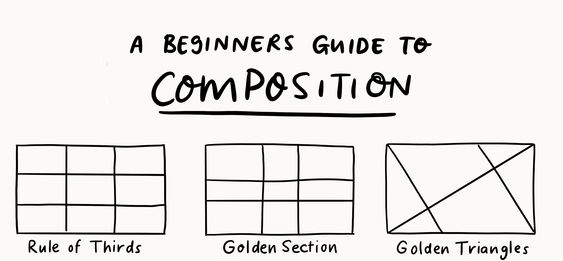
A Beginners Guide to Composition
I am not going to do an information dump about theories of composition here (I have added links to some good blogs on the subject below) but the “rule of thirds” is one that springs to mind here. The idea that you should look for naturally occurring in divisions of thirds in a scene and try and locate points of interest at the intersection of the “Golden section”.
Rule of Thirds
The Golden Section
I had been influenced by ideas of composition from photography and the work of artist-turned photographer, Henri Cartier-Bresson,in particular.
Rule of Thirds – Henri Cartier Bresson
I liked his use of diagonals in particular, and this has influenced my paintings of urban scenes.
When I came to Donegal I was so blown away by the vast overarching skies and majestic landscapes. I got very excited by everything I saw. I tried to capture everything. The houses, the mountains, the sea, and the sky. Most of the time it worked.
Swirling Clouds Round Errigal
Donegal Painting
From Ferry Coll
From Cruit Island
Wild Wind Across Dunfanaghy
Shored up near Muckish
Further Up Shore
You can probably look through these paintings and tick off the composition approaches I instinctively used; the diagonal, the pyramid, the rule of thirds and so on. They all worked.
Then, it really pains me to admit it. I lost it. I got carried away and overreached myself and painted this big beast.
Sailing By Edernish
What was I thinking? There is far too much sky in this painting. Worse than that, it was a large canvas. There are things I like about the painting, the light on the island in the bottom half of the painting, but the sky was just too vast. It pained me that I had such a large reminder of my errors of judgment. I don’t mind screwing up every now and then but I hate waste and that was an expensive canvas. It’s no coincidence that I am planning a blog post on reusing stretcher bars to stretch my own canvases.
My confidence was dented. It put me off large paintings for quite some time. It wasn’t until I did the commission I mentioned earlier, that I got thinking about what had gone wrong. I realized that I had to rigorously apply the same rule of composition to large canvases as I instinctively did to my small ones. So I tried an experiment, I took a successful composition of a medium size painting and did a much larger version of it. This composition was based on a compound curve.
Over to the Rosses 60x40xmView From Arranmore, Ireland 92x73cm
It wasn’t a copy of the smaller painting. It wasn’t meant to be, although it was meant to encapsulate the same feel of the smaller work, with some adjustments. I have included some more detail, changed the tree, and added a shadow and a ditch in the bottom third of the painting. I think it worked.
I have since done another small oil sketch of another composition before I scale it up. It’s another diagonal composition. Although, the larger version will not be “portrait” format but my usual “landscape” orientation.
I will add the larger version later in the week. So you will have to wait to see if that composition works as well as this smaller one. Watch this space!
This is only a short post because my cold from hell isn’t shifting and I have been ordered to rest by Séamas, which as you see, I am failing to do!
I like red and orange. Especially in winter. I have noticed that I like to paint red and orange things in wintertime. I previous years it has been red coats on the harbor beach at Tenby, or grandparents buying ice-creams in Brynmill Park. This year it’s the autumnal orange foliage of Donegal.
I painted this small painting over a number of days, over Christmas. I would usually paint a picture like this in one day but the light kept going and I wasn’t very energetic so I decided not to rush it and wait until the next day. I think my patience was well-rewarded.
I have painted this house before, in a much larger painting. It’s interesting how the more distant view produces a cooler more airy painting.