My leg and ankle are recovering from my accident this springand although I can walk a faster than I used to, I still cannot walk long distances which means that a lot of my favourite Gower walks are off limits to me. I find staying indoor too much isn’t good for my mental health (especially during the Pandemic) and it is vital to get out and see different places nearby. Fresh air is good for the soul, the mind and more importantly it blows away the virus!
This blog is about a very short road trip around parts of the Penrice estate down to Oxwich Bay we did this week. My husband drove and I took the photographs. Penrice Castle was built by the Mansel Talbots. They were one of the most powerful families in South Wales and certainly one of its biggest resident landowners and MPs for Glamorgan in the Victorian era. The “new” Castle at Penrice was built by Thomas Mansel Talbot in the 1770s, as an alternative residence to the rambling old house at Margam. Thomas, who had travelled to Euope and considered himself a man of great taste had a neo-classical villa built. He also had the land around the house landscaped and a park laid out to improve the romantic scenery that had first attracted him to the place. His son, Christopher Rice Mansel Talbot, who was born at Penrice in 1803, modernised the old Aberavon Port and renamed it (modestly) Port Talbot as an industrial hub for South Wales. The house at Margam was also pulled down and a new mansion was built there between 1827 and 1830 near the ruins of the old abbey.
I will the road trip start with a map. All road trips need a map. There is an excellent map of Gower at Mapsta here. Our trip starts at the top left hand side of the map where a lane turns a sharp left from the A4118 road down a narrow single track lane. A word of warning if you fancy this road trip. This is not a trip for a large vehicle. Most of the lanes are single track and are very narrow. We spent most of it praying that we did not meet any thing coming the other way, and we drive a tiny Kia, as it would have possibly meant a ggod deal of reversing! Thankfully we didn’t.
Penrice Loop #1
.
Home Farm Penrice (SOLD)Down long narrow lanes past a parking spot for a woodland walk at Mountybank (see estate map)Map of the Penrice EstateUp a steep and winding lane past Penrice VillagePenrice, GowerAlong wet and winding lanes past Pitt FarmThe road then bends and drops back down towards Oxwich VillageWe past a series of sturdy cottages and then turn left at the junction in Oxwich
The carpark is free in the winter during the week (possibly only during pandemics)This morning’s heavy rain has left puddles everywhere but there’s still a beautiful view across the bay to Great Tor and Three Cliffs
We saw people. There were not too many but enough to watch. There was even a small wedding party having their photos taken on the beach off in the distance. It was heartening to see people managing to commit to a future together come what may! It must have been next to impossible planning their day as we have had a national lockdown, a local lockdowns and a mini-firebreak and there are rumours of another lockdown after Christmas.
A wedding party off in the distanceCan you see them now?
On the way back home, we continue anti-clockwise on our loop back up a steep hill to the main road past Underhill Cottage. It was originally the Head Gamekeeper’s cottage. It has a lovely, sunny position overlooking the beautiful Oxwich Marsh and the sea with Nicholaston Woods behind. These days it is a holiday cottage. It is possibly one of the few sorts of holidays you could be confident of not getting cancelled these days (if you live locally, that is).
Underhill Cottage (Oxwich, Gower) SOLD
Buy my book “Footnotes: An Artist’s Walk around the Gower Coast” here
I recently had the pleasure of donating a painting and three mounted prints to the NHS Annual Practice Supervisor/Assessor Team Awards for 2020. These awards are presented by the local NHS Education Team for nurses who have gone the extra mile to help student nurses. Many years ago I was a teacher who helped train the trainee teachers in our school, so I know how important the role of a mentor/trainer is in a practical placement. Training students can be incredibly rewarding. You are not only supporting a young professional at the start of their careeer, but also through training them, you are forced to reflect on your own practice. I also know from recent personal experience from being in Morriston Hosiptal with my broken leg/ankle just how hard all nurses work, especially the student nurses on their placements. I used to be fairly exhausted after teaching for 5 hours in a working day but nurses work an incredible 12 hour shift! So to find the time and emotional energy to fit in student training along with all their other duties is really deeply impressive. I also really valued the care, kindness and good humour they demonstrated to me and the other patients on that ward.
This year’s award ceremony took place, via Zoom, this week on the 25th November.
St Marks Nursing Home, Swansea, was the recipient of my oil painting “Coastwatch Station, Rhossili”. Nursing homes have had a particularly challenging time this year because of Covid 19, so I am really pleased that they have a new painting to cheer up the staff and patients.
Coastwatch, Rhossili, Gower
My three mounted prints of Three Cliffs Bay, Gower went to the Hafod Y Wennol Learning Disabilities Centre, Ur Ysgol Nursing Home, as well as to Martyn Morgan, who works in Mental Health. I am sure that they were all well-deserved winners and have played an important role in training and supporting our future nurses. Thank you!
Donated Prints of Three Cliffs Bay
You can buy prints of Three Cliffs Bay, Gower via Artmajeur.com here
I have found that my energy is slowly but steadily returning after my operation on my broken leg in March (although painting light is shrinking with the shortening days). I spent much of the spring and early summer sitting in my chair wishing I could go outside into the fresh air or climb the stairs to my attic studio. I painted watercolours instead, and thought a lot about colour and composition. I learnt to simplify my images and edit them with more ruthlessness than I had done before.
Gola Houses (watercolor)
I have attempted to carry these lessons into the compositions of my oil paintings. I suspect that I need to go further. I am always torn between a desire to accurately convey what is probably a well-known location to local people, and the need to create an effective composition. In otherwords I want to create an engaging painting, regardless of whether a viewer has visited Donegal or not.
Blue Door, Gola (oil on canvas) SOLD
Here’s an example of editing my composition. I used several reference photos for this painting of Bád Eddie (Eddie’s Boat) but you will see that I decide to leave out the all the lamp posts. I felt they made the picture look cluttered. I also left out the the skylights on a couple of the houses for the same reason. I did, however, decide to include a couple of series of fence posts on the right side of the painting as they lead the eye down the hill.
One of the reference photos for Bád Eddie at Bunbeg
Bád Eddie, Ireland. (Oil on canvas) SOLD
I have gone further with my editing of the reference image in my most recent painting of Arranmore. This is a painting of a (probably abandoned) white house that I had painted a watercolour of earlier in the year .
The White house, Arranmore, Ireland (watercolour)
A lot of the compositional work is done when composing the reference photograph, but there is often a bit more tinkering to be done to clarify the image further.
The White Bridge, Arranmore, Ireland (100cm x 65cm) (Oil on canvas)
Here you can see that I have again removed most of the telegraph poles, just leaving one further down the road. The fence posts as usual, get to stay. The ones on the right led the eye down the road. The central part of the painting on the right side is too cluttered for my liking too. It’s very confusing for the viewer. I have since discovered that this is because there are too many “tangents“. The word “tangent” usually just indicates that two things are touching, but in art the term describes shapes that touch in a way that is visually annoying or troublesome. This also describes those telegraph poles I removed. It all makes for an image that is easier to “read”.
Tangent Chart – From emptyeasel.com
I also removed a several of the buildings so that there is a clear view over to the tiny island of Inishkeeragh with its solidary summer home. Finally, I also simplied the pair of yellow buildings to the far right. I found the semi-abstract result pleasing and I felt that the lack of detail balanced the detail in mud, rocks and grasses on the near side to the left of the painting. I like to balance detail with areas of flat colour, such as the roof of the house or the sea, as I think that too much detail all over makes the head sore. The human brain doesn’t process images in this way any way. Our eyes/brains will focus on one or two areas and “generalise” other larger areas of colour.
Thus, I hope I have created a succesful painting rather than slavishly copying a photograph.
White Bridge Arranmore, (in situ)
Read more about avoiding confusing tangents in compositions here
I am very excited to have my paintings choosen to accompany the acoustic piano version the single, ‘Out Of My Mind’ by the Opacas. Thank you The Opacas for inviting me to collaborate, and to Patrick Boyle in particular who made the beautiful video!
From Magheraclogher Beach (Bunbeg) (Private Collection)
I decided to apply the detailed techniques I have used for painting the hilly city of Swansea to the rural homes of the coastal townland of Bunbeg. I am usually drawn to painting old fashioned Irish cottages, as I like their clean lines and simple shapes. This time, I decided to challenge myself by painting modern Irish houses. The homes of this part of Bunbeg are almost all modern homes, although there are one or two old cottages tucked in amongst the two-storey houses. I found the arrangement of houses on the hilly a pleasing one. I was particularly keen on the road that snakes its way down the hill on the far left of the composition. I decided to leave out all the lamp posts as I felt the cluttered the scene. However, the real joy of the composition is rather unexpected (if you have never seen it before, that is) shipwreck on the right-hand side of the painting. Bád Eddie.
Mageraclogher beach, Bunbeg, on the West coast of Donegal, is a vast, beautiful, and usually windswept beach. It is like a natural amphitheater. In its center, fleetingly illuminated by the autumn light, just for a moment is the ruined hulk of a boat.
Bád Eddie, Ireland.
This is a shipwreck, known locally as Bád Eddie, Bád meaning boat in Irish/Gaeilge. I initially thought “Bad Eddie” was a nickname like Paul Newman’s character in the movie The Hustler, “Fast Eddie”. It made me think the wreck had been some sort of errant boat, but no it just means Eddie’s Boat in Irish. This is, after all, Gaoth Dobhair (Gweedore), an Irish speaking area of Ireland.
There are shipwrecks and there are shipwrecks. I am very familiar with images of bones of the Helvetia that have lain submerged on Rhossili Beach on the Gower Peninsula for over 120 years. Bád Eddie, however, is loved in a way that the Helvetia can only dream of. She has starred in a pop video with Bono and Clannad, no less! She has had a film about her life made and broadcast on the TG4 the Irish language channel (see the film below, it is well worth watching), she has her own popular Twitter account too – Bád Eddie @CaraNaMara
Bád Eddie’s Twitter Page
.
Bád Eddie, isn’t her real name. She was actually named Cara Na Mara (Friend of the Sea). Her first career was as a fishing boat and she was originally built in Brittany, France, and bought by local fisherman Eddie Gillespie. In 1977 she needed two planks repaired and she was towed ashore onto Magherclougher beach and somehow got left. The repairs were never done and she has lain here for over 40 years. So this, if there can be such a thing, is a happy shipwreck. No one died when this ship was washed up. No one had to rescue the crew. There are no sad memories, except for Eddie who never fixed his fishing boat.
Bád Eddie in her better days: From Twitter
In fact, Bád Eddie has helped create nothing but good memories. Over the years she became the playground to the local people and families on holiday in Gweedore. She has featured in thousands of family holiday photos and locals include her in their weddings, communions, even christenings. Sadly, the Atlantic Storms have taken their toll on Bád Eddie, and there’s less on her today than when I saw her two winters ago.
Decorated for Christmas: Image Donegal Daily
The locals love her and also recognize that she is a big tourist attraction and they want her preserved to keep that tourism alive. So there is an ambitious plan to create the first permanent sculpture in the sea in Ireland, a stainless steel full-size replica of the boat, incorporating what is left of the structure. I think a sea sculpture is a brilliant idea. There are some amazing sea sculptures in England, “Another Place” by Antony Gormley at Crosby, Near Liverpool in England and “The Scallop” by Maggi Hamblin at Aldeburgh, on the Suffolk coast – both have had their share of controversy (The Scallop has been called “The most controversial piece of Art in Suffolk”) but they have certainly increased tourism to their areas. I don’t imagine the Bád Eddie sea sculpture will cause too much controversy. The difficulty is around getting enough money together to build it. The project has the support of Donegal County Council, but more funding is needed so a gofundme campaign has been set up.
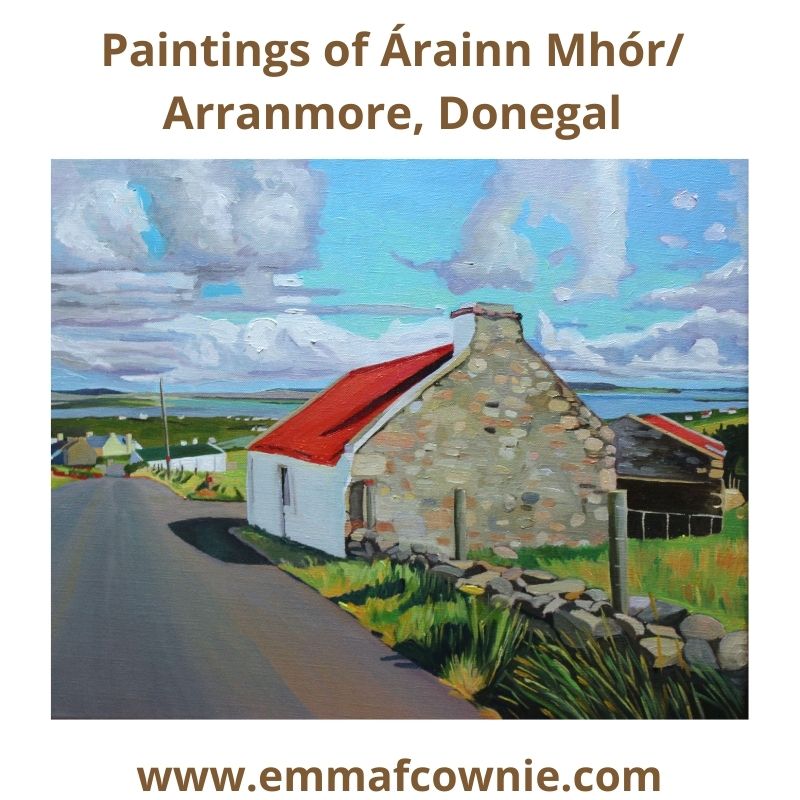
I recently join the Stair Árrain Mhór – Árrain Mhór History Facebook group and was overwhelmed by the positive response I received from the members when I put my most recent post online there. I was asked if I had any more paintings of Arranmore for them to see, so here’s a collection of all my paintings of the Island that I have completed in the last two years.
Where it reads (Private Collection) it means that the painting has been sold. I hope you enjoy looking at them.
Poll na mbadaí (Harbour of the Boats) Arranmore, Ireland.
Here is my latest Donegal painting. I am delighted that it will be going to its new home in California, USA, very soon.
A narrow lane curves down to a shining white cottage and outbuilding and to the right. This is not a public road but a lane to the house, just around the bend. Here it is bathed in glorious winter light. The low sun creates long dark shadows along the lane. The sheep look up, they are not used to strangers (not like the sheep on the Gower that barely give visitors a second glance). On the horizon, you can make out the tiny but distinctive shapes of Muckish and Errigal mountains . You can just make out a line of fence posts that lead down towards the small natural harbour that gives its name to this place: Poll Na Mbadaí or Poolawaddy. The meaning of Poolawaddy (also spelled Pollawaddy) is often disputed. In irish Poll a Mhadaigh, could mean Poll – the harbour, a Mhadaigh – of dogs or Poll na mbadaí, Poll – the harbour, na mbadaí – of the boats. I suspect that the harbour of the boats is more likely, as it is a natural harbour and pier, but I could be wrong. I only have a basic understanding of Irish but I like to try and read it because place names are very descriptive (as they are in Welsh too) and often poetic. A harbour of dogs is just as possible, after all, there are tiny islands nearby named Calf, Duck and Gull Island.
Arranmore Island map
It feels like it has taken me 7 months to get here. The last painting I finished just before I broke my leg in eraly March was also a painting of this area (see below). It has taken me so long to recover my “painting stamina” and gradually paint larger canvases (although some artists would not consider 80×60 cm “large”). I don’t think I will go any larger for now. I feel exhausted after finishing a large painting these days.
View From Poolawaddy (Private collection) painted in early March 2020
I like to understand what it is that I am painting, to get a sense of its history and the people who live/d there. I might call a building an “outhouse” for example but very often that building was once a family home, a newer bigger one having been built next to it. It matters to me to know that. It helps me make sense of a place. I only know only a little about the History of Arranmore, however, so what I have written here has been taken from articles I have found online (I have included links and a list of websites at the end).
Life on the east side of Arranmore Island, where Pollawaddy is located, is marginally easier than on the west side. This is because Cnoc an Iolair, the highest peak on the island (reputedly once home to golden eagles), provides relative shelter from the prevailing westerly Atlantic winds. This side of the island certainly seems more sheltered, gentler.
Poolawaddy, Arranmore, Ireland (from the other side of the bay). Calf Island is to the right of the bay.
After the Protestation plantation in the 17th century, Arranmore Island, Donegal’s largest island, like other large parts of West Donegal, had been given to the English Lord Conyngham. However, when the terrible potato blight leading to the Great Hunger (“an Gorta Mór”, in Irish) spread during in the mid-1840s he declared the island, which he had never set foot on in his life, as unprofitable and sold it to a Protestant man John Stoupe Charley of Finnaghy, Belfast on 29 June 1849. The new landlord came to live on the island, building a “Big House” (now the Glen Hotel) after 1855 just down the road from Poolawaddy. Very near Poolawaddy, RIC police barracks were built, presumbably built around at the same time to protect the landlord’s property. Interestingly, the RIC left the island after about 40 years and there is still no police station on the island (although the Guards do visit on a regular basis).
Ruins of the RIC barracks: Image from thearranmoreferry.com
Landlord Charley decided to clear as many starving tenants off the land, so he demanded them to present the receipts of their rent payments or face eviction. Of course, few if any had been given written receipts, let alone kept them since most of them could not read or write. The choice they were faced with was either the poor house in Glenties or to emigrate to America in a ‘coffin ship’. Many of these subtenants were evicted in 1847 and 1851. Many who made it into the new world settled on ‘Beaver Island’ (Lake Michigan, USA ). The two islands are twinned. The Árainn Mhór & Beaver Island Memorial, built in 2000, and the sign that Beaver Island is 2,750 miles away, is a memorial to this link. Many of the first islanders who emigrated to Beaver Island were from Poolawaddy. Evictions carried on after John Charley’s death in 1879, when his widow Mary and his brother Walter Charley MP were left to manage his lands. The British government even sent a gunboat, “Goshawk” in 1881 to “assist … the serving of ejectment processes on the tenants in the island of Arranmore”!
Poolawaddy Pier, image from thearranmoreferry.com
The Islanders who left for America emigrated permanently, but seasonal emigration was a more common feature of island life, with many young people working as labourers for farmers in the Lagan, a fertile area in northwest Ulster, and also in Scotland as ” tattiehokers” for the summer. Rósie Rua was one such youngster. She was born in 1879 and was reared on Aranmore Island by her mother and her step-father, the Butcher. In adult life, she gained renown as the best traditional singer in Aranmore and wrote a memoir of her life with the help of Padraig Ua Cnaimhsí. Unfortunately, the memoir seems to be out of print, but I could read some sections of it on google.books.
Róise Rua
In her memoir she describes how at aged nine she was hired out to farmers in the Lagan. Her family home was not far from Poolawaddy and she describes catching the boat to Scotland to work as a farmworker or ” tattiehoker” for the summer. She wrote that “the steamer had dropped anchor off Calf Island, and we saw the boats pulling out from the shore with their passengers. In no time at all, we were all down at Pollawaddy ourselves and one of the small boats brought us out. Lily was the name of the steamer.I was amazed at the size of her…just about a hundred passengers in all boarded the Lily at Calf Island.”
Róise Rya’s Home:Image thearranmoreferry.com
Rósie Rua has a singing festival, Féile Róise Rua held in her name on Arranmore. The first was held in 2019. Sadly the pandemic distrupted the 2020 festival. The festival went online on facebook and you can watch some of the performers here. Fingers crossed the next one can go ahead in 2021! I will leave you will a clip of Jerry Early singing “I’ll Go” (5.55 onwards). Just look at the view out of his window!
Following on from my last blog (which covered Sarah Purser, Rose Maynard Barton, Gladys Wynee, Kathleen Fox, Estelle Solomons, Phoebe Donovan, and Norah McGuinness), here’s my second group of my favourite female (deceased) Irish artists. I am covering this group in chronological order, although is overlap, date-wise with my list of artists in part 1. This group of women, although still largely drawn from the “Protestant Ascendancy“, were noticeably less wealthy than many of the artists in part 1.
Remember Paul Henry and his beautiful landscapes paintings of the wild west coast? Well, his wife, Grace was an accomplished artist in her own right but her reputation suffered from being overshadowed by her husband’s fame.
Grace Henry was born Emily Grace Mitchell in Aberdeenshire, in Scotland. She was the ninth child of ten of the Rev. John Mitchell and was educated at home, spending time at the family’s home in Piccadilly, where she experienced London society. When her father died the family found themselves in much-reduced circumstances, so Grace left home in 1895 to pursue a career as an artist. Remember, this is the end of the 19th century. That’s a pretty incredible decision for a single woman.
In 1899 she left Scotland for the continent, visiting Holland and Belgium, studying in Brussels and Paris. Whilst in Paris, she met and married Paul Henry in 1903 and moved first to London and then to Ireland. The couple traveled in Achill Island for the first time in 1910 which was intended to be a two-week stay, with the couple going on to live there until 1919. This period spent on the island did place a strain on the Henry’s marriage, as Grace was not as happy living there.
Grace Henry HRHA (1868-1953) Cottages, Western Landscape
Grace Henry
Grace Henry
Her work developed while on the island, starting with Whistler- inspired nocturnal scenes with muted colour and simple compositions, becoming stronger as she grew in artistic confidence into the 1920s.
Despite being instrumental in setting up The Society of Dublin Painters in 1920 which provided exhibition space for many female modernist painters, her reputation suffered from her separation (although they never divorced) from her husband Paul, who left out all references to her in his two autobiographies!
Grace continued to travel later in her life, often staying with friends or living in hotels, rather than maintaining a home of her own. She also experienced periods of “melancholy”, probably depression, during these later years, though she continued to exhibit.
Letitia Marion Hamilton (1878 – 1964)
Originally from Co. Meath, Letitia was one of three sisters. Their father could only afford one dowry, so Letitia and her sister Eva remained unmarried and turned to their artistic careers to help support the household. Letitia studied at the Dublin Metropolitan School of Art where she was taught by William Orpen, continuing her studies at the Slade School of Art in London and with Frank Brangwyn.
She exhibited in Paris, Edinburgh, and Dublin. She was one of the founding members of the Society of Dublin Painters, along with Paul Henry, Grace Henry, Mary Swanzy, and Jack Butler Yeats. In 1948, she won a bronze medal at the Olympic Games art section in London. Who knew you used to be able to paint your way to an Olympic medal?
Bunbeg – Letitia Marion Hamilton RHA (1878-1964)
Carrycart, Donegal -Letitia Marion HamiltonLetitia Marion Hamilton RHA (1878-1964)
Lilian Lucy Davidson (1879-1954)
Lilian Lucy Davidson was born in Bray, County Wicklow. She was the sixth of ten children of a clerk of petty session called Edward Davidson. Unfortunately, her mother died when she was ten and it seems that her family was not affluent although it is thought that she had a private education. She went on to attend the Dublin Metropolitan School of Art (DMSA) and was awarded a scholarship and free studentship at the Royal Dublin Society in 1897, the year her father died.
Although not in very buoyant financial circumstances she travelled extensively and did so for most of her life. She painted landscapes in Belgium and Switzerland, besides various parts of Ireland. She was a regular contributor to the Watercolour Society, The Dublin Painters Society and the Munster Fine Art Club, and was part of an interesting circle being friendly with Jack Yeats whom she painted and the circle around the Gate theatre for which she wrote plays under the pseudonym of Ulick Burke. The fact that Davidson’s family was not wealthy may have influenced her choice of poorer people as her subjects, depicting them in a sympathetic manner. I love her fluid style and her treatment of every day life in Ireland. I particularly like “Night at Claddagh”, for the falshes of light from the houses and how the little details such as the woman’s red dress and bare feet suggest so much about her life.
Lilian Lucy Davidson ARHA (1879-1954) Night at Claddagh (circa 1933)
Mary Swanzy was born in Dublin, to a wealthy medical family. She was educated in Dublin and then sent to a finishing school at the Lycée in Versailles, France, and a day school in Freiburg, Germany. This education meant that Swanzy was fluent in French and German.
Mary trained in several academies in Paris. It seems that Mary was no party animal. Her life in Paris, while agreeable, did not resemble the bohemian myth. Usually, Mary was in bed by 8pm each evening and in the studio by 7.45am each morning, working intensively from the life model.
Her father had hoped she would be a portrait painter, but Mary was disliked portraiture, saying that men tended to want to be painted by men. After the deaths of her parents, Swanzy was financially independent and could travel, spending her time between Dublin and Saint-Tropez during World War I, whilst continuing to paint. She traveled far and wide, to the Balkans, Czechoslovakia, USA, Honolulu, and Samoa. It may well be that the upheavals back in Ireland including the shooting dead of her cousin, Oswald Swanzy, a Detective Inspector with the RIC, prompted Mary to travel abroad.
Her money also gave her the freedom to explore different artistic styles. She painted in many styles including cubism, futurism, fauvism, and orphism, and she was one of Ireland’s first abstract painters. In the mid-1920s Swanzy settled in Blackheath, London, making regular trips to Dublin and abroad.
To be honest, I agree with the assessment of critics who have described her work as having a “prim, Edwardian feeling” that shows through the veneer of modernism. I think it was painted from the head, not the heart. I much prefer her work that was done in Samoa in the 1920s. Here her work seems relaxed, natural and joyous.
Mary Swanzy
Margaret Clarke (1888-1961)
Margaret Clarke
Margaret was born in Newry, County Down, Ireland, one of six children of Patrick Crilley. I am guessing from her surname that she was raised a Catholic. She had intended to become a teacher and went to night school to train at technical college but in 1905, she won a scholarship to go to the Dublin Metropolitan School of Art. There she studied under William Orpen, who regarded her as one of his most promising students, she later became his assistant. In 1914, Margaret married her fellow student Harry Clarke, and they had three children.
Margaret first exhibited with the RHA in 1913 and would go on to exhibit over 60 artworks in the forty years until 1953, the majority being portraits. Amongst the portrait commissions Clarke received were ones for Dermod O’Brien, President Éamon de Valera, Archbishop McQuaid, and Lennox Robinson. She spent a great deal of time on the Aran Islands with fellow artist Seán Keating and her husband, from which she produced a number of landscapes and smaller studies.
Red Roofs, Greystones
Over her lifetime Clarke won many awards including the Tailteann gold, silver and bronze medals in 1924, and another Tailteann bronze in both 1928 and 1932. Upon the founding of the Irish Exhibition of Living Art in 1943, she was appointed a member of the executive committee.
May Harriet “Mainie” Jellett (1897-1944)
Mainie Jellett
Born in Dublin, Mainie was the daughter of a barrister William (who was later also an MP). She studied at the Metropolitan School of Art in Dublin under William Orpen, and then in London under Walter Sickert.
In 1921 she moved to Paris, where she encountered cubism and began an exploration of non-representational art. Her new style, including colour and rhythm was greatly inspired by her stay in France. After 1921 she and artist Evie Hone, her companion and life partner, returned to Dublin but for the next decade she continued to spend part of each year in Paris. In 1923, she exhibited two cubist paintings at the Dublin Painters’ Exhibition.
Decoration 1923
The response was hostile, with the Irish Times publishing a photograph of one of the paintings and quoting their art critic as saying of them ‘to me they presented an insoluble puzzle’.
Mainie devoted much of her energy—throughs essays and lectures—to trying to overcome conservative attitudes in Ireland, which was then culturally isolated. Her work was also part of the painting event in the art competition at the 1928 Summer Olympics.
Madonna of Eire
In the 1930s figurative elements reappeared in her painting, and her later work included landscapes and religious subjects. She also made designs for the theatre and ballet. Jellett died young of cancer, but the year before her death, her campaigning on behalf of modern art bore fruit in the founding of the Irish Exhibition of Living Art, of which she was the first chairperson. This was an exhibiting society that became the main venue for avant-garde art in Ireland for many years. Sadly Mainie was not to live a long, dying of cancer at 46, but she had made a significant contribution to Irish Art and Feminism in that short time.
Achill Horses
Nano Reid (1900-1981)
Nano Reid was born in Drogheda, County Louth. She was the eldest of four children of Thomas Reid, a well-to-do publican, and grew up above their pub. Although she started her training to become a nurse, her parents were persuaded by their Catholic parish priest to let her go to the Metropolitan School of Art in Dublin.
In 1927, Nano went to study in Paris and London and after that stayed in Ireland. After returning to Ireland, Reid began to exhibit landscape painting at the RHA. Like other painters of the period, such as Paul Henry, she traveled to the west of Ireland for painting inspiration with her early work showing the landscapes, local people, and fishermen of the area.
I much prefer her portraits to her landscape work.
In Dublin, Nano shared a house with her friend Patricia Hutchins. There was gossip about the nature of the women’s relationship, but Hutchins went on to marry. After WWII, Nano moved to Fitzwilliam Square, taking in young men as lodgers. She used to go on shared holidays to Connemara with her gay friend, self-taught Belfast artist, Gerard Dillon in the 1940s and 1950s.
In 1950, Reid and Norah McGuinness (see part 1) were selected to represent Ireland at the Venice Biennale of Art. This was quite remarkable, considering this was the first time the country had shown at the event. The nation’s cultural identity was to be shaped by this event, and international perceptions of the country would be determined by what they chose to show. The reason for their selection was most likely because it was believed these two artists could compete on an international level.
This second group of female artists ranged from the wealthy and hard-working Mary Swanzy who only had to please herself to Margaret Clarke who started her training at night school, and most of these artists had to teach painting to supplement their income. Their work is diverse in style from figurative to cubism. As a group, they had traveled widely, with Mary Swanzy traveling the widest. Artists like Mainie Jellett embraced very public scorn to promote new ways of painting in the Irish State.
These women were always swimming against the tide. They were independent, working women in an era when women were expected to limit their attention to their homes and families. Taken as a group as a whole, it is probably unsurprising that a significant number were either lesbians or did not marry. Husbands and families did not appeal to Sarah Pursar and Nona Reid and would more than likely impede their ability to paint and to pursue their artistic careers. Only Kathleen Fox and Margaret Clarke were married and had children. Norah McGuiness’s “open marriage” was deeply shocking to contemporary society. Although the support and expertise of men such as J.B. Yeats and William Orphen were pivotal for many of these women, their own organisational skills such as the founding and running the Dublin Painters’ Society and the Irish Exhibition of Living Art, were impressive. They also encouraged and supported many younger artists. Of all these artist, I liked the portraits of Margret Clarke and Letitia Hamiliton’s vigorous landscapes. In the end, it was Lilian Davidson’s lively figurative work that I enjoyed the most.
Yet, is hard not to resist the conclusion that the world continues to ignore and downplay female artists. Art UK’s list of 18 “Incredible Irish Artists” only included 6 female artists! The 6 female artists were “incredible” but many of the male artists that were included on that list were definitely not “incredible”. Ireland Before You Die’s list of the 10 Best and most famous Irish artists includes just 2 female artists. Any modern list of “top” or “hot” artists, Irish or otherwise, is invariably heavily dominated by male artists. It is hard to escape the conclusion that female artists are still swimming against the tide! However, it is significant that auction houses such as Dublin-based Adam’s spent a lot of time, money, and effort putting together a Summer Loan Exhibition of Irish female artists in 2014. All of the paintings were on loan from private collections from both North and South of the border. The catalogue is thoroughly researched, and includes many more women than I have included on my list. It is important that Adams’s exhibition celebrated and publicized the significant role that women have played in the history of Irish art, a role that has too often been overlooked.
Group of artists at “Young Irish Artists Exhibition 1903”
After writing about Paul Henry’s work in my last blog, I was embarrassed to realise that I am very ignorant about Irish Art/History, especially female artists. So to remedy this woeful ignorance I set myself the challenge of list of my favourite Female Irish artists, in the spirit of my earlier series of blogs on Our Favourite Female Artists. I initially thought about a top ten but I failed miserably to limit myself to 10, I came closer to 18 in the end. I am absolutely no good at throwing stuff out, and my list of artists is no exception, so I have organised each selection by the date of birth of the artist.
I will freely admit that my taste is pretty traditional, preferring figurative to abstract art but I do like a lively personal life too (I am rather nosy). I also like and admire the work of long-dead artists, especially those who lived and worked in the period from the 1870s to the end of the Second World War. I think that I feel that I can safely admire their work without accidentally copying it, which always seems to be a danger with living artists. A lot of the information in this blog is taken from the Catalogue for Irish Women Artists 1870 -1970 Summer Loan Exhibition and Wikipedia.
It is a universal truth female artists of the late 19th and early 20th centuries worked under very different circumstance to male artists. In 1870 women were seen as amateurs in the art world and lacked the opportunities for training, exhibition and sales. They were chaperoned by men and when in 1893 they were eventually let into professional schools such as the RHA school, they were barred from life drawing and anatomy classes (think of those unsuitable naked bodies!). Despite these limitation (or maybe because of them) many Irish female artists traveled abroad to train and returned to Ireland with wider horizons than their male contemporaries.
Female artists from the Dublin Metropolitan School of Art, c. 1910
Visual arts were seen as a ‘genteel hobby’ rather than a genuine vocation for women. Many of the Irish female artists of this period came from well-off, if not always extremely wealthy, origins. A middle-class Protestant background was more likely to be an encouragement to female artist’s talents, rather than working-class Catholic roots. They also generally remained single and only a few became mothers.
Sarah Purser (1848 – 1943)
Sarah Purser by J.B. Yeats
The female artists of Ireland tended to come from wealthy (usually Protestant) backgrounds. Sarah Purser was no different, as she was born into privilege although she made her own fortune through hard work and canny investments. She was the daughter of Benjamin Purser, a prosperous flour miller and brewer. At thirteen she was sent to school in Switzerland where she learned to speak fluent French and began painting.
When in 1873 her father’s business failed and she decided to become a full-time portrait painter. She used her many social connections to gather commissions – she famously commented “I went through the British aristocracy like the measles”.
She was a trail-blazer in many other ways too. From 1911 she held regular social gatherings for Dublin’s intelligentsia at her home, Mespil House. Sarah became wealthy through astute investments, particularly in Guinness, for which several of her male relatives had worked over the years.
In 1924 she founded the Friends of the National Collections of Ireland and was instrumental in setting up the Hugh Lane Gallery. She was also the first woman artist to be elected a full academician of the RHA in 1925. Elizabeth Coxhead remarked, “At thirty she was the oldest and most serious, with no time to waste on cerebral love affairs and agonies of the soul”. I have a sneaky feeling that Sarah was not interested in men, anyway.
W.B.Yeates, Maude Gonne (A Republican and Suffragette) and Michael Davitt (lying in state), She also painted the not-so famous.
Rose Maynard Barton (1856 – 1929)
Rose Barton RWS (1856 – 1929) St Patrick’s Cathedral Watercolour, 27.5 x 18cm
Tipperary-born Rose Barton began a long relationship with the Royal Water Colour Society of Ireland in 1872 when she first exhibited with them. Three years later she spent some time in Brussels, taking painting and drawing classes, and in 1878 she exhibited for the first time at the RHA. The following year she sat on the committee of the Irish Fine Art Society.
Her watercolours, mainly painted in Dublin and London, are distinguished by an emphasis on the almost tangible atmospheric effects of weather conditions. She became known not only through these original works but also through her illustrated books of both cities
Her version of smokey London was very appealing.
She was a great observer of children. The child in white in the painting on the right isn’t a girl, but George, Prince of Wales!
Gladys Wynne (1876 – 1968)
Gladys was the was the fourth daughter of George Robert Wynne, Archdeacon of Aghadoe, Killarney, County Kerry. She was a watercolor artist, who spent most of her life in Glendalough, County Wicklow, living in Lake Cottage. Landscape was her chosen field and she painted the area throughout her career. It seems that Gladys might have preferred a different life, that of being a wife and a mother as she apparently turned down a proposal of marriage, and regretted having done so. Her work is very chocolate box-ish but I like their gentle character.
Now to two a female artists who interest me because they were witnesses to, and involved in, the Irish Rising: Kathleen Fox and Estella Solomons.
Kathleen Fox (1880-1963)
Kathleen was the daughter of Captain Henry Charles Fox of the King’s Dragoon Guards. She was from an Irish Catholic upper middle class family with a British Army tradition. She attended the Dublin Metropolitan School of Art, studying under William Orpen. As it was almost impossible to get a female model for the nude in Dublin,William Orphen brought girl models from London. He also allowed his students to talk and smoke in his life-class.
Whilst in Dublin, Kathleen got to know Constance Gore-Booth (Countess Markievicz) and Willie Pearse (brother of Pádraig). After 1912 She spent 4 years in Europe, returning to Dublin in 1916, and she witnessed and recorded some of the events of the Easter Rising first hand. She sketched at the scene as Countess Markievicz and her 118 fellow rebels were surrendering to British troops outside the Royal College of Surgeons, St. Stephen’s Green. Conscious of the existing political tension, she completed the painting in secret and then sent it to a friend in New York for safekeeping.
The Arrest of Countess Markivicz
Unlike many of our other female artists, Kathleen became a mother, although as she married at the relatively late age of 37, perhaps she had not expected to do so. Whilst in London, Kathleen had met British army Lieutenant Cyril Pym, and married him in 1917. Cyril was killed in action in 1918, and she gave birth to their daughter later that year. In the 1920s she focused establishing herself as a portrait painter. Her work was shown in London at the New English Art Club, the Society of Women Artists, and the Royal Society of Portrait Painters. She later became known for her paintings of interiors and flowers in the 1940s and 1950s.
Estella Solomons (1882-1968)
Estella’s family, the Solomons, came to Dublin from England in 1824, are one of the oldest continuous lines of Jews in Ireland. Her father, an optician whose practice in 19 Nassau St., Dublin, is mentioned in James Joyce’s Ulysses.
From age 16 she studied Art in Dublin and London. Estella was a committed nationalist who sympathised with anti-Treaty forces during the Easter Rising and Civil War. Her studio in Brunswick Street (now Pearse Street) became a regular rendezvous for Dublin’s artistic and political community, including Arthur Griffith and Horace Plunket. She was a member of Cumann na mBan, an Irish republican women’s paramilitary organisation, and her studio was often raided, leading her to burn portraits of those she harboured, for fear they could be used as evidence against her.
She painted landscapes and portraits, including Jack Yeats, Arthur Griffiths, poet Austin Clarke, James Stephens and George Russell. She later married poet and publisher Seumas O’Sullivan, although her parents opposed the relationship as O’Sullivan was not of the Jewish faith, so they waited until her parents had both died to marry in 1919.
Estella Solomons – A Donegal Landscape
Joan Jameson (1892 – 1953)
Joan Jameson was the daughter of Sir Richard and Lady Musgrave of Tourin, Cappoquin, Waterford and she studied in Paris at Academie Julian. She was a member of the Society of Dublin Painters (founded in 1920) which provided exhibition space for many of female modernist painters. I like her depiction of life of ordinary people, such as fishermen and farmers but also the daily work of womem, as shown in the painting of two women making the bed (bottom right).
Norah McGuinness (1901 – 1980)
Norah was a rebel. She rebelled against her Protestant family of coal merchants in Derry by becoming an artist. Norah won a three year scholarship to study at the Metropolitan School of Art in Dublin at the age of 18. Her family did not approve of her choice to study art and become an artist. I think that she is unique in my collection of female artists in that respect. Norah moved to London to study at the Chelsea School of Art. In 1923 she won an RDS medal and the following year exhibited for the first time at the RHA. During these years Norah supported herself by designing sets and costumes for the Abbey and Peacock theatres and illustrated books. Her travels and her quest to gain artistic knowledge had her travel from France to London, to New York and then finally settling in Dublin.
With Nano Reid (see my next blog post) she represented Ireland in the 1950 Venice Biennale. This was the first time Ireland participated in this international exhibition. Each artist showed 12 works and in Italy at least, the response was positive – the Italian President even bought McGuinness’s painting “The Black Church”. You can read more about Norah’s career here
Norah’s personal life was pretty scandalous by any standards. Norah married Geoffrey Taylor also known as Geoffrey Phipps (a poet – known as the “Irish Adonis“), in 1925 but the marriage was dissolved in 1929, because Norah had been having an affair with writer, David Garnett and Geoffrey started an affair with American poet, Laura Riding. Geoffrey ‘behaved like a gentleman’ in allowing Norah to divorce him in an undefended case. Then the Daily Mail splashed on its front page the judge’s summing up, with vituperative condemnation of the scandalous immorality of bohemian writers.
Laura Riding’s 1934 novel “14A” reads like some crazy bedroom farce, with a ménage à quatre involving writer Robert Graves (“I Claudius” etc), his wife Nancy, Geoffrey and Laura and culminating in both Laura and Robert throwing themselves out of different windows. Laura’s book portrayed Norah as a jealous hysteric and thief. So Norah sued the publisher for libel, and the book was immediately withdrawn from circulation and did not appear in any authorised bibliographical or biographical account until 1976. The Daily Mail was still getting excited about these antics in 2018!
Phoebe Donovan (1902 – 1998)
Phoebe came from a well-off family in Wexford. She began painting as part of a local art group. Donovan grew up on a farm and raised animals and sold eggs to gather the money needed to attend art college. Eventually, she studied Art in Dublin. Sean Keating taught her portraiture. When the Art school closed for the afternoon, she would “make sure to get locked in so I could keep painting; usually still-lifes.”
Her dedication to art meant she never considered marriage. “Art is a full time job – you just can’t live a normal life,” she explained. “I always painted better when I was lonely. Not just alone. Lonely. I put more into it.” Throughout the 1930s and 40s Donovan was a member of the Society of Dublin Painters.
Phoebe Donovan – Vinegar Hill
In this selection, Phoebe Donovan’s work is my personal favourite, largely for her painting of Vinegar Hill. I love the sense of airiness and the treatment of the foliage. This selection of female artists is pretty diverse. Many of them were very determined indiviuals who challenged traditional gender roles by supporting themselves (and their families) through their Art, rather than marrying. Some led quiet lives, others were actively involved in politics. Most of them traveled extensively, and at least one of them was a working mother. For an fascinating personal life and good old front-page scandal, though, you can’t beat Norah McGuinness. Actively rejecting contemporary social conventions, these women independently pursued their own goals as artists, educators and pioneers.
I was recently commissioned by a collector to paint a version of a painting by Paul Henry. This was quite a daunting request. At the moment, my top three favorite (dead) painters of the Donegal landscape are Paul Henry, and William Hubert Craig and Letitia Marion Hamilton.
Born in Belfast, Paul Henry studied art in Belfast and then Paris. He lived in London briefly, and then moved to Achill Island on the West coast of Ireland in 1910, with his artist wife, Grace. They lived here until 1919 when they moved to Dublin. His paintings depict the West of Ireland landscape in a beautifully spare post-impressionist style.
Paul Henry’s paintings portray the rugged mountains, wind-swept trees, dark boglands and towering clouds of the west coast of Ireland. His images of Ireland are genuinely “iconic”. This is because in 1925 he was commissioned by the London Midland and Scottish Railway Company to design a travel poster.
This poster for Connemara was distributed throughout the world (mostly in North America) to encourage tourists to explore the west of Ireland. The Irish Times commented in that year: “If thousands of people in Great Britain and America have been led this summer to think over the claims of Ireland as holiday ground it is largely through the lure of Mr Paul Henry’s glowing landscape of a Connemara scene.”
Many people bought reproductions of the poster and more posters followed.
This travel poster was produced for the London Midland and Scottish Railway Company c1920s. It shows Mount Errigal in Donegal which is the tallest peak in the Derryveagh Mountains and has been voted as ‘Ireland’s Most Iconic Mountain’ in the past. Some small country cottages at the foot of the mountain by the lough side can be seen in the foreground. Artwork is by Paul Henry (1876-1958), who was famous for his paintings of clouds and rugged Irish landscapes. During the 1920s several of Paul Henry’s works were reproduced as posters or print. These helped to establish the standard scenic view of Ireland in tourist literature and in government publications and this poster is a prime example of his outstanding, unique talent.
Many of Paul Henry’s landscape paintings are in public galleries and museums but they also turn up at auction on a regular basis and almost always do “very well”.
The small painting that was auctioned this July, was the one I was commissioned to interpret. This was “Claddagh Village” painted in 1928. I do not know what the painting sold for, but the estimate was for a whopping €40,000 – €60,000
I had to think quite a bit about this painting and Paul Henry before I started work on my own version. I have never done versions of other artists’ works, although I have seen artists sketching famous paintings in art galleries. I am the sort of artist who peers very closely at the surface of a painting in a gallery, to try and get a sense of how a painting was made.
I suppose I approached this task in a similar manner. I peered carefully at the impasto brushwork in the photograph of the painting. I looked at how he had laid the colours down. Although the paint was thick in places, in others it was applied thinly and the colour of the canvas/grounding showed through the paint. There was something about Paul Henry’s paintings that bothered me. I could not quite put my finger on it. How can I put it, they were all very blue, even when they had red in them. Indeed, “Claddagh Village” had curious splashes of red on the right-hand side of the painting, and I wasn’t sure what they were meant to represent. Was the hedge on fire? Surely not.
Part of the answer it turns out that Paul Henry was mildly colour bind. So when he used red it was probably squeezed neat from the tube. Greens, warm, cool, or otherwise, are often absent from his paintings. This caused me to pause. Should I copy Paul Henry’s colour scheme or use my own palette of colours? I decided I needed to know more. So I research the subject matter a bit more.
Claddagh was a fishing village in County Galway. It’s thatched cottages were pulled down in the 1930s, but old photographs of the original houses still survive.
These photos gave me a good sense of the chunky shape of these very old houses but not their colours. So I looked for modern photos of Galway thatched cottages for the colour. I finally, found some images of puffy clouds over Connemara and put together a reference sheet for colours and shapes. I decided although I would use Paul Henry’s composition I would not copy his colours, as such, use the reference images in the way I usually paint pictures.
Visual References
Once I had settled these questions in my mind, I put them to mind and painted. My canvas was about the same size (24x30cm) as the one he used (23x30cm). My choice of blue for the sky was very different from the beautiful (almost) duck egg blue Paul Henry used. My cloud was a summer cloud.
My shadows had more blue and mauve in them, that Henry’s which had a lot of grey/brown in them. Interestingly, had I been painting a watercolour version I probably would have copied his choice of colour for the shadows.
I dithered over the russet-coloured bush. I wondered if it had been green in real life or if the painting was done in autumn. In the end, I left it russet. I don’t think I conveyed the thickness of the thatch as well as Henry did. My thatch looks too new.
Right at the end as I painted the grey stone wall, I realised with an oddly blinding clarity that the smudges of red could only be a rain shower! How stupid was I to think that the bush was on fire? The whole painting was about a pair of small rain clouds producing a tiny gust of rain, whereas my version was about a hot sunny day.
Paul Henry’s painting is an infinitely superior painting to mine as it has movement too; in the rain shower, how he has painted the road, the depth of the shadow/reflection on the gable ends of the houses. He handles the paint so confidently. It tells a story, about a sudden shower, whereas mine is about space and empty street. I always thought that Paul Henry was the master of simplifying a scene, I just had not appreciated how effective his use of impasto paint was. I found that very appealing.
Claddagh Village, Paul Henry
Now I understand why artists will make copies of the great masters, because you cannot truly understand how a painting is made until you try and put together your own version. Looking at the surface of a painting will only get you so far in understanding it. I was not attempting to copy “Claddagh Village”, although that would have been interesting, but reimagine it. As many husband joked, it’s Claddagh village, just on a better day.




 This poster for Connemara


