Posted on 5 Comments

At the edge of the world – Malin Head, Donegal.

Star of the BBC Shipping Forecast

The name will be familar to British ears who ever listened to the daily shipping forecast on BBC Radio. It is broadcast late at night just before 1 am and very early (5.20am). Anyone who is a night owl or insominiac will have listened to it. The list of shipping zones and forecasts is not only practical but also poetic and rather mysterious. Following the litany of locations and numbers is very soporistic. Listen to the clip below. The actual broadcast is from 2.46 onwards ZZzzzzzzzzz

Shipping Forcast (1993) – almost always broadcast on the radio, you have to use your imagination!

Many British people may not know where Malin Head it is anymore than than they know the location of German Bight or Viking. To Irish ears, however, it is well-known as the most northerly tip of the island of Ireland and also features on Met Eireann’s, sea area forecast, broadcast on RTE.

800px-UK_shipping_forecast_zones
UK_shipping_forecast_zones

Malin Head to Mizen Head

People regularly tranverse the length of Ireland from Malin Head, Donegal, to Mizen Head, Cork. It’s a fair stretch. Just under 400 miles (640 km). Some incredible people have cycled it in just over 15 hours. Ordinary mortals take about 4 days.

Amazingly some super-human runners have done it in about the same time – 4 days! I recently listened to a radio interview with the heroic Sophie Power. Sophie is from England and she recently ran the length of Ireland in under 4 days. This is a World Record. She beat the previouis record by three hours. Being a mother, she had to fit it in during her children half-term holiday and didn’t get to pick the day with the nicest weather – just the Tuesday of half-term and so she started off in driving rain! Many years ago I used to run (only piddly 10ks and 5ks) and I would certainly prefer to run in rain than heat.

Incredibly Sophie ran most of the distance without sleep, snatching the odd half an hour on her second and third day. She ended up hallucinating, and with a knee injury that had to be braced. When she finished the race in Cork she had developed heat stroke! That alone shows you how far south Cork is. There’s no way she’d get heat stroke in Donegal! She’s planning to come back and run the Cork Marathon.

Sophie Power at Malin Head

At the Edge of the world

Standing at Malin Head is like standing at the edge of the world. To the north is nothing can be seen but sky and sea. A long way off is Iceland and much. much further away to the north-west is North America. It feels very remote (but surprisngly accessible from Letterkenny and Derry/Londonderry) but to fishermen and sailors, I’m sure it’s not. Scotland is surpisingly close to the north-east. If you have ever flown from England to Belfast on a clear day, you can see the Scottish Isles and the Isle of Man scattered across the Irish Sea, pretty close the Antrim coast. Donegal is just a bit further along.

Map of Inishowen, Donegal from c.1790
Painting of Crashing Waves At Malin Head"
Crashing Waves At Malin Head, Inishowen, Donegal – Emma Cownie

Lookout on Malin Head

On the most northerly tip of the island of Ireland, you will find a tower that was built in 1805 during the Napoleonic wars as a lookout tower to defend against any attacks by the French. You can see at the top left hand side of my painting above. Edges of places are places to look out from – for invaders, or for incoming storms. Weather reports that were important to local and international shipping were first recorded at Malin Head in 1870. It was in that year the tower became a signal tower for Lloyds of London. Semaphore was used to connect with ships at sea and the lighthouse on nearby Inishtrahull. In 1902 the first commercial wireless message was sent from Malin Head to the S.S.Lake Ontario by the Marconi Company.


Divers’ magnet

There are the wrecks of many ships lying off the coast in this area. Many of these such as SS Audacious, SS Carthaginian and RMS Justicia date to the time of the First World War, when Ireland was still part of the British Empire.

In 1917 two German mines sank Laurentic and although her crew successfully abandoned ship, but 354 of them died of hypothermia in her lifeboats.Interestingly, Laurentic was carrying about 43 tons of gold bars when she sank. Most of the 3,211 bars were salvaged by 1924; three more bars were found in the 1930s, however 22 gold bars have still not been recovered.

The Great Emergency/Second World War

During the Second World War, Ireland was neutral. The Irish army built lookout posts in places along the coast to prevent any violation of this neutrality. This was important as this part of Donegal is so close to Northern Ireland, which not not neutral and was bombed by the Germans. There is an EIRE 80 sign built of stones during the war so aircraft would know that they were over Ireland (not Northern Ireland). They acted also as a navigational aid for pilots. Eire 79 is at Fanad Head to the west. Eire 81 is at Glengad Head, further along the Inishowen Peninsula, to the east. You can see it on the map below. The SS Athenia, a passenger ship carrying 1,418 people was torpedoed by a German U-boat just hours after war had been declared in 1939 off the coast of Malin Head! Most of the passengers survived but 117 perished.

Tourism Sign at Malin Head

Some scenes from the film Star Wars: The Last Jedi film was shot at Malin Head. I have to admit that I am not a Star Wars fan – I never made it through awhole film. I have to admit that I’m more of a Star Trek fan. Apparently, it is possible to have a tour of the locations used for the film from local tour guides. The road leading up to Bamba’s Crown has been renamed locally from the R242 to the R2D2 in recognition of the Star Wars connection. Also beside the tower, there is a short lovely refreshing walk along the cliffs to Hell’s Hole. The cliffs are massive here and even on a relatively calm day the sea is restless and a bit intimidating It needs to be remembered that this not just a sea here but an Ocean.

Birds Eye View of Malin Head, Donegal- Emma Cownie

Read more

https://www.inishview.com/activity/the-tower

https://www.authenticvacations.com/star-wars-filming-locations-ireland

https://www.odohertyheritage.org/maps

Posted on 3 Comments

Spring Newsletter

Spring Newsletter 2024

Read about my other appearances in the media here 

New Work Spring 2024
See Derry City Paintings Here
New Work 2024

The Causeway Coast and Antrim


A selection of some of my paintings of the area. Please check my website to see my full collection of work

Antrim and Causeway Coast

A Recent Commission

Mumbles View _ Emma Cownie
"Mumbles View" 120cm x40 cm

Paintings of West Donegal, Fanad and Gower, Wales 

Paintings of West Donegal, Fanad and Gower, Wales

Wishing Everyone a Happy and Relaxing Easter/Spring Break! 

Posted on 4 Comments

Winter Update

Winter Update - Emma Cownie

This is my winter update sent out to subscribers of my email

Three New Gower Paintings (1)
A Slim Light on Threee Cliffs Gower – NOW Sold
The Marsh at Pennard Pill, Three Cliffs.
The Marsh at Pennard Pill, Three Cliffs. Still Available
Worms Head from Rhosilli, Gower
Worms Head from Rhosilli, Gower – NOW SOLD


Also Available 

Low Tide, Summer Morning on Three Cliffs Bay (Gower)
Low Tide, Summer Morning on Three Cliffs Bay (Gower) 76x51cm / 30’x20′
The Peeping light on Whiterocks Bay, Antrim
The Road to Benwiskin, Sligo


See more paintings here 

Posted on 6 Comments

Boat on Rossbeg Beach, Donegal

Painting of Rossbeg Beach

The west coast of Ireland is dotted with islands, big and small but also plenty of sea stacks. Perhaps, they were once sea arches, I am not sure. If they were the crown of the arch fell in to create these majestic pillars. They can be seen from miles away. Even on misty days. This one, Tormore (in the painting above and below) is miles away, near a very remote location called Glenlough Bay. There is something exciting and other worldly and timeless about  it.

Rossbeg Beach, Donegal
Rossbeg Beach, Donegal (Photo credit:Emma Cownie)

Rossbeg (sometimes spelt Rosbeg) is a tiny townland on the west coast of Donegal, just three miles south-west of Portnua and Nairn. This is the Dawros Peninsula. There is a pier and a scattering of houses, some are modern, but many are old cottages, probably used as holiday lets.

Road above Rossbeg Beach:- Phot Credit Séamas Johnston
Road above Rossbeg Beach:- Photo Credit Séamas Johnston

There is another beach around the corner too.

Rossbeg on the Map
Rossbeg on the Map
Boat on Rossbeg Beach: Photo Credit - Emma Cownie
Boat on Rossbeg Beach: Photo Credit:- Emma Cownie
Rossbeg Beach, Donegal
Rossbeg Beach, Donegal (Tide further in): Photo Credit:Emma Cownie
Rossbeg postcard
https://www.johnhindecollection.com

The beach and the view is just perfect. The water is so very clear that the rocks and seaweed are visible from quite some distance from the shore.

Rossbeg Pier (From Marina.com) note the cows on the baech
Rossbeg Pier (From Marina.com) You can see the seaweed from up high too!
Rossbeg Beach:- Photo Credit Séamas Johnston

Boat on Rossbeg Beach, Donegal, painting by Emma Cownie

Boat on Rossbeg Beach, Donegal, painting by Emma Cownie SOLD

SEE DONEGAL PAINTINGS                                             BUY DONEGAL PRINTS 

Posted on 4 Comments

Back in Donegal

I have decided that perfect is the enemy of good, and I need to give up on the idea that I should write lengthy blogs posts, as I end up writing nothing! So here goes,

Donegal Paintings
Two grey scale paintings

One of the many great things about being back in West Donegal is that I can paint much larger paintings as my art studio is much bigger here than in Derry. So I now have two on the go!

Donegal Greyscale #1

These are both painted in acrylic paint. I find it easier to make adjustment in the value/tones in acrylic before I move onto a layer of oil as a final layer. Acrylic can act as a foundation layer for oil, but not the other way around. I had forgotten how physically tiring painting a large painting is.  My arms are tired!

Donegal Greyscale #2


If you want to know about Greyscaling and why I have adopted this technique since moving to Ireland please see my post “Adventures In Acrylic Paint” 

Posted on 12 Comments

Up Bloody Foreland, Donegal

Up Bloody Foreland

Bloody Foreland is one of my favourite locations in Donegal. It is one of the wildest, windiest and most beautiful places I have been. The light is sharp and clear.  You feel healthier for breathing the air here.

House on Cnoc Fola
House on Cnoc Fola

The wind is always blowing. It is very remote and feels a bit like the edge of the known-world.

Derelict house, Bloody Foreland
A derelict house, Bloody Foreland

The name Bloody Foreland (Cnoc Fola in Irish means Hill of Blood) does not to refer to some past battle that took place here in mythic times, but  intense red hue of the rocks at sunset. The Irish language dominates here.

Folklore records that Balor, the one-eyed supernatural warlord was eventually slain by his grandson Lugh Lámh Fhada on the slopes of Cnoc Fola. Indeed, some say that the tide of blood which flowed from Balor’s evil eye stained the hillside and gave it its name.

Bloody Foreland, Donegal

I particularly like the incredible stone walls, made of massive granite boulders, that snake across the hills here. They date from the 1890s. They suggest to me a landscape where stones were plentiful and labour cheap. It is also the sort of place where writers come to get away from the modern world and think about writingDylan Thomas, travelled to An Port, further south to write poetry, but left without paying his bills.

Old Farm BuildingsOld Farm Buildings, Bloddy Foreland 

Bloody Foreland,  also makes a refreshing contrast to the slopes of Brinlack and Derrybeg, round the corner, which are heavily peppered with larger modern houses and bungalows from the era of “Bungalow Bliss“.

Houses on Bloody Foreland, Donegal

This is the first time that I have been able to paint Ireland whilst in Ireland. Previously, I have worked from my photos back in Wales. Now I think that being surrounded by these colours all the time is affecting my work in a different way.

I am experimenting a little with less detail and letting my under painting show through more – to give a greater sense of the roughness of the landscape here. I am feeling my way. I don’t know how my paintings will develop in the future, but not knowing is a sort of freedom from painting the same thing in the same sort of way.

Painting of Houses on Bloody Foreland

Up Bloody Foreland, Donegal


Posted on 17 Comments

Summer Newsletter 2021

Here’s my summer newsletter. I am shutting up shop for a  month from 20th June to 20th July. All going well, we will be safely installed and open for business (online at least) in Donegal by mid-July. I am already longing to get back to my painting routine.  I can’t quite  believe that after being ground so long by my broken leg and the pandemic that we will actually move house/studio to another country by then. It’s a huge step!  Fingers crossed it all goes smoothly!

Posted on 12 Comments

Gola Staycation (2021)

Gola Staycation

Caravans tucked away on coastal inlets and islands are not an unsual sight in Donegal.  I am always impressed by their presence as there are no roads for lorries and it must have taken a good deal of effort and ingenuity to get it there. Getting to have a “Staycation” in 2021 amidst all the uncertainty of vaccine rolls out & third (or is it fourth?) waves looks like it will take an equal amount of effort! So instead join me in imagining the view from the static caravan’s wide window across the rugged terrain of Gola Island on this late spring morning.

Painting of caravan on Gola island, Donegal
Gola Staycation (2021) 100×65 cm

Posted on 11 Comments

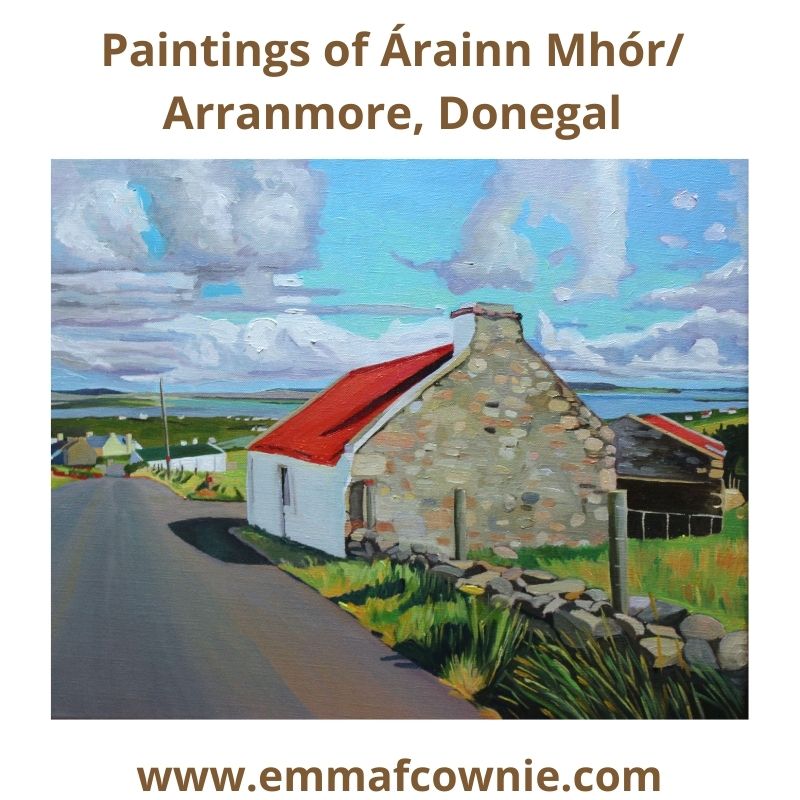
Paintings of Árainn Mhór/Arranmore, Donegal

Arranmore Donegal

I recently join the Stair Árrain Mhór – Árrain Mhór History Facebook group and was overwhelmed by the positive response I received from the members when I put my most recent post online there. I was asked if I had any more paintings of Arranmore for them to see, so here’s a collection of all my paintings of the Island that I have completed in the last two years.

Where it reads (Private Collection) it means that the painting has been sold. I hope you enjoy looking at them.

To see my Donegal paintings for sale click here

Poll na mbadaí (Harbour of the Boats) Arranmore, Ireland.
Poll na mbadaí (Harbour of the Boats) Arranmore, Ireland (Private Collection).


Painting of old cottage on Arranmore, Donegal_Emma Cownie
Brightening Up (Arranmore, Donegal) SOLD


Darkening Clouds On Maghery
Darkening Clouds On Maghery, Ireland (SOLD)


Painting of Arranmore lane, Ireland by Emma Cownie
After the Rain, Arranmore, Ireland (Private Collection)


Landscape Arranmore Ireland
Stone Shed Arranmore Ireland (SOLD)


Landscape painting Donegal
View From Poolawaddy (Private collection) painted in early March 2020


Painting of The Two Tin-Roofed Sheds, Ireland
The Two Tin-Roofed Sheds, Ireland


Red Roofed House Painting
Rusty Roofed House, Arranmore, Ireland


Irish Landscape painting_Emma Cownie
The Two Red Roofed Houses, Ireland (Private Collection)


landscape painting of Arranmore Island_Ireland_Emma Cownie
Down the lane, Arranmore (Private Collection)


Painting of Arranmore, Donegal, Ireland_Emma Cownie
Cloughcor, With Errigal Behind (Ireland) (Private Collection)


Donegal painting
View from Arranmore (Private Collection)

Donegal painting of area around Cloughcor, Arranmore
Around Cloughcor (Arranmore) (Private Collection)


Painting of Donegal Island of Inishkeeragh_EmmaCownie
Over to InishKeeragh (Private Collection)


Donegal landscape painting for sale_EmmaCownie
Gortgar, Arranmore (SOLD)


From Cloughcor To Maghery (Arranmore) (Private Collection)


Painting of Donegal cottage
House by the Wild Red Flowers (Arranmore) (Private Collection)


Painting of Donegal. Arranmore.
Old Courthouse, (Arranmore Island) (Private Collection)


There are also some small watercolours I did when I could not get to my oil paints and easel due to a broken leg/ankle

Watercolour of an old white cottage with a new slate roof, Arranmore, Ireland by Emma Cownie
House on the hill,, Arranmore, Ireland (Sold)

Watercolour of Irish cottage, Donegal
The White house, Arranmore, Ireland

Watercolor of Old White Cottage, Arranmore, Ireland by Emma Cownie
Old White Cottage, Arranmore, Ireland

Watercolour of Arranmore, Ireland
Two Red Roofed Sheds, Arranmore, Ireland


Some of the above paintings are available to buy as prints on artamajeur.com.


Posted on 21 Comments

Over to Inishkeeragh, Ireland

I love looking at maps and finding out the names of places. This is particularly true of the islands that litter the coast of West Donegal near the Rosses. I am always asking my husband, what island is that? He’s usually pretty good at knowing the names (I check on a paper map later). In the summer I spotted a house on a tiny slip of an island to the south of Arranmore.  Can you see it in this photograph below?

View from Arranmore

View from Arranmore

Closer. See it now?

Inishkeeragh

Inishkeeragh

I thought it was just one lone house (was that another house at the other end of the island, maybe?). What glorious solitude! What must it be like to stay on that island all with the spray of the sea so close looking at big Arranmore? This is my painting of the island.  I was curious about the feint outlines of ruined houses I could see either side of the restored summer house. I wondered about them and their families.

Inishkeeragh-001
Over to Inishkeeragh (SOLD)
Map of Inishkeeragh (Google)

This is Iniskeeragh. Ireland (like Wales) is rich in descriptive place names. They usually describe are named after features of the landscape, such as hills, rocks, valleys, lakes, islands, and harbours. In Irish, its name is “Inis Caorach” which means “Sheep or Ewe Island”. So either sheep were kept on the island (it seems pretty small for that) or its a shape reminded people of a ewe, which might be more likely?

Inishkeeragh (Google)

After some research (online and in books) back home I discovered that the island had at least 12 families living there permanently, it also had a schoolhouse. I find this incredible for such a small, lowing lying island. It’s 650m x 300m (2132ft x 984ft) in size. I tried to work that out in football pitches. It’s the equivalent to 40 football pitches, so maybe its not as tiny as I think. It is very low. It’s no higher than 11 feet above sea level. Yet you can read their names in the 1901 census here. The family names of the farming families are familiar Donegal ones: Gallagher, Boyle, Sweeney, Rodgers, O’Donnell and a sole Bonner, Grace (35) who was listed in the census as a knitter, she was one of only 2 knitters on the island. 

Ruins on Inishkeeragh:- Photo credit Roger Curry

These Donegal islands may seem remote to modern eyes, but they played their part in the culture and history of modern Ireland.  Gola Island, Gweedore, may well have served as the model for Robert Louis Stevenson’s Treasure Island. Two men from Gola, Patrick McGinley and Charles Duggan, were aboard the Asgard, the yacht that brought arms into Howth in north county Dublin in 1914, in preparation for the Easter Rising of 1916.  Tiny Inishkeeargh also had its connection with the wider world. Writer and political activist Peadar O’Donnell (1893-1986) was a for a time teacher’s assistant at the school on the island and he set his second novel, The Islanders, here.  Peadar went on to become one of Ireland’s foremost radicals of the 20th-century.

School House:- Photo credit Roger Curry

Life was tough on the island. Roise Rua described her work on the island kelp-making as “tedious and exhausting”. The tenants had to pay rent of £50: £26 for the use of the land and £24 for the use of the seashore – making kelp, picking winkles or shellfish, dulse and the like.” Sadly, like many other Donegal island communities, such as Owey and Gola, the people of Inishkeeragh was forced to relocate to the mainland in the 1950s.

Inishkeeragh Village:- Photo credit Roger Curry

Sea levels played a big part as at least twice in the twentieth century an exceptionally high tide coinciding with a bad gale forced the islands to take refuge in the two houses that had lofts. They apparently spent hours “in terror, fearing the overloaded floors would collapse.” A storm in 1953 washed away the pier and the government of the day would not pay for it to be repaired. This meant that subsequent storms swept through the houses and within 5 years all the families were forced to leave the island.

Photo Credit: Roger Curry
Inishkeeragh – Photo Credit: Roger Curry

There was a reunion of Inishkeeragh families and their descendants in 2015 on the island. Internationally renowned Country singer, Daniel O’Donnell, was part of the celebrations (his mother was born on nearby, Owey Island).

Daniel O'Donnell and Inishkeeragh
Daniel O’Donnell and the Inishkeeragh Reunion

You can see the photos of the day on their facebook page here. You can visit the island with Arranmore Charters, be sure to book beforehand.

Addition sources for Inishkeeragh (Inis Caorachin) came from:

Atlas of County Donegal, Jim Mac Laughlin and Sean Beattie (2013)

Donegal Islands, Ros Harvey and Wallace Clark (2003)

Roger Curry’s Donegal photos can be found at https://pbase.com/rogercurry/image/51657229