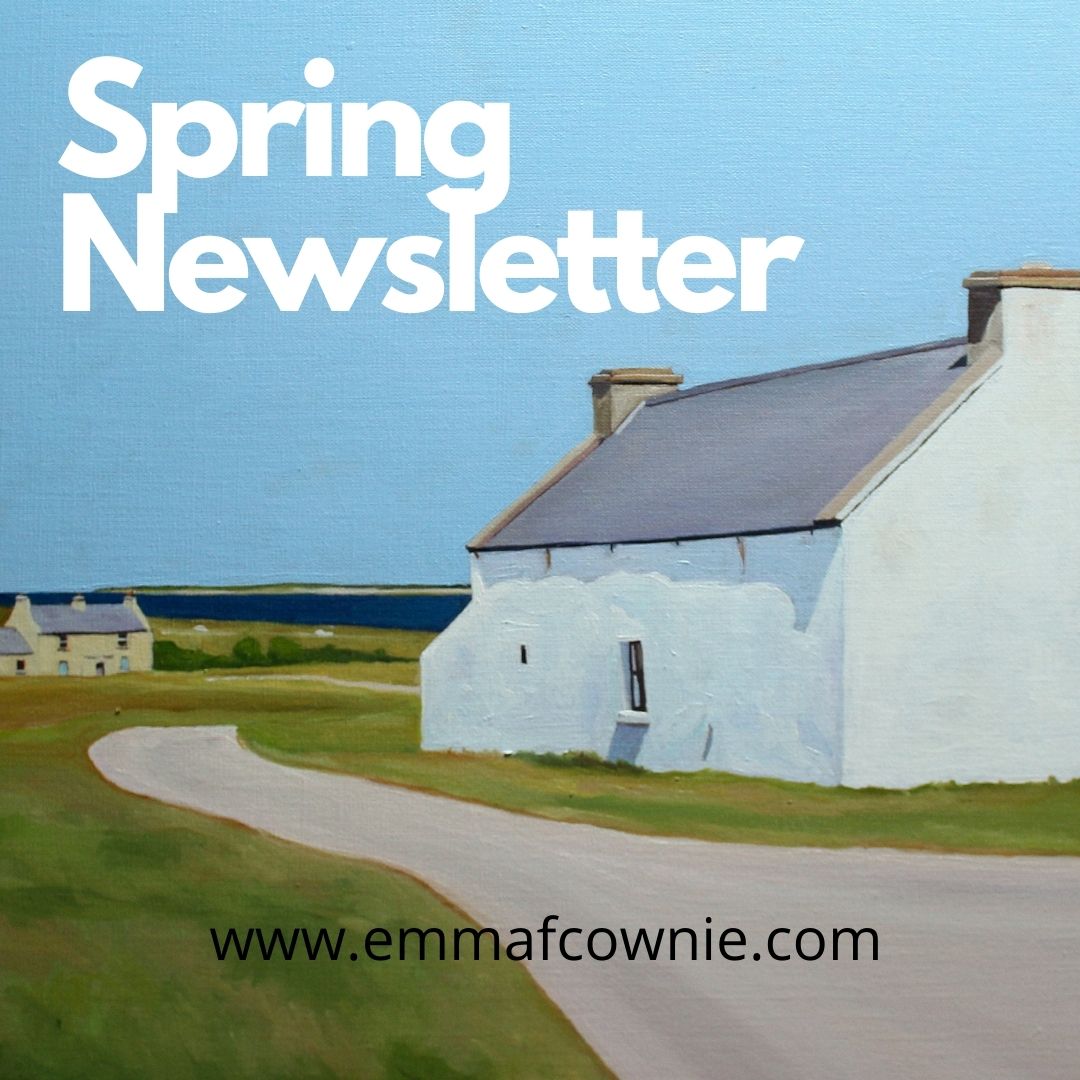
I was delighted to give permission to Eugene Vesey, poet and author, to use my artwork on the back of his book “Opposite Worlds”. In the story, the main character Frank spends his honeymoon with Mary on Gola island.
Last Thursday morning Bingo, one of my two cats, collapsed in the front garden under a hedge and we had to take him on the long drive to the vets to end his suffering. It broke my heart. I had had him for over a decade and loved him dearly. Hattie, his cat companion of the last 6 years, misses him too and she has been outside looking for him. That’s even sader. We are keeping her indoors for now.
Bingo
So my concentration hasn’t been great. I have struggled to write anything, although I had almost finished another blog. Every time, I looked at images, trying decide what painting to start next, I am crippled by indecision. So I have been painting instead a series of small studies. Playing with composition, and simplifying images. The idea is to reduce detail to the minimum.
Caravan at Magheraroarty 24x18cm
Inishbofin #2 24x18cm SOLD
I then moved on to slightly larger canvases. The photographs of the paintings don’t quite capture their colour. Unfortunately, they have a blueish cast to them.
Inishbofin #3 30x24cm
Inishbofin #4 30×24 cm
Inishbofin #5 30 x34cm
Inishbofin #6 30x24cm
Inishbofin # 7 (SOLD) 30x24cm
Inishbofin #8 30x24cm
I will continue with these and hopefully I will find it within me to paint some much larger versions. In the meantime, we have a large rescue cat we have named Tadhg (pronunced “Tag”) from Burtonport Animal Rescue, in the office. He is named after a famous Irish rugby player, called Tadhg Furlong, on account of his robust physique.
Human Tadhg, the rugby player
Unfortunately, Hattie hissed at him when she first saw him, so we are introducing them very, very slowly. Swapping scents and feeding them on opposite sides of the same door etc. Tadhg was a stray and hasn’t had much experience of the indoor life, so he’s getting used to things like doors (they move when you rub up against them, you know) and mirrors (there’s a big black and white cat in window thing in the bedroom next door he’s worried about). He also loves carpets and heating. When he wants a break he sits under the chair in the corner of the room. I hope we can successfully integrate Tadhg into our animal family!
Here’s my summer newsletter. I am shutting up shop for a month from 20th June to 20th July. All going well, we will be safely installed and open for business (online at least) in Donegal by mid-July. I am already longing to get back to my painting routine. I can’t quite believe that after being ground so long by my broken leg and the pandemic that we will actually move house/studio to another country by then. It’s a huge step! Fingers crossed it all goes smoothly!
Caravans tucked away on coastal inlets and islands are not an unsual sight in Donegal. I am always impressed by their presence as there are no roads for lorries and it must have taken a good deal of effort and ingenuity to get it there. Getting to have a “Staycation” in 2021 amidst all the uncertainty of vaccine rolls out & third (or is it fourth?) waves looks like it will take an equal amount of effort! So instead join me in imagining the view from the static caravan’s wide window across the rugged terrain of Gola Island on this late spring morning.
We are all glad to see the back of 2020 but I am pausing for a moment to reflect on some of my painting sales over the year. Sadly, my accident and having my leg in a cast meant that I couldn’t get up the steep stairs to my attic studio (or anywhere else) to paint any oil paintings for over three months but things have ticked over during 2020.
I would like to say thank you Rob and David who waited a very long time in the cold with me for the ambulance to come, to the paramedics and firebrigade who got me out of the woods, to NHS staff at Morriston who fixed my very broken leg and looked after me, as well as to the Physical Therapists who gave me lots of advice on exercises over the phone. I still have a way to go!
I have to say an absolutely massive thank you to my brillant husband, Séamas, who trudged up and down two flights of stairs with trays of food many times a day (and lost weight doing so) for months. He kept my spirits up when I got frustrated and tearful. It wasn’t that often as I was so glad to be home but it was all hard work for him in the midst of a pandemic! He also kept the show on the road by packing up and arranging the shipping my paintings. He was, and remains, utterly wonderful!
Here’s a selection of some of my sales from 2020
Some of my “people” paintings sold in 2020
Some of my paintings of Wales sold in 2020
Some of my paintings of Ireland sold in 2020
A Selection of Commissions from 2020
My top four personal favourites of 2020
Owey in Late Spring – Top of my personal favorites of 2020!
Here’s to a happier and healthier 2021 to everyone!
I have found that my energy is slowly but steadily returning after my operation on my broken leg in March (although painting light is shrinking with the shortening days). I spent much of the spring and early summer sitting in my chair wishing I could go outside into the fresh air or climb the stairs to my attic studio. I painted watercolours instead, and thought a lot about colour and composition. I learnt to simplify my images and edit them with more ruthlessness than I had done before.
Gola Houses (watercolor)
I have attempted to carry these lessons into the compositions of my oil paintings. I suspect that I need to go further. I am always torn between a desire to accurately convey what is probably a well-known location to local people, and the need to create an effective composition. In otherwords I want to create an engaging painting, regardless of whether a viewer has visited Donegal or not.
Blue Door, Gola (oil on canvas) SOLD
Here’s an example of editing my composition. I used several reference photos for this painting of Bád Eddie (Eddie’s Boat) but you will see that I decide to leave out the all the lamp posts. I felt they made the picture look cluttered. I also left out the the skylights on a couple of the houses for the same reason. I did, however, decide to include a couple of series of fence posts on the right side of the painting as they lead the eye down the hill.
One of the reference photos for Bád Eddie at BunbegBád Eddie, Ireland. (Oil on canvas) SOLD
I have gone further with my editing of the reference image in my most recent painting of Arranmore. This is a painting of a (probably abandoned) white house that I had painted a watercolour of earlier in the year .
The White house, Arranmore, Ireland (watercolour)
A lot of the compositional work is done when composing the reference photograph, but there is often a bit more tinkering to be done to clarify the image further.
The White Bridge, Arranmore, Ireland (100cm x 65cm) (Oil on canvas)
Here you can see that I have again removed most of the telegraph poles, just leaving one further down the road. The fence posts as usual, get to stay. The ones on the right led the eye down the road. The central part of the painting on the right side is too cluttered for my liking too. It’s very confusing for the viewer. I have since discovered that this is because there are too many “tangents“. The word “tangent” usually just indicates that two things are touching, but in art the term describes shapes that touch in a way that is visually annoying or troublesome. This also describes those telegraph poles I removed. It all makes for an image that is easier to “read”.
Tangent Chart – From emptyeasel.com
I also removed a several of the buildings so that there is a clear view over to the tiny island of Inishkeeragh with its solidary summer home. Finally, I also simplied the pair of yellow buildings to the far right. I found the semi-abstract result pleasing and I felt that the lack of detail balanced the detail in mud, rocks and grasses on the near side to the left of the painting. I like to balance detail with areas of flat colour, such as the roof of the house or the sea, as I think that too much detail all over makes the head sore. The human brain doesn’t process images in this way any way. Our eyes/brains will focus on one or two areas and “generalise” other larger areas of colour.
Thus, I hope I have created a succesful painting rather than slavishly copying a photograph.
White Bridge Arranmore, (in situ)
Read more about avoiding confusing tangents in compositions here
We are all told to stay local in Wales, until July anyway. I am still recovering from the operation to pin my broken leg so all of my journeys are very short, and very slow, anyway. I have been taking more adventurous journeys of the mind to Donegal, and to the little village of Maghery in particular.
It lies just a stone’s throw (4 miles or about a 10-minute drive) down the road from Dungloe (I regard Dungloe as the center of my universe when I am in Donegal because it has supermarkets like Lidls, Aldis, Supervalu, and The Cope). The Irish name for Maghery Glebe is An Machaire. We know that people lived here over 5000 years ago because they built stone circles, left tombs, a Crannóg, and a stone fort.
Maghery Beach with Arranmore in the distance
We have only ever been to Maghery twice. On both occasions, it was to visit Crohy sea arch. We failed to find the arch, but we did see some very fine sea stacks called Na Bristí on our second visit. We also found found two beautiful beaches, a Napoleonic signal tower, and Second World War look out post and my favouite, and an Éire Sign.
I would like to visit again, but instead, I can only visit online and “in paint”. The drive through the village has inspired my latest series of three paintings. (The first two paintings have gone to collectors in France and the USA). I was drawn to paint the pink and mauve old houses in particular, mixed in with the white stone cottages.
Driving into Maghery SOLDPink House Maghery – SOLD
Through Maghery, Donegal Ireland
Its only now that I realise the mauve house in my 3rd painting is a very similar colour to the early morning sand on the pristine beach nearby.
Maghery Beach, with Maghery village and Napoleonic signal tower
People have been looking out at the Atlantic Ocean and the surrounding land from the hills near Maghery for hundreds of years. They haven’t always been admiring the view, either. During the Napoleonic Wars, a signal tower was built on the headland in the years 1804-6.
Signal Tower at Maghery
This was one of a series of 12 towers built along the Donegal coastline, to watch out for invasion from French forces. We dont have these in Wales, although Wales invaded by a French force in 1797. That’s beacuse it was not built to protect the Irish population from the French, but because the British did not trust the Irish not to welcome the French with open arms. A few years earlier Irishman, Wolfe Tone, had attempted but failed to land a French force near Lough Swilly. The plan had been to throw the British out of Ireland. His landing failed but there was a successful landing of French forces further down the coast in Mayo. A brief declaration of an Irish Republic followed, but the Irish Rebellion ultimately failed, after a series of battles in Wexford culminating, in defeat at Vinegar Hill.
The signal tower is thus a symbol of deep mistrust by the British. This particular tower is well preserved and surrounded by walled farmer’s fields. The men who were garrioned here communicated with neighbouring signal towers by raising and lowering a large rectangular flag, a smaller blue pendant and four black balls in various combinations along a system centred on a tall wooden mast. This must have been very difficult if not impossible in poor weather conditions.
About 200 meters down the road is the Second World War Eire sign. I am not sure why but I was more excited to see this than the tower. Perhaps, because it was tucked away, designed only to be seen from the air. Perhaps also beacuse it is cut into the grass like a prehistoric chalk horse.
Eire 74 sign at Maghery
The letters spell the word Éire, which means “Ireland” in the Irish language. Over 80 of these numbered Éire signs were dotted around the coast of the Republic during the Second World War. I originally thought this was to warn German bombers that they were flying over a neutral country. This was important as neighbouring Northern Ireland, being part of the United Kingdom, was not neutral. I was wrong, the main purpose of these numbered signs was as a navigational aids for the Allied planes.
Although the Republic were offically neutral they were indirectly involved in the war. In the Spring of 1939, expecting another European War, the British Government had asked the Irish Government to set up a Coastguard Service. The Irish Government agreed to build a series of small concrete huts, known as Look Out Posts (or LOPs) along the coast. There is this one at Crohy and there was another on Arranmore Island near by. The letters Eire (without the accent on the “E”) were written in stone nearby to give aircraft an idea of where they were. The stones were painted white. The numbers (74 in the case of Crohy) were added in 1942 after the Americans entered the war in December of 1941. (Thank you to Séan Bonner for this information).
These huts were pre-built in parts and assembled on site by the army (as the Coastguard Service was under the control of the army). The Irish Government agreed to build the huts and set up the service but on condition that they only would supply radios to the huts in the event of a war. Coast watchers worked around the clock in pairs, reporting every activity observed at sea or in the air by telephone.
As the aircraft would have seen it (Photo Credit:Conor Corbet)
Allied aircraft were allowed to fly over the Republic through the “Donegal Corridor” to airbases in County Fermanagh. These airbases were crucial to provide “cover” for the shipping convoys that came across the Atlantic bringing industrial raw materials and food to Britian. Without fear of air attack, German U-boats would operate as ‘wolf packs’, picking off the ships one by one. All flights were meant to take place at “a good height”. If any aircraft crashed, as at least six did, if they could claim they were on a non-combative mission, they would be repatriated. While it was easy for Allied pilots to make that claim, it was not realistic for Luftwaffe pilots to do so, they tended to be interned. Ireland also helped Britain in secret by setting up an armed air/sea rescue trawler called the Robert Hastie at Killybegs, Donegal, to help any shipping casualties and to supply planes that had run out of fuel.
I didn’t realise it at the time but this is just an updated version of the Napoleonic tower. The ruins above the Eire sign is that of a coast watch station. Coast watchers worked around the clock in pairs, reporting every activity observed at sea or in the air by telephone.
Further along the road is Crohy Head. I think techically is Crohy Head, South. Although there is space to park and a sign announcing its presence, you can sense that the local authority are not all wildly keen to promote this attraction in case people fall down the steep field/cliff face trying to get a good look at it.
The Sign for Na Bristí
I am sitting here with my pinned leg resting on a chair, and it’s twitching unhappily at the sight of these photos now. My leg does not like to think about rough terrains right now. I can just about manage a slow walk around my local park these days (it’s going to be a long slow build up to full recovery). We must have been mad! I thought so at the time too. Still, my husband Séamas who climbed down to the beach to take some photos whilst I sat on the hill holding onto some yapping dogs. To my shame, there was an artist with his easel painting en plein air at the top of the field. I wonder if he could hearing me hushing the dogs and telling Seamas to hurry up.
Sadly, the light was, in my opinion, in the “wrong direction” and early morning would be a better time of day to catch the sea stacks. The sea arch, was just out of sight around the corner. I think that I will save up and buy a drone to take photographs from higher up without imperilling any of my (or my husbands’) limbs! Or a boat. Things to dream about from my chair.
Here is a marvelous drone photo of Crohy Head.
Sea Stacks and Sea Arch at Crohy Head (Photo: Gareth Wray)
A while back I came across a quote on the internet that has stuck in my mind:- “If I knew the world was to end tomorrow, I would still plant an apple tree today.” I was quite struck by this sentiment, especially in the light of current events.
I could not remember who said it. So I did some research. I was intrigued by what I discovered online. I found a number of statements:-
It was originally said by Martin Luther, a 16th century German monk
It was originally said by Martin Luther King Jnr, the 20th century African-American Civil Rights Campaigner.
It wasn’t said by 1) or 2)!
This puts me in mind of one of my favourite internet memes by that teller-of-truth Abe Lincoln…
Just joking!
The apple seed quote apparently originates in Nazi Germany in the 1930s, in the Protestant Confessing Church, which used it to inspire hope and perseverance during its opposition to the Nazi dictatorship.
To be honest, it doesn’t matter who said or when (although there’s a lesson about taking things at face value there) because I like the sentiment. No matter how dreadful things seem, they will pass. Eventually.
Here is my apple seed for this week.
The Road by the Loch, Ireland (80x60cm/ 31.5×23.5″)
Failures are always a challenge. When I used to be a Secondary school teacher, I always learned more about teaching when I faced a difficult class than a nice docile one. They made me go away and think about what I was doing and how I could do it better. Painting is no different.
I have been thinking about the composition of larger paintings. When I used to think about painting a scene I used to think in terms of “that’s a small painting, it won’t “stretch” to a larger canvas”, or “That’s a mountain, definately, therefore, it’s subject suitable for a large canvas”. I am parodying myself somewhat but generally, I have this feeling that small birds belong on small canvases and big landscapes belong on larger ones.
My thinking was challenged by a commission I did in the summer where a client asked for a very large version (120 x 90cm) of a relatively small painting (41 x 33 cm). So I scaled up and despite my anxiety, it worked. This was important as my confidence had been dented by a previous large landscape painting that hadn’t work out for me.
Small and Big Versions
It got me thinking about composition. I understood the basics and had looked of compositional grids in Artbooks as a teenager and thought I’d internalized them. I realized that I had got sloppy. I’ll explain.
A Beginners Guide to Composition
I am not going to do an information dump about theories of composition here (I have added links to some good blogs on the subject below) but the “rule of thirds” is one that springs to mind here. The idea that you should look for naturally occurring in divisions of thirds in a scene and try and locate points of interest at the intersection of the “Golden section”.
Rule of Thirds
The Golden Section
I had been influenced by ideas of composition from photography and the work of artist-turned photographer, Henri Cartier-Bresson,in particular.
Rule of Thirds – Henri Cartier Bresson
I liked his use of diagonals in particular, and this has influenced my paintings of urban scenes.
When I came to Donegal I was so blown away by the vast overarching skies and majestic landscapes. I got very excited by everything I saw. I tried to capture everything. The houses, the mountains, the sea, and the sky. Most of the time it worked.
Swirling Clouds Round Errigal
Donegal Painting
From Ferry Coll
From Cruit Island
Wild Wind Across Dunfanaghy
Shored up near Muckish
Further Up Shore
You can probably look through these paintings and tick off the composition approaches I instinctively used; the diagonal, the pyramid, the rule of thirds and so on. They all worked.
Then, it really pains me to admit it. I lost it. I got carried away and overreached myself and painted this big beast.
Sailing By Edernish
What was I thinking? There is far too much sky in this painting. Worse than that, it was a large canvas. There are things I like about the painting, the light on the island in the bottom half of the painting, but the sky was just too vast. It pained me that I had such a large reminder of my errors of judgment. I don’t mind screwing up every now and then but I hate waste and that was an expensive canvas. It’s no coincidence that I am planning a blog post on reusing stretcher bars to stretch my own canvases.
My confidence was dented. It put me off large paintings for quite some time. It wasn’t until I did the commission I mentioned earlier, that I got thinking about what had gone wrong. I realized that I had to rigorously apply the same rule of composition to large canvases as I instinctively did to my small ones. So I tried an experiment, I took a successful composition of a medium size painting and did a much larger version of it. This composition was based on a compound curve.
Over to the Rosses 60x40xmView From Arranmore, Ireland 92x73cm
It wasn’t a copy of the smaller painting. It wasn’t meant to be, although it was meant to encapsulate the same feel of the smaller work, with some adjustments. I have included some more detail, changed the tree, and added a shadow and a ditch in the bottom third of the painting. I think it worked.
I have since done another small oil sketch of another composition before I scale it up. It’s another diagonal composition. Although, the larger version will not be “portrait” format but my usual “landscape” orientation.
I will add the larger version later in the week. So you will have to wait to see if that composition works as well as this smaller one. Watch this space!