Posted on 20 Comments

Home from Home

Painting of Irish Landscape
Painting of Donegal, Ireland
Over to Kincasslagh SOLD

I am winding down the social media for a while because we are leaving the UK to spend some time in our house in Burtonport, Donegal, Ireland. The internet will be available on a very limited basis so I won’t be able to post on here until mid-April. I will be checking my emails but I won’t be posting much, if anything, on Facebook, Twitter & Instagram.

I have mixed feeling about the enforced “break” from social media. On the one hand, I hate the way how it sucks up all your spare time and energy and how FOMO (fear of missing out) has you checking updates. There’s always the fear that if you stop “spinning all the plates” that people will forget about you! However, I am certainly looking forward to reading books, listening to the radio (there’s no TV either) and sketching and painting for fun (not oils but watercolour sketches).

I am very excited/nervous about the whole thing because I am driving there and it’s a long, long way.

Please be aware that any artwork purchased after 25th March will only be shipped after 12th April.

IMG_20181103_100343971_HDR
My home in Donegal
Posted on 21 Comments

Donegal Blues

I warn you now that this is a blog post about paint; about one shade of blue in particular. It might even involve watching paint dry. Which, unless you are an artist, probably isn’t very exciting.

Paints represent a sort of non-verbal language for me. I actually find it hard to put into words how I feel about paints. I have a “feeling” in my stomach and I want to wave my hands about a bit to express those feelings, but it all seems very inadequate. I don’t know if other artists are like this. I see colours in life and think of the paints I might use to represent them on the canvas. There is a particular warm shade of brown that I am yet to satisfactorily find in a paint. For a long time, I struggled with particular shades of green, until I found that mixing turquoise produced the right level “zing” in my summer greens. In Donegal the greens need yellow ochre to make them ring true.

1640-50
The Madonna’s ultramarine cloak

I am particularly obsessive about a particular colour that until yesterday, I was even sure how it was pronounced. This is phthalo blue. I doubt you have ever heard of it. It’s not like Ultramarine blue, made from lapis lazuli stone, which was was famously so expensive it was solely reserved for painting the Virgin Mary’s cloak.

Now, I am absolutely no good at saying words I haven’t heard someone else say out loud. That “ph” at the beginning really confused me and I used to call it “p-th-al-ff-oo” blue, deliberately tripping over the syllables because I’d never heard it said out loud. Until yesterday, when I realised I could look it up! So it did.

What! It’s pronounced “thalo”!! Why don’t they just call it Thalo Blue? I noticed in the comments below the video that someone else said ” I say it as pfthpfthpfthpfthpfthpfthpfthalo blue”. I don’t recommend, however, that you listen to the Russian pronunciation of “пхтхало блю” on google translate because it’s sort of like my original managling of the word!

phthalo-blue-organic-pigments
Phthalo blue pigments

You are probably thinking, who cares? Well, I care because I am passionate about Phthalo blue. No, that’s not true I am obsessive about it. It is very useful colour in my messy box of paints. I particularly like the version made by French paint manufacturers Lefranc & Bourgeois.


Phtahlo Blue paint
I love you!

It’s not cheap but it a very useful colour. Its very strong. It’s very dark and I love it for creating really dark blues, blues that mixed with Van Dyke Browns and make wonderful dark clouds.  I don’t like to use black for dark shades as it has a tendency to “kill” a colour.  I have found that its essential for both the massive white Cumulonimbus clouds and the really filthy rain clouds of Donegal. It’s actually a synthetic pigment from the group of phthalocyanine dyes. When it’s mixed with Titanium white it makes a delightful light blue that’s also very useful for skies.

Painting of Errigal
Swirling Clouds Round Errigal
Paint
Phthalo Blue with titanium white

Oil paints are in essence pigments carried in oil (once upon a time vegetable oil was used) usually linseed today. The pigments were originally derived from mineral salts, a few from organic materials such as roots.  Many of the historical pigments were dangerous, such as the wonderful greens called Paris Green (copper acetoarsenite) and Orpiment (arsenic sulfide), which were highly toxic.  Happily, these pigments are no longer used. Later, man-made or synthetic, pigments increased the range of colors available, phthalo or phthalocyanine blue is one of these modern colours.

Chemists first developed this blue pigment in the late 1920s and it was sold under the trade name “Monastral in 1935. This list of alternative names is bewildering. Here are some of them; monastral blue, phthalo blue, helio blue, thalo blue, Winsor blue, phthalocyanine blue, C.I. Pigment Blue 15:2, Copper phthalocyanine blue, Copper tetrabenzoporphyrazine, Cu-Phthaloblue, PB-15, PB-36, C.I. 74160.  I want to add to this long list of names Hoggar blue. Surprisingly, this colour is also used in Lidl’s Dentalux Total Care Plus toothpaste!

Now, I am sometimes faced with the situation that I have used up all the paint in a tube (and I really do get all the paint out of the tubes) but I can’t read the name or number of the paint to reorder the right one. I might be able to work out the manufacturer but its name or number. Here’s an example of what I mean.

IMG_7346
What’s your name?


IMG_7345.JPG
Still a bit of paint in here!

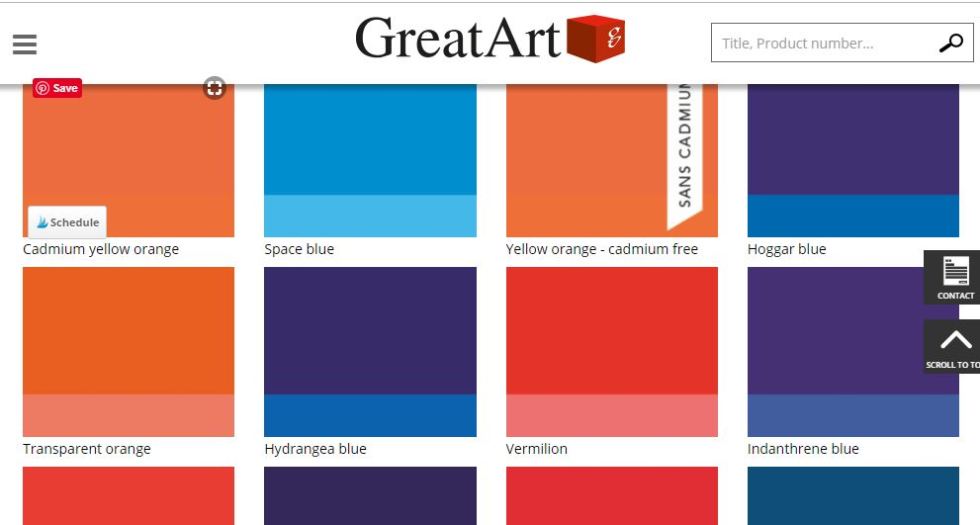
Lefranc & Bourgeois are the oldest artists’ quality colourmen in France. They share the same parent company as Winsor & Newton. This is why, it difficult to get their paints in the UK most stockists carry Winsor & Newton paints instead. A while back they decided to have a rebrand and they changed their labels and the names on the labels. This caused me great confusion because neither of the two suppliers where I usually ordered this great colour listed “phthalo blue” anymore. I’ll show what I mean. Here’s the Lefranc & Bourgeois page from the Great Art website.

Great Art.JPG

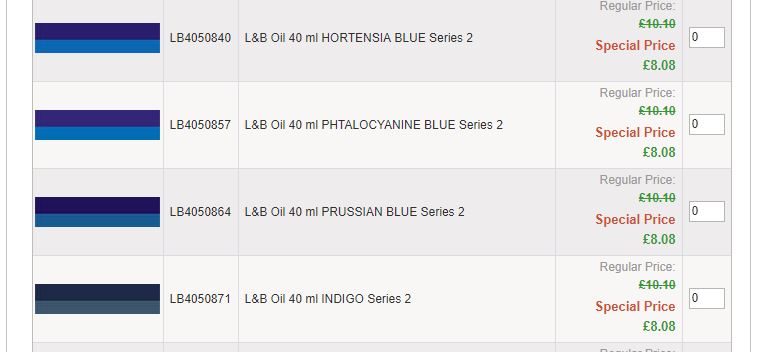
And here’s the page from L. Cornelissen & son in London:-

Capture.JPG

So I ordered a Phthalo blue made by another paint maker, Lucas 1862. It was OK but not half as good as the L&B version. It didn’t feel the same, and it didn’t mix with other colours in quite the way I wanted.

IMG_7351-1.jpg
Left L&B and Right Lucas 1862

Looking back now, I can see that Hoggar Blue and Phtalocyanine Blue are actually the same colour, phthalo blue. The colour I thought they had stopped making. This meant I spent weeks eeking the last drop of paint out of the what I thought was my last tube, thinking that this colour was no longer to be had in the UK. Then I realised that I had another tube in a drawer so I got it out and studied the label carefully.

IMG_7358
All those different names

I realised that the names for this paint in other languages used Hoggar a lot (the Hoggar mountains are in Algiers, once a French colony); Blu Hoggar /Azul Hoggair /Hoggarblau so I went back and looked at the Great Art online catalogue and worked out that my phthalo blue was actually now listed as Hoggar Blue. So I ordered this Hoggar Blue and it was the same colour as Phthalo Blue. I was so happy! It meant that a part of my vocabulary was restored to me and I wasn’t going to run out of words!

So, you can see that I wasn’t exaggerating when I said I was obsessive about colour. Who else but an artist has a celebration over a particular shade of blue? The moral of the story is that all paint is not created equal and it’s always worth being obsessive about colour.

Painting of Errigal, Donegal, Ireland
Brooding Clouds Over Errigal

Oh yes, if you want to watch the video about paint drying, be my guest. I have watched and actually found it interesting (OK I actually skipped the drying bit to see the different colours)!

Posted on 19 Comments

Painting Bunbeg Donegal

Painting of Errigal

Bunbeg. The word has a pleasing sound to it. It’s short, easy to say and has a nice rhythm to it. Most place names in the British Isles are simply descriptions of locations, or who used to own it. That is not always obvious to modern English speakers because the descriptions originated in Anglo-Saxon, Welsh,  Gaelic (Scots) or Gaeilge (Irish). Therefore, when speakers of the Celtic languages use a place name they have a ready made description of the place. It’s the same with Bunbeg. Bunbeg is the anglicised version of “An Bun Beag” which means the “the small river mouth”.  I know very little Gaeilge but once you start picking up words you see them everywhere. Beg meaning small – there’s Derrybeg (Doirí Beaga) just round the corner which means small oak.

Bunbeg is located in an area of Donegal known as Gweedore (Gaoth Dobhair), known as a bastion of Irish music, language and culture and home to legendary bands such as Clannad and Altan. If you are as old as me you may well remember Enya’s “Orinoco Flow” which was a hit in the UK way back in 1989 and seemed to be played everywhere. Enya was originally a member of Clannad.

Gweedore is the largest Irish-speaking parish in Ireland with a population of just over 4 thousand people. I enjoyed listening to two fisherman having a good gossip in Irish at Bunbeg harbor round the corner from here. I no idea what they were saying but the conversation went at a good pace. I enjoyed just the sound of the language and comparing it to the sound of Welsh which I am familiar with.

IMG_4066
Fisherman (not gossiping) in Bunbeg Harbour
IMG_4944
“Eddie”

Anyway, back to Bunbeg. The vast tidal sands that stretches across the indent in the coastline is known as Magheraclogher beach. When I say, vast I mean vast. It is one of the best known beaches in Gweedore, largely in part because of the distinctive shipwreck that’s been there since the 1970s.

It is known locally as ‘Bad Eddie’ or Eddies Boat. It has regularly appeared in Music Videos as well as providing the backdrop for countless wedding photographs and instagram posts. That mountain in the distance is Errigal, which also features in countless music videos, photos and paintings.

Photo of Bunbeg with Errigal in the distance

“Eddie” with Bunbeg and Errigal in the background

Usually photographers shoot him at low tide. Here’s the photo they use on Wikipedia.

270px-Bunbeg3333
Bunbeg – Wikipedia image

I decided to paint a different view of Bunbeg, without “Eddie”, because I liked the reflections of the clouds in the shallows, I thought it made for a more dramatic composition.  I thought the rain clouds also gave a better sense of the mercurial nature of weather of Donegal. It was also windy when we were here although, I would say that wind is a pretty much a constant feature of the “Wild Atlantic Way”.

Painting of Bunbeg Harbour, Gweedore, Donegal, Ireland.
From Magheraclogher Beach (SOLD)

This beach is popular with dog walkers and tourists as it is easily accessible, with a car park. Yet, I say “popular” the other people we saw were dots off in the distance.

For information on the history of Gweedore area click here 

Posted on 5 Comments

From Fall Island

Painting of Donegal, Ireland

I like to explore nooks and crannies and I usually use a map to help me. This way I can find interesting scenes to paint. I love looking at maps but I didn’t have one in Donegal. I thought I’d get one with the hire car but instead we were given a Stat Nav (Satellite Navigation).  You can’t spend hours looking at the lay of the land on a Stat Nav. It spent the holiday in the boot of the car. I thought we’d get one in a filling station but in Ireland you don’t fill up your own car and wander into the garage shop to look at car related stuff and packets of sweet, you have a friendly young chap filing your car up for you! We sort of knew where we were going. My husband, Seamas, had spent hours “driving” down the roads and lanes of Donegal on Street View Google.

Fall Island, Donegal
The Lone House on Fall Island

So, in the spirit of adventure I turned off the coast road, which runs from the airport to Dungloe, in search of the sea. The roads are narrow but fortunately we didn’t meet anyone coming the other way. After following an undulating single track road, it widened out and then seemingly vanished over a hill into the sea. I didn’t fancy doing a lot of reversing so I parked up to explore on foot.  Over the other side of the rise was the beach. It was low tide. The track I’d been on ran down to beach and then started up again on a island on the other side of the beach.

Fall Island, Donegal
Beach between Fall Island and the mainland

This is Fall Island and it is only 300 metres long. There is only one lone house on the island. The house was shut up for the winter.

The Rosses
The rocky Rosses

I was fascinated by the rocky landscape and the houses perched on the rocks.  These rocks are made of granite. Granite is an igneous rock which it was once magma which crystallised as it cooled down. It’s a dense and useful rock. It can be cut, carved and shaped. It is also resistant to water and pollution.

Painting of Errigal, Donegal, Ireland
From Fall Island

The granite rocks along the coastline are massive. Monumental. Their edges smoothed by the sea and the wind.

Fall Island, Donegal
View from Fall Island


Posted on 21 Comments

How I paint in the dark

Blog about artificial lighting for artists

Hedgehogs and bears have the right idea about winter.

Bear asleep
Is this the best way to spend winter?

They hibernate and miss the dark winter months. I am finding this winter quite a struggle. In the last fortnight most days have been characterised by gloomy skies and poor light quality. In previous years I have struggled to get much painting done. I have spent hours tapping away on the computer looking up at the black sky outside my window, waiting for the sun to rise so I can start painting, and then often abandoning work at 2pm when the light goes. The best light to paint by is undoubtedly daylight, and my attic studio is blessed with a lovely northern light, but I needed to extend my painting time, to keep working.

A couple of years ago I invested in a “Professional” artists’ light. It was pretty pricey at £60 ($75US) but I hoped it would be worth it. I think it helped me paint on for about half an hour after the light had faded but not much more.

Daylight Professional Artists Lamp (old version)

So I decided to add to it with a photographer’s’ daylight lamp. These have screw fittings so I had to buy a converter so that it would fit the clip fitting that I also bought. The whole set up did not cost much more than £12 ($15) so just on price it was likely to beat the expensive artist’s light. The bulb arrived, but when I opened it up I was so surprised it’s strange appearance (it was easily twice the size of the regular light bulb) that I laughed so hard that I dropped it, and it and smashed! Drat (not my actual words). I then had to order another one and wait all over again for a new one to be delivered.

Photography Daylight White E27 Lighting Lamp Bulbs 135W 5500k
Don’t Laugh! Photography Daylight White E27 Lighting Lamp Bulbs

It was worth waiting for. It was pretty good. It was cheap too. So I got a second one to place either side of me. This enabled me to paint on for an hour and half after the light had gone. This year, I have gone for a “full-Hollywood-lighting” with three of these beauties blazing away. The artist’s light has been relegated to acting as handy arm to clip the photographers’ lights to! I don’t even bother to switch it on, anymore, unless it’s really dark.

How artists see to paint in the dark
The two photographers lights clipped on the bendy arm of the artist’s lamp.

Now I think I can paint any time of the day or night (almost). It’s best for augmenting natural light and extending painting times. In yesterday’s gloom I was still struggling to see pale yellows and light greens. I am very tempted to see what a fourth one will do for me.

Artificial light in an artists studio
Lights on in my attic studio
Oil paintings of Donegal, Ireland
Recent paintings of Donegal painted (partially) under artificial light

Interestingly, despite all this artificial light I find I still need my SAD lamp to keep me relatively cheerful and regulate my sleep patterns. I have found that if I don’t get a good shot of SAD light around 7pm I awake at 4am bright-eyed and decidedly grumpy. That extra burst of light helps tell my brain that I should not wake up until 6.30, at least. That’s the best I can do most days. I long to sleep in til 9am but for some reason I just can’t.

What do other artists do to keep working in the winter months? Or you sensibly, wrap up warm and go to sleep for four months like hedgehogs and bears?

Sleeping hedgehog
That looks so cosy!

Here’s another artist’s solution to the dark days of winter.

To see my landscape painting click here 

Posted on 31 Comments

Behind every cloud …

Donegal painting
“May the friendships you make, Be those which endure, And all of your grey clouds, Be small ones for sure” – Extract from an Irish Blessing “Behind every cloud is another cloud” – Judy Garland   I have had an ambivalent relationship with clouds. I prefer bright sunshine. I In fact I have obsessively looked for bright sunshine and shadows to paint.  I have found the relationship between objects and their shadows exciting.
Oil painting of light and shadows on a Swansea steet.
Up Sketty
  This can be difficult in Wales where we can get days or even weeks of overcast or wet days. So when the sun is out I go mad, rush all over the place taking reference photos to paint later in my studio.  I have been guilty of often portraying Swansea only in its best light.  Someone once said I made Swansea look like a Mediterranean country.   Don’t get me wrong, on a sunny day it’s beautiful place and I have painted dark and rainy scenes too (see below) but not the rain clouds as I prefered painting bright blues skies.
Painting of car in a rainy night street
The Driving Rain (SOLD)
Oil Painting of gas station in the rain
That Petrol Emotion (SOLD)
I have never really been happy with how I painted clouds. They never quite came off the way I wanted them to. The paintings looked fine but I had not enjoyed the process of painting them. For a long time I could not quite put my finger on what it was that I was finding dissatisfying about the experience.
Oil painting of Mumbles Head, Swansea
Clouds Gathering Over Mumbles Head
So I did a bit of research and read up on something called “scumbling” and watched a video on youtube demonstrating the technique. This is a way of applying paint with a dry brush to painted canvas. This way a broken layer of paint is added allowing the colour underneath to show through.  J.M.W. Turner was the king of scumbling. Think of that painting of his “Rain, Steam and Speed” where the steam train is emerging out of the clouds of rain and steam. This is my humble effort at scumbling.
Old painting of clouds in West Wales
A Change in the Weather
I was quite pleased with it but it did not pass the “praise test” with my husband, Seamas. He’s my most valued audience and source of feedback. It’s not that he didn’t like the painting, he just didn’t say anything at all about it. So I decided this technique wasn’t quite working for me. I watched a few more videos on Youtube where artists knocked off beautiful clouds in a matter of minutes. This just seem to make things worse. I swirled the paint around on the canvas and it all just felt “lumpy” to me.  I scrubbed the canvas. Humph. I decided Youtube videos were great for tips on mending jeans or adjusting security lights but not for painting techniques. I had to find my own way. Or truth be told, I forgot about it for a while. Finally, I think I have started to make a break-through. It came from being in another country, Ireland, where the skies are full of constantly changing clouds. This was something quite different to the light of Wales. To start with I tried to painting bright sunshine, as I do in Wales.
Irish Cottage, Arranmore, Donegal, Ireland
On The Way To Arranmore
Round the Rosses
Round the Rosses (SOLD)
I like the light in these painting a lot. Then I was tempted by the landscape to explore the changing skies too. You can’t paint Mount Errigal without a swath of clouds around its shoulders.
Under the Shadow of Errigal
Under the Shadow of Errigal (SOLD)
I started to get sucked into the drama of the Donegal skies. I slowly discovered the key, for me anyway, is very thin layers of paint. After all, clouds are just water vapour. They are made of tiny fine particles of water. They are not solid things and this was where I had been going wrong, making them solid things. They are not. Ironically, this is what exactly what the Youtube videos were showing me but I needed to find my own way of doing it. I didn’t like painting a layer of opaque blue and then adding cloud on top. I prefered a number of very thin layers of paint.  The natural colour of the linen canvas I use, actually helped contribute to the colour of the “dirty” rain clouds.
Mount Errigal from Ballymanus Beach, Donegal
Mount Errigal from Ballymanus Beach, Donegal (SOLD)
So my clouds got thinner and finer.
Painting of Owey Island, West Donegal, Ireland.
Over to Owey Island, West Donegal, Ireland
So that a puff of wind would move them along. Or light luminate them.
Painting of view from Burtonport to Arranmore, Donegal, Ireland,
From Ferry Coll
So, I have started painting “overcast” pictures where the light is slivery rather than golden. I can be a challenge because the light affects all the colours, the greens are flater and duller and I am using yellow ochre and naples yellow far more than I do painting sunny Welsh landscapes.
Oil painting of Dunfanaghy and Muckish, Donegal
Across to Dunfanaghy (SOLD)
Painting of Arranmore, Donegal. Finally, my favourite recent painting is the one I did of Muckish mountain. I loved the massive rounded clouds that seemed to be echoing the humped shape of the mountain.
Painting of Muckish, Donegal.
Shored up near Muckish
I have only started feeling confident painting clouds and I think I have some way yet to go. Fortunately, I won’t be short of clouds to paint in Wales and Ireland.    
Posted on 20 Comments

Over to Owey Island

Blog about Owey Island Donegal, Ireland

I love painting the coast, particularly if it’s rocky. Owey Island, lies just a short distance off Cruit Island near Kincasslagh in west County Donegal. Strictly speaking there have been no permanent residents since the 1970s. [Photos from http://www.welovedonegal.com/islands-owey.html]

There is no electricity or mains water, yet plenty of people visit and many visit during the summer months. If you want to visit, there is a ferry service run by Dan the Ferryman.

View of Ireland From Owey Island: Ian Miller
View of Ireland From Owey Island (Ian Miller)

The name Owey, in Irish Gaelic “uaigh”, means cave. The island is a cavers, kayakers and rock climbers’ paradise.

The island is encircled by massive rock stacks and it also has an underground lake. As I am cave-phobic this video is the closest I will ever get to it!

I am fascinated by rock stacks and Donegal has plenty of them. I like to think of how these massive structures have gradually been eroded by wind and waves over thousands of years, forming first sea arches and then stacks.

I also love the colour of the rocks and the wild Atlantic Ocean. The ocean is incredible shades of blues, greens and mauves, mixed in with browns and frothing surf. Although I feel I am getting better at representing the layers of Donegal sky and clouds, but capturing the movement of the seas is still frustrating me.

Painting of Owey Island, West Donegal, Ireland.
Over to Owey Island (SOLD) 


If you to find out more about Owey Island see Ian Miller’s Unique Ascent’s website for detailed descriptions and incredible videos.

Just thought I’d add a post script about the “Holy Jaysus Wall”. I think if you look at photo of it you will understand the name. It makes me feel ill just looking at it!

Holy Jesus Wall, Owey Island
Holy Jesus Wall

Irish climber and alpinist John McCune, climbed it in 2014.

Here’s a fascinating film clip from the 1970s about Owey Island’s postman, Neil McGonagle, who used to visit the dwindling population on Owey Island by small boat four times a week to maintain the island’s contact with the outside world.

https://www.rte.ie/archives/2018/0205/938419-owey-island-postman/


Painting of donegal, Ireland
Owey Island (SOLD)

Posted on 9 Comments

On the Way to ArranmoreArranmore

Painting of cottage near Arranmore, West Donegal, Ireland
Painting of Irish cottage, Arranmore, Ireland
On the Way to Arranmore

I wonder whether the post to Arranmore Island, Donegal, goes astray a lot. There are two other islands with similar names off the coast of Ireland and Scotland. There are the Aran Islands off Galway Bay to the south as well as the Scottish Isle of Arran. Arranmore or Árainn Mhór, in Irish Gaelic.

Map of Arranmore, Ireland
Map of Arranmore, Donegal

It lies off the west coast of County Donegal, Ireland. It is the largest inhabited island off County Donegal, with a population of 514 in 2011, down from 528 in 2006, 543 in 2002, and over 600 in 1996. The island is part of the Donegal Gaeltacht, with most of the inhabitants speaking Ulster Irish.

Painting of view from Burtonport to Arranmore, Donegal, Ireland,
From Ferry Coll

There is a frequent ferry service from Burtonport and this old cottage was spotted nestling into the rocks of one of many islands, Inishcoo, en route to Arranmore. There is no ferry service to the many little islands scattered off the coast of West Donegal. People get to these remote islands in their own little boats. There are landing stages and steps down to sea cut into the rocks. Of course, you could always swim to Inishcoo. Amazingly, the local cows do.

To buy any of my landscape paintings click here

Posted on 19 Comments

The Old School, Owey Island

I sounds mad, but I didn’t have a map when I was driving around Donegal. I sort of hoped I could buy one in a petrol station but I never did. The Hire Car people lent us a Sat Nav but I could not be bothered to plug it in and it stayed in the boot the whole week.

I am very lackadaisical when it comes to planning holidays, I think all my energy goes into the logistics of getting there. Anyway, I assumed that my husband would tell which places were worth visiting. Afterall, he had spent hours “flying” up and down the roads of Donegal on StreetView. I sort of knew where I wanted to go; Bunbeg, Bloodyforeland, Falcaragh, Dunfanaghy, Derryveagh,  Kincasslagh and Dungloe and the distances between them were not very great.

Donegal Islands Map
Donegal Islands Map

On the only properly sunny afternoon we had in Donegal, I took a left off the road from Dungloe to Kincasslagh. The sign said “Cruit Island Golf Club”.  I reasoned that golf clubs are usually located in beautiful places, near the coast. So I followed a single track road and over a small concrete bridge on to Cruit Island. If you look at the map above, you can see that Cruit Island is long, three miles long, in fact.

Bridge to Cruit Island

Cruit Island at Low Tide

Cruit Island at Low Tide

After a pleasant drive along a single track road, and passing what can only be called mansions at the north end of the island, we reached the golf club. Now in the UK golf clubs can be funny about other people coming onto their property, but there was nowhere to turn the car so I kept driving. Eventually we reached the golf club car park which looks out across wild waves to an island. This was no calm inland lough. This was the Wild Atlantic. The wind was fierce and the waves crashed and boomed.

Owey Island, Donegal.

It was mesmerising. The island was just across the turquoise water. It was dotted with houses, some clearly derelict, others in good order. I didn’t know it at the time but this was Owey island.

Quay on Owey Island
Quay on Owey Island

It turns out that Owey island is uninhabited for much of the year, having no permanent residents, but people do live there in the summer months. It was last inhabited on a full-time basis in the mid 1970s. The last residents were three old boys who were moved to the mainland of Donegal, or as the islanders call it, Ireland. All the houses were built on the south side of the island, facing Cruit Island Golf Club. The north of the island is too rocky and too exposed to the north Atlantic Ocean gales.

Buildings on Owey Island

My eye was drawn to one building in particular. Standing on the brow of a hill, its missing roof caught my attention. It had also had a walled yard behind it. I was too far away to be able to tell whether this was a derelict old building or an incomplete new one. There are many incomplete “new” buildings littering the Irish landscape.

Painting of the old School, Owey Island, West Donegal
Old School, Owey Island

This turned out to be the old school. The walled yard was the play ground. It was a tiny school with just one teacher who would have to teach all ages of the small number of island children.  It was a school for the younger children, and when they were old enough the children would then be sent to the mainland for their secondary school education.

Apparently, the school children had to bring a sod of turf to school each morning. The turf was fuel for the fire and the idea was that they provided the heating for the school room in the cold months. It has been pointed out that as the teacher’s table and chair were at the front of the room, they would usually sit right in front of the fire. When I used to be a teacher, I used to teach in a “temporary” demountable  classroom (it had been there for 40 years) and in winter, I would often stand next to the gas fire, myself. So I liked that idea!

Available landscape paintings can be seen here: https://emmacownie.artweb.com/available-paintings-donegal-ireland

To read more about life on Owey Island see: http://www.welovedonegal.com/islands-owey.html

Posted on 13 Comments

Under The Shadow of Errigal

Oil painting of Mount Errigal, Donegal, Ireland
Under the Shadow of Errigal (SOLD)

In Steven Spielberg film “Close Encounters” (1977) Richard Dreyfus experiences a close encounter with a UFO and subsequently becomes increasingly obsessed with subliminal, mental images of a mountain-like shape and begins to make models of it, including one made from his mash potatoes.

CloseEncounters_DreyfussLED
Richard Drefus’s dinner is about to turned into a mountain

I bring this up because my husband got a bit like that with Mount Errigal. It has a very distinctive shape and it can be seen from miles around. My husband was always pointing it out to me. His father used to help run a boxing gym called Errigal in Derry, Northern Ireland, so it has an added resonance for him. Again and again he’d announce “There’s Errigal” to me.

It looks like it should be an extinct volcano, but I’m not sure entirely that it is. We saw it when we flew in from Dublin, from the runway at the airport, from the beach at Carrickfinn, From Bunbeg beach, from the Rosses, from Gweedore. Its barren surface is rather moon-like, but when the sun catches its slopes its quite mesmerising. When it was hidden by cloud you knew the sun wasn’t going to come out for some time. The surface isn’t covered with snow but light-coloured quartzite scree that glows pink in the sun.

I would like to climb it one day. I have been told it only takes a couple of hours (from the other side). In the meantime there is a nice time-lapse film of clouds floating past Errigal for you to watch.

You can purchase my Donegal landscape paintings here