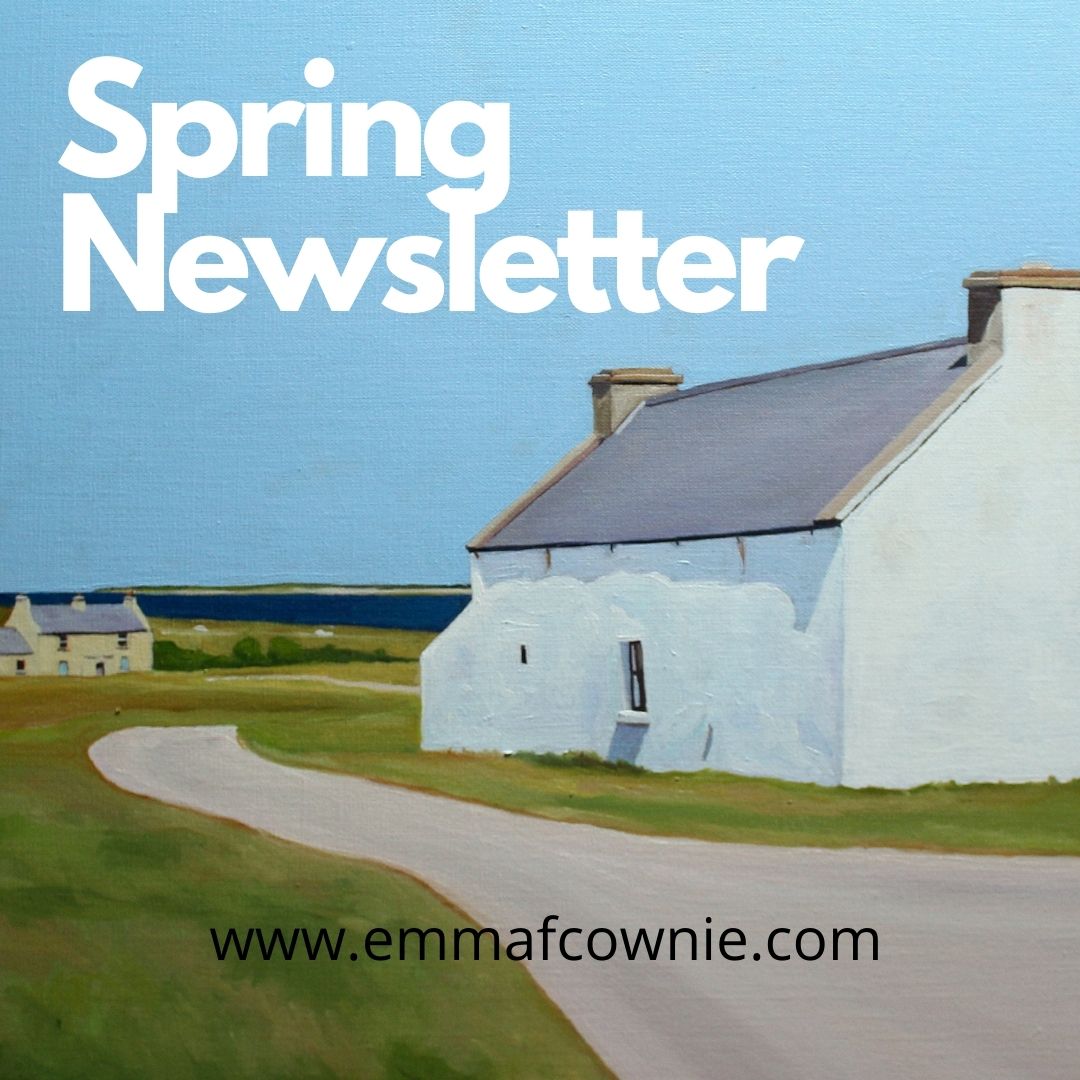
While many of you are baking in England and dealing with a hosepipe ban, in Donegal it’s cloudy with occasional showers. I thought I would share you my recent newletter. They have ended up being quarterly. It depends of how much news I have and how busy I have been. I always make it strong on the visuals and light on the words! I also make the typeface large for reading on smart phones!
Emma Cownie Newsletter Summer 2022Emma Cownie Newsletter Summer 2022
Here’s my summer newsletter. I am shutting up shop for a month from 20th June to 20th July. All going well, we will be safely installed and open for business (online at least) in Donegal by mid-July. I am already longing to get back to my painting routine. I can’t quite believe that after being ground so long by my broken leg and the pandemic that we will actually move house/studio to another country by then. It’s a huge step! Fingers crossed it all goes smoothly!
Here is a short series of paintings based on the shadows in a backlane in Swansea. The photographs I used for these paintings were taken a couple of years ago. I came across them in my folder of printed images and decided I wanted revist my “urban minimal” themes. The light in St Thomas is quite different to that in Brynmill, where I am at the moment. I don’t know if its because the sea is closer to this part of Swansea, or because Kilvey Hill has a particular angle of steepness, but on a sunny day the light is luminescent.
I particularly wanted to used a glazing medium called liquin, to see if I could add depth to my shadows. I first did an under-painting using red ochre and sepia and then used the medium to add colour to shadows.
Back Lane, St Thomas (Swansea)(2021)
As I grew in confidence I used more liquin medium to paint the drying washing on the line and shadows on the stone wall.
Hung Out to Dry (St Thomas, Swansea)
I think the darker shadows were more successful than the lighter ones.
Backlane Basketball (Swansea) 2021Â
I particularly enjoyed the contrast between the neat house with its clean, fresh drying washing and the apparent ugliness of the rough breeze-block wall in the backlane. This painting is very hard to photograph because of the very light and very dark colours. Some part of it end up too light or too dark! I think I got about right but I am still not happy with the final image. Just a reminder that you need to see a painting in real life to really appreciate it.
Too Dark!Too Light!Just right? A Soft Breeze (St Thomas, Swansea) 2021
We are in the midst of lockdown in Wales, the schools are shut and the good news is that the covid numbers are falling. They need to fall a lot further because when the schools and the university students come back they will shoot up again. I had in a mind a longer blog post, but I find that after I have got up, done my yoga/ankle exercises and painted in the morning light, that I am too tired for much else. That post will have to wait a little longer.
So I have decided to show you my most recent work. I have been painting Tenby, which I can only visit in my imagination.Tenby is a harbour town and resort in southwest Wales. It’s known for its 13th-century town walls and its stretches of sandy shoreline, including Castle Beach.
I have been working on a triptych (which is three paintings) but I have only finished two of them, so its a diptych (two)! I will add the third one when I have completed it. I was trying to find unusual angles to paint. As much as I love painting Tenby and its colouful houses and boats, I need a fresh angle to present my brain with a new set of challenges to solve. This first painting, the challenge lay in how to paint the headland off in the distance and balnce it with the very dark shaows in the foreground. In the end I simplified the details and make sure that the tone was cool with warm grey and mauve. I was particularly pleased with the shadows on the beach and the blue house.
Out of the Tenby Shadows
My second painting is a view of the pier or quay from Castle Hill. This is a headland on which the ruins of Tenby Castle overlook the harbour. I liked the fact that this was the “underside” of the view we usually see of the harbour. The pier is a working pier as can be seen from the lobster pots stacked at the far end. It’s also where the Caldey Island boat picks up supplies for the islanders and the abbey every day (so long as the wind is not from the South West or over 20mph). Apparently royal mail has continued to visit throughout the pandemic, so that the monastery shop has been able to continue to operate. The boat that takes visitors to the island leaves from Castle Beach round the corner. The island is usually open from Easter to September for visitors, I don’t know whether that happended this year. A visit to Caldey in the boat was a pretty outdoor affair in ordinary times, so maybe they will start again in the summer, who knows.
Tenby Pier, Wales (Sold)
I will add my third painting when I have completed it.
Update:Here’s the third and final painting of the three.
My leg and ankle are recovering from my accident this springand although I can walk a faster than I used to, I still cannot walk long distances which means that a lot of my favourite Gower walks are off limits to me. I find staying indoor too much isn’t good for my mental health (especially during the Pandemic) and it is vital to get out and see different places nearby. Fresh air is good for the soul, the mind and more importantly it blows away the virus!
This blog is about a very short road trip around parts of the Penrice estate down to Oxwich Bay we did this week. My husband drove and I took the photographs. Penrice Castle was built by the Mansel Talbots. They were one of the most powerful families in South Wales and certainly one of its biggest resident landowners and MPs for Glamorgan in the Victorian era. The “new” Castle at Penrice was built by Thomas Mansel Talbot in the 1770s, as an alternative residence to the rambling old house at Margam. Thomas, who had travelled to Euope and considered himself a man of great taste had a neo-classical villa built. He also had the land around the house landscaped and a park laid out to improve the romantic scenery that had first attracted him to the place. His son, Christopher Rice Mansel Talbot, who was born at Penrice in 1803, modernised the old Aberavon Port and renamed it (modestly) Port Talbot as an industrial hub for South Wales. The house at Margam was also pulled down and a new mansion was built there between 1827 and 1830 near the ruins of the old abbey.
I will the road trip start with a map. All road trips need a map. There is an excellent map of Gower at Mapsta here. Our trip starts at the top left hand side of the map where a lane turns a sharp left from the A4118 road down a narrow single track lane. A word of warning if you fancy this road trip. This is not a trip for a large vehicle. Most of the lanes are single track and are very narrow. We spent most of it praying that we did not meet any thing coming the other way, and we drive a tiny Kia, as it would have possibly meant a ggod deal of reversing! Thankfully we didn’t.
Penrice Loop #1
.
Home Farm Penrice (SOLD)Down long narrow lanes past a parking spot for a woodland walk at Mountybank (see estate map)Map of the Penrice EstateUp a steep and winding lane past Penrice VillagePenrice, GowerAlong wet and winding lanes past Pitt FarmThe road then bends and drops back down towards Oxwich VillageWe past a series of sturdy cottages and then turn left at the junction in Oxwich
The carpark is free in the winter during the week (possibly only during pandemics)This morning’s heavy rain has left puddles everywhere but there’s still a beautiful view across the bay to Great Tor and Three Cliffs
We saw people. There were not too many but enough to watch. There was even a small wedding party having their photos taken on the beach off in the distance. It was heartening to see people managing to commit to a future together come what may! It must have been next to impossible planning their day as we have had a national lockdown, a local lockdowns and a mini-firebreak and there are rumours of another lockdown after Christmas.
A wedding party off in the distanceCan you see them now?
On the way back home, we continue anti-clockwise on our loop back up a steep hill to the main road past Underhill Cottage.  It was originally the Head Gamekeeper’s cottage. It has a lovely, sunny position overlooking the beautiful Oxwich Marsh and the sea with Nicholaston Woods behind. These days it is a holiday cottage. It is possibly one of the few sorts of holidays you could be confident of not getting cancelled these days (if you live locally, that is).
Underhill Cottage (Oxwich, Gower) SOLD
Buy my book “Footnotes: An Artist’s Walk around the Gower Coast” hereÂ
Dylan Thomas, the poet, grew up in Swansea and he descbed it as “An ugly, lovely town … crawling, sprawling … by the side of a long and splendid curving shore”.
About 5 years ago I went through a phase of painting a number of intricate paintings of Swansea. I loved the layers of Victorian and Edwardian houses with their high pitched roofs. I went to great effort to walk out onto the quay and the beach to take photos with a zoom lens. The quay is no longer accessible, as part of the walkway has since collapsed.
I recently reworked a couple of these paintings that I still had.
The Old Observatory, Swansea
Over to Bernard Street, Swansea
I was recently commissioned to paint another painting from this series. The commissioned work would be similar, but the composition and the execution of the work would be slightly different. I had mixed feelings about the project because I knew how fiddly these paintings are. These paintings take a great deal of concentration! I use a small brush for all the work on the buildings and they take several days of very focused effort to complete. Still, I hadn’t painted one for many years so I decided to paint one again. Perhaps it’s like a transatlantic flight, something that you can endure once a year but no more often than that. So here it is.
Swansea from the Beach Revisited (2020 commission)
Still, for all my wingeing I can’t help but say that I was really pleased with the final painting. My head hurts from all that focusing on the small houses with their white gables and red chimneys. However, I did like thinking about the different places in the painting as I painted them. The perspective squeezes the buildings together in a way and makes them look closer to each other in a way they are not in real life, by that I mean, on the ground.
The square building that stretches across the rest of the painting is the Guildhall, which contains the beautiful panels painted by Frank Brangwyn. Rising up behind these buildings is are the parts of Swansea known as Sandfields, Brynmill, and Townhill.
The Brangwyn Hall in Swansea.
Once upon a time, they were villages or rolling farmland, but now they are all merged into the sprawling City of Swansea. As Dylan Thomas aptly described it “The town of windows between hills and the sea.” On rainy days the clouds descend on Townhill and it can no longer see or be seen!
I am now working on a medium-sized much “looser” Donegal landscape painting, before making a start on two more commissions.
You can now buy a print of this painting here. Click on “reproductions” tab to see your options.
To follow in Dylan Thomas’s footsteps you can visit his favourite places around Swansea:-
As a rule, I don’t rework my paintings. Either they work or they don’t. Here’s the exception. This is a large painting (80x100cm) that has hung in my hallway for the past five years. It was for sale on an online gallery a several years ago but for some reason, it was taken off. I am not sure why.
Life in the Uplands (2015)
I didn’t really look at it until this summer when it got moved into our bedroom and I looked at it again. I was talking to my mother and sister on messenger/facetime and they saw it on the wall behind me – “Oh, that’s a nice painting” they both called out. “Oh, no that’s old,” I said as if it was a dress I had smuggled back from the shop. Why wasn’t I proud of it? I thought about it. It was an example of my early work when I was going through a phase of drawing lines around everything. I believed this was in the style of the fauvists like Derain and Matisse.
To be honest, it worked at the time but my painting has changed a lot since 2015 and I wasn’t comfortable with those lines. There was no light. I love painting shadows and light and yet there were none in this painting. Curiously, the omission of the skyline helped give a lightly claustrophobic sense of being in a crowded town. That was its real strength. It was a forerunner of my urban minimal series of paintings of Brynmill which culminated in my “Hollowed Community” Exhibition in Cardiff in 2017 (see examples of this series below)
Top of Rhyddings Park
In light and Dark
Rhyddings House Swansea
Brynmill Primary School
Former Cricketers, Swansea
Former Grocers, King Edward’s Road, Brynmill, Swansea.
Why had I painted this scene on an overcast day? Why had I cropped it in so tight so there was no sky? I really could not remember. I tried to find the view again. I spent some time hanging out of the windows at the back of our house trying to find the same angle. Eventually, I discovered something similar from the attic window.
View from the attic
There were a lot more trees. These are the plane trees line that Bernard Street. This road runs from Brynmill uphill to Gower Road, in the Uplands. The trees branches are cut back to stumps every year to control their growth but they burst forth every summer again (See three of my urban minimal paintings below, which feature the trees of Bernard Street).
Bernard Street, in the Summer, Swansea
Bus Stop (back of Brynmill Launderette)
It wasn’t the only thing that had changed in the last 5 years. Many of the houses had been painted in a different colour. A tin roof towards to centre of the middle (on the right) was now orange with rust. The sunshine also created shadows and changed the colour of many of the roofs.
So I started painting and worked on this when I wasn’t working on commissions. I changed the colour of the chimney pots in the foreground of the painting.
Work in Progress (Summer 2020)
It took some time as I ended up pretty much repainting the whole canvas. The end result was painting with more depth and yet a “lighter” feel. There were still some of those lines but I had reduced them so they did not dominate the painting. I was much happier with this version of Brynmill/Uplands in the sunshine.
Over to Bernard Street, Swansea (2020)
Here are the two paintings side by side so you can see the changes I made.
Life in the Uplands (2015)
Over to Bernard Street, Swansea
My next post will be about the paintings that I decided could not be reworked and what I did with them.
Perhaps I should have called this post “the invisible people”. I have a bit of a fascination with things and people that often go unnoticed. The unnoticed have now become the invisible. With the coming of the terrible coronavirus crisis, the sight of elderly people on the street is a thing of the past. They are now “self-isolating” for anything up to 12 weeks.
My confinement is more of a challenge than the “lock-down”. My broken leghas me confined to my bedroom and the bathroom. We have too many steep stairs for me to go anywhere else. I just look out the window and take satisfaction in the quietness in the street outside. As an artist, I am used to quite a high degree of isolation. Yet, I know that this level of isolation must be incredibly hard, especially for the elderly or vulnerable if they do not have the internet or can’t work messaging apps. Even if they can, it’s still hard. People need face-to-face interactions with other people, even if it’s only buying groceries at the local shops. I know my father is missing his shopping trips.
Swansea People painting by contemporary artist Emma Cownie
I hate how news reports of coronavirus deaths often like to report that a certain number are elderly or “had underlying conditions” as if that somehow means those people don’t matter so much. Every single one of them matters. They are all someone’s loved ones; nan, dad or sister, son. My husband has “an underlying condition” as do my parents, my brother-in-law and many of my friends. They are sheltering indoors, relying on the fit and young to keep the hospitals and shops up and running.
Swansea People painting by contemporary artist Emma Cownie
So today’s gallery of my people paintings has an added significance for me. This is a reminder of all the vanished; the people you don’t see on the streets. They are still here, at home, maybe, watching TV or listening to the radio. I hope that they are chatting away on skype or messenger or maybe like me they are just peering out their windows.
Walk of Life (Sold)
My “The Walk of Life” painting has added significance for me. When I painted it was struck by the old lady’s determination and how tiny she was in comparison with the younger people around her. I thought the composition captured the variety of life on Swansea, Oxford Street on a summer’s afternoon.
I never thought that I would have my own zimmer frame, but I do. I have to keep the weight off my healing left leg for another 4 weeks so it is vital for getting from my bedroom to the bathroom. It’s a fantastic bit of kit. Light and simple yet sturdy and reliable. Like the lady in the painting, mine has two wheels at the front and I will sometimes carry an object like a book in a bag from one room to another. I have tried holding stuff in my mouth but it just doesn’t work.
I am delighted that the American collector who recently bought this painting is a nurse who works with elderly ladies like this one. He will understand just how liberating a zimmer frame is to the disabled and elderly. During my stay in the hospital, I watched very elderly ladies, who had fallen, broken their hips and had them replaced, push past pain and discomfort slowly but steadily make their way up and down the ward with the help of a frame. Once they proved their mobility they could negotiate their return back home. I have a set of crutches but I like the frame better. So although “The Walk of Life” always was a celebration of the human spirit and determination, but I now know that the old lady is just getting on with her life. She probably doesn’t want applause or pity but she certainly might want to have a good chat.
While the rest of the world is on coronavirus lock-down I am confined to my bedroom with my leg in a very heavy plaster. Moving from the bed to a chair involves a lot of hopping and a zimmer/walker frame. It all takes a lot of effort to achieve simple things that I never gave much thought to before.
I broke my left leg. I have broken both lower bones and dislocated my ankle. Six days ago I had an operation to pin the bones in my ankle. My brother asked if breaking a bone is more painful than a toothache. The answer is definitely yes. I have endured 50 shades of different pain since I went for a walk with our dogs 2 weeks ago in my favourite woods, near Ilston, Gower. It was just about the worst time to break my leg, to be honest.
Ilston River (SOLD)
I had walked about half a mile along the side of the stream. I had bought a new camera with me and my attention was caught by the sunlight on a mossy tree. I decided I would move closer to take a photo. Instead, I stumbled over a muddy stick and as I put my left foot out to steady myself I felt it twist and a sickening snap. I rolled on the wet ground, hoping against hope that I hadn’t done something dreadful but the horrible pain told me that I had. My foot was bent out of shape. Just to think about it makes me feel ill, even now.
As I lay on the ground, I wondered what to do. I tried shouting “Help” a few times but felt silly/useless. What could I do? My husband was in Ireland. Fortunately, I had my mobile phone in my handbag and it was charged with credit so I rang for an ambulance and waited, and waited. The call handler told me not to move. It was cold on the wet mud. I took a photo of my bent leg. I have not looked at it since. I don’t think I can bear to.
Ilston Cwm – Close to where I broke my leg
I assumed that the ambulance would not be too long (I was very wrong on this score) and I started to worry about my two dogs, what would happen to them? I rang my neighbours Rob and Liz and told them what had happened and where I was. Rob said he would come for the dogs. So I waited. I lay and looked up at the sky. Blue patches and white clouds drifted by. It started to rain. Then the sun came out again. I was still lying on the ground. I don’t remember what my dogs were doing but they were nearby. I think Biddy, the collie-cross, tried to present me with a few sticks to throw for her. I clutched my injured leg, it really hurt. I rang my husband. It went to voicemail. “I am lying in Ilston Woods, I think I have broken my leg. I have rung for an ambulance. I have spoken to Liz and Rob. Rob’s coming for the dogs….” I felt bad about leaving him a message when there was nothing he could do.
View From the Bridge 100 x73 cm
After a long time, a family appeared on the track, a couple with their two girls. “Help, I think I have broken my leg”. I think they were surprised by this as they walked towards me very slowly. I told them that I had called for an ambulance and my neighbour was coming. They took my phone number and said they would go down to the road and look out for Rob and/or the ambulance. So they left me and I waited and waited. Company had distracted me from the pain in my leg and being on my own meant being with the pain. I rang my husband again and then Biddy started barking. It was Rob. Thank God.
“How long have you been lying there?”
“45 minutes. The Call handler said to stay where I was”
“That’s stupid advice. She can’t see your situation. You will get hypothermia. We need to get you up” So with great difficulty, Rob helped me up off the wet mud and I hopped in slow agony to a mossy tree, where I first leaned against a trunk and later sat on a low branch. He had brought a heavy hi-vis coat which he put around my shoulders. It was blissfully warm.
I wish I could say that was the end of it. That the ambulance came soon after but they didn’t. We waited and waited and rang the ambulance again. It was difficult explaining where I was to call handlers who were not local. They wanted to know the name of the church at Ilston. Ilston is the tiniest of Gower villages. There are about 10 houses. There is only one church. What did it matter what saint it was dedicated to?
So after another long wait, I asked Rob to walk down to the house opposite the church at Ilston to ask them to ring the ambulance, perhaps they would be able to give better directions. We had often passed the people who live here, they waved in a friendly manner and I was hopeful that they would help. Rob left with my two dogs, Biddy and Mitzy, in tow. I sat and waited. The pain was worse when I did not have any company to distract me. I looked at the mud by my feet. I was dimly aware of a robin on a branch a few feet away from me. And then like a miracle, little Mitzy appeared by my side. She was collarless. I was so glad to see her. She was not leaving me. Good loyal rescue dog to the rescue. I took her photo as a distraction from the pain.
Mitzy the faithful rescue dog, to the rescue.
Rob returned with David (and Biddy on her lead). David is 73 and lives in the house opposite the church. He made several trips along the track, and brought me many very welcome items like a big blanket, gloves, hat and a hot water bottle. I was really thirsty and he also bought a bottle of water but David’s wife had said I could not drink anything, her advice turned out to be right, so I just washed my mouth out with it. He made several trips. The last one in the dark with a torch. He took quite a risk, helping us in the dark. We got excited because the beam of his light reflected in the stream and it looked like two people were coming along the track, but it was just him. It got very dark, The moon came out and a barn owl hooted. We told him to go home, we were worried about him in the cold night air. He reluctantly set off.
I started to think that no one was ever going to come. I was so cold. It would be difficult enough to get me out of here in daylight but in the dark? I kept thinking up with ideas for getting how to get me back to the road; What about a horse? A wheelbarrow? One by one my desperate ideas were politely considered and sensibly dismissed. Rob was a reassuring presence. They will come he said. Then eventually, Rob said, says, “I think I can see lights along the track, more than one!”
At long last, the ambulance service had come. After 5 hours of waiting. Two figures dressed in green, a woman and a man, carrying torches were coming along the path, with David and his brother-in-law leading the way. I was so relieved. Once they were there, I knew they could sort everything out. And they did. Lyndsey the paramedic was lovely and reassuring. She worked under very difficult circumstances. It was dark and very cold. She checked my blood pressure, temperature and although I felt so cold my body temperature was normal (hurray for thermal vests, I say). I was given a small dose of morphine which had me seeing stars and then liquid paracetamol. They called Sketty Fire Brigade to put me on a stretcher to carry me half a mile down the track (and over the church fence) to the waiting ambulance. It was a long journey looking up at the cold frosty stars through the tree branches from that stretcher. It was a full moon. They carried me wordlessly. There was a short snort of laughter when I said “Well Done” after they had hoisted me over the churchyard railing.
Ilston Church Yard
It was a very long night. The journey to Morriston Hospital Hospital seemed slow. Where are we now? I would ask. It was the pain that made it feel that way. We waited outside A&E in the ambulance for quite a while. Lyndsey told me her mother was the first baby born in the NHS and called was Aneira, after the Welsh founder of the NHS Aneurin Bevan. Eventually, I was taken in for my first X-ray. I was visited by a number of doctors who introduced themselves to me by their first names; Jeremy, Mohammed, Chris there were others but I have forgotten them. After a wait, the doctors in A&E manipulated my leg (I was under light anesthetic) and put it in plaster so that the agonizing swelling could start to go down. The leg was X-rayed again. Everything was aligned nicely. Every now and then the average waiting time in A&E was announced on the loudspeaker. It started at 8 hours, later it was 13 hours and then by lunchtime the next day it was down to 2 hours. I lost track of time. I didn’t get much sleep in A&E. It was a fascinating place, very hectic. No wonder there are so many drama series set in Emergency Rooms & Casualty Departments.
Anyway, to cut a very story short I waited a day for a bed in the trauma ward. I then spent another 7 days waiting for the swelling to go down so the ankle could be pinned. I was “nil by mouth” for 4 days in a row but never made it to the operating theatre. Thankfully, on Monday I did, finally. It was probably just as well as the ankle specialist was working that day. The coronavirus emergency meant that the ward was rapidly cleared, as they needed the beds and staff elsewhere. I was sent home on Tuesday via Red Cross Ambulance.
All through this experience, I have been impressed by the kindness and amazing patience of medical staff as well as just how much pressure the NHS is under. The pressure has just intensified ever since. I would like to thank Rob and David in particular, who waited so long in the cold with me, and Liz and David’s wife, and anyone who I came in contact within A&E, Ward A (which then had to move upstairs to become Ward G), the operating theatre and the Red Cross. Thank you xxx
Postscript:- Biddy and Mitzy went home with Rob and slept all the next day. Seamas flew back from Ireland on a plane full of racegoers heading for the Cheltenham Races.