Hedgehogs and bears have the right idea about winter.
Is this the best way to spend winter?
They hibernate and miss the dark winter months. I am finding this winter quite a struggle. In the last fortnight most days have been characterised by gloomy skies and poor light quality. In previous years I have struggled to get much painting done. I have spent hours tapping away on the computer looking up at the black sky outside my window, waiting for the sun to rise so I can start painting, and then often abandoning work at 2pm when the light goes. The best light to paint by is undoubtedly daylight, and my attic studio is blessed with a lovely northern light, but I needed to extend my painting time, to keep working.
A couple of years ago I invested in a “Professional” artists’ light. It was pretty pricey at £60 ($75US) but I hoped it would be worth it. I think it helped me paint on for about half an hour after the light had faded but not much more.
Daylight Professional Artists Lamp (old version)
So I decided to add to it with a photographer’s’ daylight lamp. These have screw fittings so I had to buy a converter so that it would fit the clip fitting that I also bought. The whole set up did not cost much more than £12 ($15) so just on price it was likely to beat the expensive artist’s light. The bulb arrived, but when I opened it up I was so surprised it’s strange appearance (it was easily twice the size of the regular light bulb) that I laughed so hard that I dropped it, and it and smashed! Drat (not my actual words). I then had to order another one and wait all over again for a new one to be delivered.
Don’t Laugh! Photography Daylight White E27 Lighting Lamp Bulbs
It was worth waiting for. It was pretty good. It was cheap too. So I got a second one to place either side of me. This enabled me to paint on for an hour and half after the light had gone. This year, I have gone for a “full-Hollywood-lighting” with three of these beauties blazing away. The artist’s light has been relegated to acting as handy arm to clip the photographers’ lights to! I don’t even bother to switch it on, anymore, unless it’s really dark.
The two photographers lights clipped on the bendy arm of the artist’s lamp.
Now I think I can paint any time of the day or night (almost). It’s best for augmenting natural light and extending painting times. In yesterday’s gloom I was still struggling to see pale yellows and light greens. I am very tempted to see what a fourth one will do for me.
Interestingly, despite all this artificial light I find I still need my SAD lamp to keep me relatively cheerful and regulate my sleep patterns. I have found that if I don’t get a good shot of SAD light around 7pm I awake at 4am bright-eyed and decidedly grumpy. That extra burst of light helps tell my brain that I should not wake up until 6.30, at least. That’s the best I can do most days. I long to sleep in til 9am but for some reason I just can’t.
What do other artists do to keep working in the winter months? Or you sensibly, wrap up warm and go to sleep for four months like hedgehogs and bears?
That looks so cosy!
Here’s another artist’s solution to the dark days of winter.
“May the friendships you make, Be those which endure,
And all of your grey clouds, Be small ones for sure” – Extract from an Irish Blessing
“Behind every cloud is another cloud” – Judy Garland
I have had an ambivalent relationship with clouds. I prefer bright sunshine. I In fact I have obsessively looked for bright sunshine and shadows to paint. I have found the relationship between objects and their shadows exciting.
Up Sketty
This can be difficult in Wales where we can get days or even weeks of overcast or wet days. So when the sun is out I go mad, rush all over the place taking reference photos to paint later in my studio. I have been guilty of often portraying Swansea only in its best light. Someone once said I made Swansea look like a Mediterranean country.
Don’t get me wrong, on a sunny day it’s beautiful place and I have painted dark and rainy scenes too (see below) but not the rain clouds as I prefered painting bright blues skies.
The Driving Rain (SOLD)That Petrol Emotion (SOLD)
I have never really been happy with how I painted clouds. They never quite came off the way I wanted them to. The paintings looked fine but I had not enjoyed the process of painting them. For a long time I could not quite put my finger on what it was that I was finding dissatisfying about the experience.
Clouds Gathering Over Mumbles Head
So I did a bit of research and read up on something called “scumbling” and watched a video on youtube demonstrating the technique.
This is a way of applying paint with a dry brush to painted canvas. This way a broken layer of paint is added allowing the colour underneath to show through. J.M.W. Turner was the king of scumbling. Think of that painting of his “Rain, Steam and Speed” where the steam train is emerging out of the clouds of rain and steam. This is my humble effort at scumbling.
A Change in the Weather
I was quite pleased with it but it did not pass the “praise test” with my husband, Seamas. He’s my most valued audience and source of feedback. It’s not that he didn’t like the painting, he just didn’t say anything at all about it. So I decided this technique wasn’t quite working for me.
I watched a few more videos on Youtube where artists knocked off beautiful clouds in a matter of minutes.
This just seem to make things worse. I swirled the paint around on the canvas and it all just felt “lumpy” to me. I scrubbed the canvas. Humph. I decided Youtube videos were great for tips on mending jeans or adjusting security lights but not for painting techniques. I had to find my own way. Or truth be told, I forgot about it for a while.
Finally, I think I have started to make a break-through. It came from being in another country, Ireland, where the skies are full of constantly changing clouds. This was something quite different to the light of Wales. To start with I tried to painting bright sunshine, as I do in Wales.
On The Way To ArranmoreRound the Rosses (SOLD)
I like the light in these painting a lot. Then I was tempted by the landscape to explore the changing skies too. You can’t paint Mount Errigal without a swath of clouds around its shoulders.
Under the Shadow of Errigal (SOLD)
I started to get sucked into the drama of the Donegal skies. I slowly discovered the key, for me anyway, is very thin layers of paint. After all, clouds are just water vapour. They are made of tiny fine particles of water. They are not solid things and this was where I had been going wrong, making them solid things. They are not.
Ironically, this is what exactly what the Youtube videos were showing me but I needed to find my own way of doing it. I didn’t like painting a layer of opaque blue and then adding cloud on top. I prefered a number of very thin layers of paint. The natural colour of the linen canvas I use, actually helped contribute to the colour of the “dirty” rain clouds.
Mount Errigal from Ballymanus Beach, Donegal (SOLD)
So my clouds got thinner and finer.
Over to Owey Island, West Donegal, Ireland
So that a puff of wind would move them along. Or light luminate them.
From Ferry Coll
So, I have started painting “overcast” pictures where the light is slivery rather than golden. I can be a challenge because the light affects all the colours, the greens are flater and duller and I am using yellow ochre and naples yellow far more than I do painting sunny Welsh landscapes.
Across to Dunfanaghy (SOLD)
Finally, my favourite recent painting is the one I did of Muckish mountain. I loved the massive rounded clouds that seemed to be echoing the humped shape of the mountain.
Shored up near Muckish
I have only started feeling confident painting clouds and I think I have some way yet to go. Fortunately, I won’t be short of clouds to paint in Wales and Ireland.
For the next month I am selling a selection of Art Christmas cards based on my paintings direct from my website. This is an experiment as I have previously only sold paintings and prints direct. So here goes.
You can buy them in packs of 5 of the same design of a pack of 6 with two of each design. I am offering free postage but remember to leave enough time for delivery as the final postal dates are 18th (2nd class) and 21st (1st class) in the UK.
I love painting the coast, particularly if it’s rocky. Owey Island, lies just a short distance off Cruit Island near Kincasslagh in west County Donegal. Strictly speaking there have been no permanent residents since the 1970s. [Photos from http://www.welovedonegal.com/islands-owey.html]
There is no electricity or mains water, yet plenty of people visit and many visit during the summer months. If you want to visit, there is a ferry service run by Dan the Ferryman.
View of Ireland From Owey Island (Ian Miller)
The name Owey, in Irish Gaelic “uaigh”, means cave. The island is a cavers, kayakers and rock climbers’ paradise.
The island is encircled by massive rock stacks and it also has an underground lake. As I am cave-phobic this video is the closest I will ever get to it!
I am fascinated by rock stacks and Donegal has plenty of them. I like to think of how these massive structures have gradually been eroded by wind and waves over thousands of years, forming first sea arches and then stacks.
I also love the colour of the rocks and the wild Atlantic Ocean. The ocean is incredible shades of blues, greens and mauves, mixed in with browns and frothing surf. Although I feel I am getting better at representing the layers of Donegal sky and clouds, but capturing the movement of the seas is still frustrating me.
Over to Owey Island (SOLD)
If you to find out more about Owey Island see Ian Miller’s Unique Ascent’s website for detailed descriptions and incredible videos.
Just thought I’d add a post script about the “Holy Jaysus Wall”. I think if you look at photo of it you will understand the name. It makes me feel ill just looking at it!
Holy Jesus Wall
SONY DSC
Irish climber and alpinist John McCune, climbed it in 2014.
Here’s a fascinating film clip from the 1970s about Owey Island’s postman, Neil McGonagle, who used to visit the dwindling population on Owey Island by small boat four times a week to maintain the island’s contact with the outside world.
I wonder whether the post to Arranmore Island, Donegal, goes astray a lot. There are two other islands with similar names off the coast of Ireland and Scotland. There are the Aran Islands off Galway Bay to the south as well as the Scottish Isle of Arran. Arranmore or Árainn Mhór, in Irish Gaelic.
Map of Arranmore, Donegal
It lies off the west coast of County Donegal, Ireland. It is the largest inhabited island off County Donegal, with a population of 514 in 2011, down from 528 in 2006, 543 in 2002, and over 600 in 1996. The island is part of the Donegal Gaeltacht, with most of the inhabitants speaking Ulster Irish.
From Ferry Coll
There is a frequent ferry service from Burtonport and this old cottage was spotted nestling into the rocks of one of many islands, Inishcoo, en route to Arranmore. There is no ferry service to the many little islands scattered off the coast of West Donegal. People get to these remote islands in their own little boats. There are landing stages and steps down to sea cut into the rocks. Of course, you could always swim to Inishcoo. Amazingly, the local cows do.
Once-upon-a-time I worked full time as a teacher in school of just under 2,000 pupils and I would teach approximately 150 pupils in a day. That’s a lot of faces to put names to every day. I was pretty good at learning all those names too. These days, however, I might only speak to a handful of people in a day; my husband, my neighbour and local shopkeepers. So, when presented with an opportunity to met with and chat with to new people I relish it. Clyne Christmas market gave me a lovely opportunity to talk to all sorts of people.
I am pretty new to running a stall, I did it once about 4 years ago. I really enjoyed it back then but teaching commitments meant that I did not have the energy to keep doing it. That has changed now. I have the energy and the time to pursue this and yesterday I had a stall at the first Clyne Farm Christmas market. I realise that I have a lot to learn.
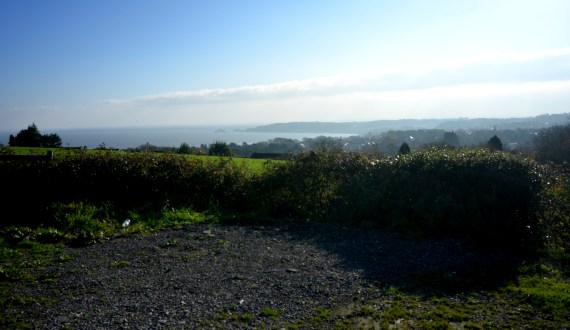
Clyne Farm sits on top of Clyne Common, high up above Swansea. It has sweeping views towards the sea-side village of Mumbles and across the massive Swansea Bay.
View Towards Mumbles (from the car park)
Once upon a time it was a riding stables but in recent times it has transformed itself into an top-class accommodation and activity centre.
Minnow at Clyne Market
Sparkly Bow Stall
Yesterday was their first Christmas Market and we were blessed with sparkling crisp sunshine. The photos above were taken in the first half an hour before it got busy. The crowds ebb and flow. After a quite half an hour, it is quickly jammed with families carrying babies wrapped up to the eyes in jump suits and bobble hats. The little girls are drawn to the “Sparkly Bow” stall further down my aisle. The table covered in glittery objects is exactly the right height to catch a 5-year-old’s attention – at eye-level.
This first onslaught is followed by another wave of families with dogs on leads, and in carried in their arms. There are lots of woolly coated “cockerpoos” (Cocker Spaniels Crossed with Poodles) and some sharp-eyed border collies. They take in everything. Later as people leave for lunch in the other hall, it becomes calmer. People are clutching bags with their purchases. I recognise some people who came around earlier return to buy. It’s in the post-lunch calm that I make most of my sales. I chat with many of the people in the hall. My cards of Mumbles Pier starts a number of conversations about a controversial development of the Pier Head area that the local community (Mumbles Action Group) are currently fighting.
Clyne Christmas Market
I manage a quick break and visit some of the animals on the farm. I’d met Ted the collie and Flo the goat and her surrogate daughters, the sheep Brillo and Lucy, yesterday.
Ollie the colt (6 months old)
Along a muddy tack there children’s pony rides on offer. I had to make a special journey along a different muddy path to see Peggy the Pig. She is massive. I give her a pat on her broad back and was surprised that her back was covered in bristles, not wiry hair. Her floppy ears cover her eyes, like nature’s sunshades, but it can’t be easy for her to see. I was told by Sarah who works at Clyne, that Peggy is pretty laid back and is a “morning” pig. She is active in the morning and spends her afternoons sleeping. Someone speculates that she’s a Gloucester Old Spot. I assume that they have only one big spot but looking it up later it seems that they were probably right and she’s an “Old Spot”.
Peggy the Pig at Clyne Farm
The hall is filled with bright sunshine but by the late afternoon, I’m starting to feel the cold. Although there’s carpet in the hall the concrete floor underneath is cold. I run to my car to fetch my woolly hat. As the afternoon wears on I notice that the tip of my nose is numb! After 5 hours in the hall, my feet are starting to feel like blocks of ice. The girl opposite me is wearing thin daps and ends up sitting on her chair with her feet tucked under her. At four o’clock the sun is low in the sky and someone mentions that there’s Christmas Parade in town at 4pm. That seemed to be the signal for the stall-holders to pack up and within minutes the hall is bustling with activity as the stalls are rapidly dismantled. I drive home with the sun setting over Clyne Common.
Me and my stall at Clyne Market (my bag handles have just snapped!)
What I learnt
Get new cash bag – my beautiful leather cash bag handle snapped as soon as I put it on. Although I tried to tie a knot in it, it kept coming undone.
Thermal socks are needed (possibly 2 pairs).
Clear prices on each rack. We had a price list but it was difficult for people to read it. Bull-dog clips or cardboard luggage labels are good for this.
Paper bags for purchases – brown or white. Environmentally friendly and they look cool
Camping chair – a wooden chair was hard to sit on all day.
Paypal card reader or izettle for mobile payments. Not everyone has enough cash on them and you don’t want to lose sales
Presentation is vital. Rustic chic is cool – I had wooden racks and a table easel but more wooden boxes for cards would be good. I learned a lot from Ed Harrison at Minnow across the hall. His presentation was excellent.
We didn’t get an “Indian Summer” in September, which when we usually get one in Wales. What we have had, instead, is a series of sunny days in late October/early November. The sparkling autumn light is stunning. From a painter’s point of view is more interesting than summer light. So last week I drove down to Three Cliffs Bay to enjoy the light. I was surprised by the dark blue of the calm sea. It was quite a different colour from the summer sea.
Three Cliffs Autumn Light
I was hoping that there would be plenty of orange bracken and there was. Not on the slope of the the Three Cliffs, as they are covered in grass, but on the slopes of Cefn Bryn, in distance.
Painting of Pobbles Bay, Three cliffs, Gower
These colours sum up the Welsh landscape for me. In fact, I think I like the Welsh landscape in autumn/winter best. The red and the green of the bracken and the grass also put me in mind of the red and the green of the Welsh flag.
Welsh Flag (an interpretation)
Light on Great Tor (Gower)
I find it ironic that there’s less light around but its better quality, from an artists’ point of view. I still have not adjusted to the clocks going back last month, and I am still waking at 5 -5.30am! It does not seem to matter what time I go to bed, I awake in the dark feeling ready to rise. So I get up and here I am tapping away at my computer in the dark waiting for the sun to rise. Soon I will have to get my SAD lamp out to stop the slow slide in winter gloom. Before, you ask, yes, SAD lamps work for me.
Does anyone else suffer from this problem? Does anyone have any tips for sleeping in later?
Update: I sat with my SAD lamp on for 20 minutes around 7 pm last night and it seemed to help me go back to sleep when I awoke at 4.30 am, and I didn’t get that “wake up” surge of hormones til 6.30. A definite improvement.
The people of Britain love their dogs. It is no secret that I love animals. I come from a family of animal lovers. My younger brother has three cockerpoo type dogs, my sister has a Cocker Spaniel called Dolly one and myself and my husband have two gorgeous mutts.
Animals can do no wrong in my family. I suspect that my mother would prefer to see photos of friends’ dogs rather than photos of their grandchildren!
So its no surprise that I often choose dogs (and their owners) as subjects for my art. I also love painting dogs as commission portraits.
I am not always terribly good at making eye contact with people when I am talking with them but when I am out walking, I will often catch the eye of a dog and a glance will pass between us. Perhaps, I am imagining this.
Dogs are cool. They live in the moment and know how to fully enjoy themselves. They love being out and about and enjoy seeing that. There is no joy like the joy of dog running free in the park or in the woods.
I like to try and see the world from their point of view. This usually means a low view point. Little Jack Russells are a favourite of mine. They have a big personality.
I particularly like to capture the body language between the dogs and and their humans. I am intrigued by the bond that links them. Even if they are just a dog and a human, they are a pack. The human is not always, “top dog”!
I sounds mad, but I didn’t have a map when I was driving around Donegal. I sort of hoped I could buy one in a petrol station but I never did. The Hire Car people lent us a Sat Nav but I could not be bothered to plug it in and it stayed in the boot the whole week.
I am very lackadaisical when it comes to planning holidays, I think all my energy goes into the logistics of getting there. Anyway, I assumed that my husband would tell which places were worth visiting. Afterall, he had spent hours “flying” up and down the roads of Donegal on StreetView. I sort of knew where I wanted to go; Bunbeg, Bloodyforeland, Falcaragh, Dunfanaghy, Derryveagh, Kincasslagh and Dungloe and the distances between them were not very great.
Donegal Islands Map
On the only properly sunny afternoon we had in Donegal, I took a left off the road from Dungloe to Kincasslagh. The sign said “Cruit Island Golf Club”. I reasoned that golf clubs are usually located in beautiful places, near the coast. So I followed a single track road and over a small concrete bridge on to Cruit Island. If you look at the map above, you can see that Cruit Island is long, three miles long, in fact.
Bridge to Cruit Island
Cruit Island at Low Tide
After a pleasant drive along a single track road, and passing what can only be called mansions at the north end of the island, we reached the golf club. Now in the UK golf clubs can be funny about other people coming onto their property, but there was nowhere to turn the car so I kept driving. Eventually we reached the golf club car park which looks out across wild waves to an island. This was no calm inland lough. This was the Wild Atlantic. The wind was fierce and the waves crashed and boomed.
Owey Island, Donegal.
It was mesmerising. The island was just across the turquoise water. It was dotted with houses, some clearly derelict, others in good order. I didn’t know it at the time but this was Owey island.
Quay on Owey Island
It turns out that Owey island is uninhabited for much of the year, having no permanent residents, but people do live there in the summer months. It was last inhabited on a full-time basis in the mid 1970s. The last residents were three old boys who were moved to the mainland of Donegal, or as the islanders call it, Ireland. All the houses were built on the south side of the island, facing Cruit Island Golf Club. The north of the island is too rocky and too exposed to the north Atlantic Ocean gales.
Buildings on Owey Island
My eye was drawn to one building in particular. Standing on the brow of a hill, its missing roof caught my attention. It had also had a walled yard behind it. I was too far away to be able to tell whether this was a derelict old building or an incomplete new one. There are many incomplete “new” buildings littering the Irish landscape.
This turned out to be the old school. The walled yard was the play ground. It was a tiny school with just one teacher who would have to teach all ages of the small number of island children. It was a school for the younger children, and when they were old enough the children would then be sent to the mainland for their secondary school education.
Apparently, the school children had to bring a sod of turf to school each morning. The turf was fuel for the fire and the idea was that they provided the heating for the school room in the cold months. It has been pointed out that as the teacher’s table and chair were at the front of the room, they would usually sit right in front of the fire. When I used to be a teacher, I used to teach in a “temporary” demountable classroom (it had been there for 40 years) and in winter, I would often stand next to the gas fire, myself. So I liked that idea!
I did not walk the length of Worms Head at the same time as my other Gower coastal Walks. This was because you cannot walk its full length between the 1st March and the 31st of August – as the last part of the Worm, the Outer Head, is closed in order to protect nesting seabirds.
So I waited until late October for a sunny morning and a low tide to set off on my adventure. It was certainly an adventure as I travelled alone and there was plenty of scope for “mild peril” and twisted ankles and, at one point, there was definitely outright fear. More of that later.
The drive down to Rhossili was beautiful. Autumn sunshine lit the russet trees and the long shadows stretched across the road. The forecast was for a fine sunny day but by the time I arrived at Rhossili, it had clouded over. I got of my car and wished I had brought a woolly hat instead of my sunhat jammed at the bottom of my bag underneath my sandwiches, banana, and the compulsory chocolate biscuits. The biscuits had been lurking down there since my last walk several months ago, but as they were individually wrapped I decided they’d still be very edible. The walk down the National Trust car park to the coast guard station at the end of the headland took longer than I expect it.
Worms Head (from Rhossili Downs)
I think this is because I am usually so mesmerized by the sight of the “Worm” that I don’t really pay attention to how far I am walking. The Worm (“Wurm”) means dragon, and it was given this name by the Vikings who regularly sailed the Bristol Channel over a thousand years ago.
Worms Head
It is a long tidal island that undulates westward like a sea beast. The shape of it changes depending on which angle you approach it. Sometimes it seems coiled, other times in snakes from side to side.
Towards Worms Head (SOLD)
I think I look up the tide times for Gower more often than most people, except for surfers. Every time I go to the coast I like to know if it going to be a low or high tide, depending on whether I want to photograph it or swim in it. If you want to visit Worms Head, a low tide is essential because the causeway over to the islands is only safe to cross 2 and a half hours either side of low tide.
I know that to be caught out ensures an extra long stay on the island (as happened to Dylan Thomas once), because swimming across the short stretch of water is very dangerous and I can remember a man who died attempting in it a few years ago.
Coast Watch Station
Fortunately, if you have forgotten to look up the tide timetable, it is clearly displayed outside the coast watch station and on the path down to the causeway. That is pretty much, the point of the coast watch station, as I have mentioned before. To watch out for fishermen and people who might get trapped by the rising tide.
Map of Worms Head (Note: High Tide)
When you arrive at the coast guard station at the end of the headland you will see the path in front of you dropping down to the causeway. Now, don’t believe any guide that tells you that this is “easy” as I have seen elsewhere online. It is not. Parts of the island are easy. Most of it and the causeway, in particular, is very very, rocky.
It resembles an assault course rather than a “walk”. There are slightly easier routes than others but they are all energetic to some degree and require a fair bit of climbing, jumping, or in my case sliding down rock faces on my backside. I was better prepared than the time I walked across it on whim one summer with my sister and my 7-year niece. That time I was wearing sandals. This time I was wearing sturdy walking boots. I regretted, however, wearing my drainpipe jeans. There were many times I could not tell if I was stiff with age or stiff from my sartorial stupidity. Nevertheless, I soldiered on.
Looking across the so-called causeway, I could not see an easy route. I could not even see an obvious way down to the causeway. Hence I ended up sliding down the rocks, hoping that I didn’t twist my ankle. That was a recurring thought throughout the morning. The trick is to stay focus 100% on where you are putting your feet, if you need to look up, then stopping to do so. Walking along and looking around at the same time was out of the question. I decided to follow a mother and her two young sons, hoping that they would find a sensible route across the rocks.
The Causeway
I think they must have been part- mountain goat because they zoomed across the rocks, sure-footed and totally fearless, happily chatting away to each other. I struggled to keep up. I started off feeling a bit chilly but by the time I reach the island 20-25 minutes later I was hot and thinking of taking off my jacket. Again you will read in some guides that it takes “about 15 minutes to cross the jagged and slippery rocks” but I found it took longer. Perhaps I stopped and looked at the view too often.
Worms Head OS Map (Low Tide)
Arriving at Inner Head, I was greeted by more warning signs, a tide timetable and a bell to ring to gain attention, if you are trapped by the incoming tide. Here, I had a choice of paths. Either to climb the back of the Worm and walk along its spine, or to take the easier lower path to the west. I took the easy path. It was my favourite path of the day. I could trundle along it, looking at the view, without worrying that I was going to trip up!
I quickly reached Low Neck which bends round to Devil’s Bridge.
Devil’s Bridge, Worms Head, Rhossili
Here, I could see I had to cross another assault course of massive fractured rocks to get to Devil’s Bridge. This is all that remains of a collapsed sea cave. It too will collapse one day, dividing the Middle Head in two. I decided instead follow a long climb over the tooth-like slabs down to the rocky “beach” part of Worms Head, to take some photographs of the Worm’s reflection in the still seawater.
I then had the joy of trying to make it back onto the path. It was a long scramble/climb and at several points I wondered if it was possible but I did eventually make it without injury.
So I finally reached the Outer Head. I was greeted by a warning sign telling people not to visit during nesting season. There were yet more rocks to clamber over before I finally reached the dragon’s head.
Here the path got steep. The grass became much thinner and the rocks were worn smooth with years of walkers’ boots on them. I scrambled up where I thought the path would flatten out a bit. Then I realise that the final part of the “walk” involved a climb up an almost sheer cliff. The mother and two sons I followed across the causeway earlier, were already fearlessly climbing up the rock face. I noted that the mother wasn’t totally cavalier about letting her boys follow her as she told them in no uncertain terms that they must listen to her instructions and have “three points of contact with the ground at all time”. I bore this advice in mind, for the rest of my trip on the Worm.
I watched, with my heart in my mouth, as they zoomed up the rock face like sure-footed monkeys. I don’t like heights at the best of times, and I knew this was beyond me. I could not face trying to climb up there, in case I freaked out half-way up. More eager climbers made their way past me. The prospect of an audience decided it for me. I turned around and started my return journey, muttering to myself “I know my limits”.
Trust me, it’s a long way down.
As I walked back I ponder my long distinguish career as a scaredly-cat. As a child I freaked out in some underground caves, Cheddar or Wooky Hole, I’m not sure which, discovered to my surprise that I was decidedly claustrophobic. As an adult, on a school trip to Disneyland Paris, I was persuaded to go on Space Mountain. I only survived the experience by keeping my eyes tightly closed for the whole trip. Apparently a lot of it happens in the dark but never once opened my eyes to find out. More recently I climbed almost to the top of Mount Snowdon, in North Wales, only to decide I could not make it to the summit. The path was very narrow and there were hoards of people. I was convinced that I’d get pushed off the path to my death. So I sat down with my eyes closed (again) and waited for my brave husband to make the journey to the top and back on his own. Yet, I enjoy watching films about Mountaineers, like “Touching the Void” and “Everest”, go figure!
I stopped and ate some biscuits and sandwiches, drank a lot of water and admired the view along the Worms’ back in both directions, towards its head and in the other direction towards Rhossili Bay and Gower. This time I walked over Devils Bridge and started the scramble over more rocks to Inner Head.
Seal, off Worms Head
I paused as I see another walker looking out to sea and I realised there is little head looking up at us out of the water. It was a seal. I could see his whiskers. He reminded me of a dog. I don’t know if he’s a common or grey seal, as they are very hard to tell apart, especially when they are in the water. He disappeared and then popped up again, before finally vanishing for good.
Keeping an eye on time time, and making sure I have more than enough time to cross the causeway, I made my way back to the south-eastern end of the tidal island. I notice a group of people are watching something on the stony beach below the cliffs. More seals! I settled down on the grass to watch. To start with, I could not get a good view, as there were so many people. Eventually after a lot of loud “Oh” and “Ahhhh-ing” (I don’t think the seals liked this as they kept looking up), the people moved on and I had the seals all to myself. I love this.
I watched them, very happily in silence, for quite a while and make some film clips to show my husband later. I am guessing they are the smaller, common seals, but I could be wrong.
I am very tired now and as I start my walk across the causeway, I see people still crossing over from Rhossili. I look at my watch. They still have two hours to cross and back it back again. I start off with confidence, only to have to retrace my steps because the drop from the rocks I am on is too high.
As I am struggling down from a lower crag I am surprised by a strange animal-like snorting sound. It sounded a bit like an alarmed dog. I looked around at what I thought were barren rocks, only to realise that I have a pair of anxious eyes looking at me. It an adolescent seal, stranded all on his own in the rocks. I quickly retreated. I didn’t want to frighten him any more than I already had.
Hidden amongst the rocks
He must have been stuck here ever since the tide went out three hours ago. I briefly worried about the other walkers finding him, as some of them have dogs with them, but I decided that if I keep quiet, maybe no one else will discover him. I know that the usual advice with wild animals is to retreat and leave them alone. After all, he is so well camouflaged, I would not have seen him if he had stayed silent. In fact I did not seen him when I came across earlier.
Spot the seal
Thankfully, crossing the causeway was slightly easier on the return journey. I think the tide was further out so I could walk alone the pebbly edge, although the climb back up the to main path was brutal.
Worms Head, Rhossili, Gower
I was relieved to be back on the main land, but there is some thing very special about being on an island, even if it’s only a tidal island like Worms Head. I think its because you are surrounded by the sea and that is an exhilarating feeling. The Gower is a bit like a tricorn hat, with a tidal island at each “corner”. This journey around the Gower coastal path started with Mumbles, with its lighthouse built on a tidal island; Burry Holmes is a tiny full stop marking the north end of Llangennith Beach but Worms Head is a comma. Not so much a footnote, but a wiggly tail making off towards the Celtic Sea. The open sea and more adventure.
Map of Gower Peninsula
To see landscape paintings available to buy please clickhere
We are back in South Wales and have been getting out and about taking photos, especially with a drone. This will help enhance composition in my landscape paintings of the Gower Peninsula.
It was freezing cold but the birds were very busy. There is a sign near by asking people not to feed the birds but the locals take no notice (note the bird feeder). I am glad because I loved watching the birds, especially the tiny coaltits. My camera work isn’t much good but at least you know its real and AI generated slop.


 Finally, my favourite recent painting is the one I did of Muckish mountain. I loved the massive rounded clouds that seemed to be echoing the humped shape of the mountain.




 The people of Britain love their dogs. It is no secret that I love animals. I come from a family of animal lovers. My younger brother has three cockerpoo type dogs, my sister has a Cocker Spaniel called Dolly one and myself and my husband have two gorgeous mutts.


